


Data integration powerpoint slides





Try Before you Buy Download Free Sample Product
 Impress Your
 Audience
 100%
100% Editable
 Save Hours
 of Time


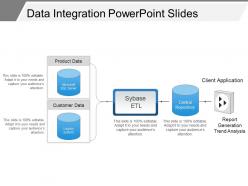
Educate your audience about the concept of data integration by incorporating this readily available Data Integration PowerPoint Slides. It will assist you in managing the data. Illustrate its different types that include data propagation, data consolidation, data federation, data virtualization, and data warehousing. Assemble your equipment perfectly by employing this data integration PPT slide. Describe different processes like data analysis, business intelligence portfolio, data storage, etc. Showcase how the data from different sources can be combined. Illustrate the process of integrating data with the assistance of this readily available data mapping PPT slide. Explaining the concept using this PPT template will help them remember the concept for a longer period. Our designers at SlideTeam have curated this template to save a lot of your time so that you don’t waste time creating it from scratch. Download this PowerPoint layout now and share the complex information in an understandable manner.
People who downloaded this PowerPoint presentation also viewed the following :
Data integration powerpoint slides with all 5 slides:
Advertise your ideas with our Data Integration Powerpoint Slides. Your products will do brisk business.


FAQs for Data
Honestly, data integration is a total lifesaver for decision-making and cutting out all that tedious manual stuff. You'll finally have one place for everything instead of digging through random spreadsheets (I swear, there's always that one Excel file nobody can find). Patterns become way more obvious when you can see your whole business at once. Teams stop doing the same work twice, and everyone actually trusts the numbers they're using. My advice? Figure out which data sources matter most first. Oh, and you'll never have those awkward meetings where everyone's looking at different numbers again.
So ETL cleans everything upfront before loading - way more controlled but takes forever. ELT just dumps raw data straight into your warehouse, then processes it there. Most people are going with ELT these days since cloud warehouses can handle pretty much anything you throw at them. Short sentences feel choppy sometimes, but whatever. If you've got compliance stuff or really messy data though, ETL's validation might save you headaches later. I'd probably start with ELT unless there's a good reason not to - you can always layer on more processing down the road.
Think of API management as your data traffic cop - it handles who gets in, how fast they can go, and where everything goes between your apps and data sources. Without it? Total chaos. Your integrations turn into this tangled web that breaks every time someone sneezes. The management layer gives you one place to control versions, security, and monitoring across everything. Honestly, most companies have way more API connections than they realize - I'd bet half aren't even documented. Start by just listing what you've got first.
Dude, build those quality checks directly into your pipeline from day one. Data validation, duplicate detection, format rules - all that stuff needs to happen before it touches your main systems. I made this mistake once and spent like 3 weeks fixing customer records that were completely screwed up lol. Automated data profiling will catch weird stuff early too. Oh and set up clear governance policies so your team actually knows what counts as "clean." Seriously though, automate everything you can. Manual checks are a nightmare and you'll end up debugging data problems way too late at night.
Ugh, data quality is gonna be your worst nightmare - half the stuff will be incomplete or just straight garbage. Different systems use completely different formats too, like one's spitting out XML while another uses JSON or some ancient proprietary thing. Performance gets messy with big data volumes, and don't even get me started on security requirements that change every other week. Honestly though, compatibility between systems is probably where you'll spend most of your time pulling your hair out. I'd definitely start with a small pilot first to figure out what specific disasters you're walking into.
Okay so basically you want all your data talking to each other in real time instead of getting yesterday's numbers. Like imagine your CRM, inventory, website stats - everything - feeding into one live dashboard. Game changer honestly. No more piecing together random reports from different systems (ugh, the worst). You'll need automated pipelines that sync everything continuously. My advice? Figure out which decisions absolutely need real-time data first and start there. Don't try to integrate everything at once or you'll lose your mind.
Dude, there's actually a bunch of solid options out there. Informatica and Talend are the heavy hitters if you need enterprise-level stuff, plus Microsoft SSIS. But honestly? The cloud tools like AWS Glue and Azure Data Factory have gotten ridiculously good lately - I'd probably start there. Google Cloud Dataflow's solid too. Apache NiFi works great for simpler stuff, and Pentaho's decent (though I haven't used it in forever). Really depends on how much data you're dealing with. No point getting some massive enterprise solution if you just need basic ETL, you know?
So basically cloud stuff runs on someone else's servers and scales itself automatically. You don't have to manage any hardware. On-premises means you're handling everything in-house - which honestly can be a pain. Cloud is way faster to set up, updates happen automatically, and you only pay for what you use. But with on-premises you get total control over your data and security. The downside? You're stuck with all the maintenance and those brutal upfront costs. If you've got super sensitive data though, you might not have a choice and need to go on-premises. I'd figure out your security requirements first, then see what fits your budget.
Honestly, start with encrypting everything - that's your foundation right there. Set up strict access controls so only the right people can touch specific data. API authentication is critical too, don't skimp on that. Use VPNs between systems whenever you can. For sensitive stuff like financial data, mask or tokenize it. The integration points are where things usually go wrong, so watch those closely. Oh, and logging is huge - you need to know who's accessing what and when. I learned this the hard way on a project last year.
So you take all your customer data from different places - website, app, support tickets, whatever - and smoosh it together into one view. Way better than having bits and pieces everywhere, trust me. Once you've got that full picture, you can actually see what people are doing and predict what they want next. Makes personalization so much easier instead of just guessing. Oh, and don't go crazy trying to connect everything right away. Just pick your biggest 2-3 data sources first and work from there. You'll thank yourself later.
Start with decent data governance - figure out who owns what and set some quality standards. Don't let teams just build random integrations everywhere (learned that one the hard way). Get proper ETL tools that won't break when you scale up. Always add validation checkpoints because dirty data is the worst. Map your data lineage too so you actually know where stuff comes from. Oh, and automate your testing and monitoring. Nothing's worse than finding out your data's been wrong after everyone's already seen the reports.
So ML basically handles all the annoying manual stuff - detecting when schemas change, mapping fields between different systems, catching duplicate records. The matching algorithms are actually getting really good now. It'll predict data quality problems before they blow up and suggest transformation rules based on what you've done before. Way less time spent fixing broken pipelines or hunting down why data doesn't match up. Oh, and definitely check out tools that have built-in ML for schema matching first - seriously saves tons of mapping work.
So compliance basically controls how you can move and store data during integration. It's such a pain honestly. GDPR means keeping EU data in the EU, plus you need encryption, access controls, audit trails - the whole nine yards. Some regulations even limit which third-party tools you're allowed to use, which is annoying when you find the perfect solution. Oh and detailed data lineage docs too. My biggest tip? Map out compliance requirements before you start building anything. Trust me, trying to add compliance later is like 10x more expensive and you'll want to pull your hair out.
Real-time streaming is huge right now - customers want their data instantly. AI-powered mapping tools are finally getting good at handling the boring setup work. Cloud platforms are pretty much standard now, but what's interesting is how everyone's pushing self-service tools so business teams can connect stuff themselves. Our IT guys are... not thrilled about that lol. API-first design is everywhere too. Oh, and data fabric approaches are trending - basically treating all your sources like one big unified thing. I'd probably focus on real-time capabilities first though, that's where you'll actually beat competitors.
Track both the obvious numbers and the messy stuff that's harder to measure. Direct savings are easy - less duplicate systems, fewer manual entry hours, faster decisions. But honestly? The real magic happens with data accuracy and how fast your team can actually find what they need. Your analysts won't be pulling their hair out anymore hunting through spreadsheets. Document where you're starting from before you change anything - I learned that one the hard way. Then check your progress every quarter or so.
-
Awesome use of colors and designs in product templates.
-
Thanks for all your great templates they have saved me lots of time and accelerate my presentations. Great product, keep them up!