


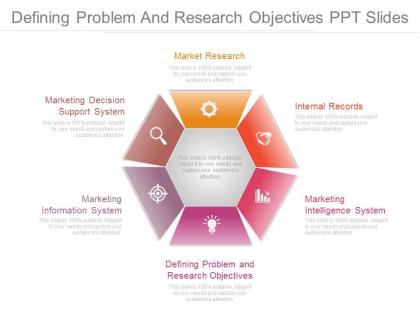
Defining problem and research objectives ppt slides




Try Before you Buy Download Free Sample Product
 Impress Your
 Audience
 100%
100% Editable
 Save Hours
 of Time


Conduct yourself in a charming fashion with our Defining Problem And Research Objectives Ppt Slides. Always avoid appearing arrogant.
People who downloaded this PowerPoint presentation also viewed the following :
Defining problem and research objectives ppt slides with all 5 slides:
Engage in competition with our Defining Problem And Research Objectives Ppt Slides. Their alluring designs make you the favorite.




FAQs for Defining problem and research
A well-structured research problem features clear scope definition, measurable objectives, theoretical grounding, practical relevance, and feasible methodology constraints. These characteristics work together by ensuring focused investigation, actionable outcomes, and strategic alignment with organizational goals, with many researchers finding that properly defined problems streamline data collection, enhance analytical precision, and ultimately deliver more impactful business insights.
Researchers identify literature gaps by conducting systematic reviews, analyzing recent publications, examining conflicting findings, and identifying underexplored populations or methodologies within their field. Through comprehensive database searches and citation analysis, academic institutions and research organizations can pinpoint areas lacking sufficient investigation, ultimately enabling focused research objectives that contribute meaningful knowledge and advance their discipline's understanding.
Stakeholder input ensures research problems align with real business needs, operational challenges, and strategic priorities through diverse perspectives from customers, employees, management, and partners. This collaborative approach helps organizations identify relevant research questions, avoid assumptions, and focus resources on issues that deliver actionable insights, ultimately enhancing decision-making and competitive advantage.
Qualitative methodologies shape research problems through exploratory, open-ended inquiry that seeks to understand human experiences, behaviors, and contexts, while quantitative methodologies define problems through measurable variables, statistical relationships, and testable hypotheses. These approaches influence problem definition differently, with qualitative research often broadening scope to capture complexity and quantitative research narrowing focus for precision, ultimately enabling organizations to combine both for comprehensive understanding.
Common pitfalls include setting overly broad or vague objectives, lacking measurable outcomes, ignoring resource constraints, and failing to align with business goals. These missteps can derail entire research initiatives, with many organizations finding that clearly defined, specific objectives with realistic timelines and measurable deliverables ultimately streamline research processes and enhance strategic decision-making.
Clear research problems enhance overall research design by establishing focused parameters, guiding methodology selection, and ensuring resource allocation aligns with specific objectives. Through well-defined problem statements, researchers streamline data collection processes, minimize scope creep, and enhance analytical precision, with many academic institutions and corporate research teams finding that clarity ultimately delivers more actionable insights and measurable outcomes.
Frameworks and models provide structured approaches for identifying key variables, establishing relationships between concepts, clarifying research scope, and ensuring comprehensive problem analysis. These systematic tools help researchers organize complex issues, identify gaps in existing knowledge, and formulate precise research questions, with many academic institutions and consulting firms finding that structured frameworks ultimately streamline the research process while enhancing methodological rigor.
Research problem scope should be determined by evaluating available resources, time constraints, data accessibility, stakeholder requirements, and organizational capabilities. Through strategic scoping frameworks, organizations streamline research focus, minimize resource allocation risks, and enhance project deliverability, with many institutions finding that well-defined boundaries ultimately deliver more actionable insights and measurable outcomes.
Aligning research objectives with problem definition ensures focused, relevant data collection that directly addresses business challenges, preventing wasted resources and misguided conclusions. This strategic alignment enables organizations to gather actionable insights that drive meaningful solutions, with companies across retail, healthcare, and financial services finding that well-aligned research delivers faster decision-making and measurable competitive advantage.
Researchers can measure success through predefined key performance indicators, quantitative metrics, qualitative assessments, stakeholder feedback, and objective completion rates. These measurement frameworks enable organizations to evaluate research effectiveness by tracking data accuracy, timeline adherence, and actionable insights generated, with many institutions finding that systematic evaluation ultimately delivers improved decision-making and competitive advantage.
Ethical considerations in defining research problems include ensuring participant privacy, obtaining informed consent, minimizing potential harm, maintaining data confidentiality, and avoiding bias in problem framing. These principles guide researchers by establishing transparent methodologies, protecting vulnerable populations, and ensuring cultural sensitivity, with many academic institutions and corporate research teams finding that ethical frameworks ultimately enhance study credibility and stakeholder trust.
Specific research objectives streamline data collection by defining exact parameters, methodologies, target demographics, and measurement criteria required. Well-defined objectives enable researchers to select appropriate collection instruments, determine sample sizes, and establish clear timelines, while preventing scope creep and resource waste, ultimately delivering more accurate insights and actionable results for strategic decision-making.
SMART research objectives are developed through stakeholder interviews, baseline data analysis, clear metric identification, resource assessment, and deadline establishment. These techniques ensure researchers create focused, quantifiable goals by engaging key stakeholders early, analyzing existing performance data, and aligning objectives with available resources, ultimately delivering actionable insights within defined timeframes.
Stakeholder analysis informs research problem definition by identifying key parties affected by potential outcomes, mapping their diverse interests, concerns, and information needs, and revealing conflicting priorities that require investigation. Through systematic stakeholder mapping, researchers can frame objectives that address multiple perspectives simultaneously, ensuring studies deliver actionable insights for decision-makers while anticipating implementation challenges across different organizational levels.
Research problem validation methods include stakeholder interviews, literature reviews, pilot studies, expert consultations, and feasibility assessments. These approaches help organizations verify problem significance, scope, and solvability by gathering diverse perspectives, confirming market relevance, and identifying potential obstacles, ultimately ensuring research investments deliver actionable insights and strategic value.
-
I discovered this website through a google search, the services matched my needs perfectly and the pricing was very reasonable. I was thrilled with the product and the customer service. I will definitely use their slides again for my presentations and recommend them to other colleagues.
-
Excellent products for quick understanding.