

Detailed Components In A Technical Feasibility Study Project Viability Assessment To Evaluate





Try Before you Buy Download Free Sample Product
 Impress Your
Audience
 100%
Editable
 Save Hours
of Time


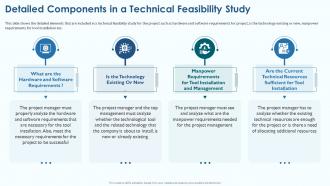
This slide shows the detailed elements that are included in a technical feasibility study for the project such as hardware and software requirements for project, is the technology existing or new, manpower requirements for tool installation etc.
People who downloaded this PowerPoint presentation also viewed the following :
Detailed Components In A Technical Feasibility Study Project Viability Assessment To Evaluate with all 6 slides:
Use our Detailed Components In A Technical Feasibility Study Project Viability Assessment To Evaluate to effectively help you save your valuable time. They are readymade to fit into any presentation structure.





FAQs for Detailed Components In A Technical Feasibility Study Project Viability
So you'll want to nail down your tech stack and infrastructure needs first. Figure out if your team can actually handle it - skills, tools, the whole deal. Budget stuff is super boring but skip it and you're screwed later, trust me. Same goes for identifying potential technical headaches before they happen. Document different approaches too since plan A rarely works out perfectly. Oh and write everything in plain English - stakeholders need to get the trade-offs without decoding tech jargon. Risk evaluation should cover both the obvious stuff and weird edge cases.
Map out everything tech-wise first - hardware, software, all the integrations. What do you already have vs what needs buying? Server capacity and bandwidth are so boring but they'll wreck your timeline if ignored. Does your team actually know how to implement this stuff, or do you need outside help? Some tech takes forever to get delivered too. I learned that the hard way on my last project. Make a quick matrix - rank everything by how complex, expensive, and time-consuming it is. That way you can see the nightmare scenarios coming before they hit you.
Start with a SWOT analysis - maps out your strengths, weaknesses, opportunities and threats pretty clearly. Risk matrices are clutch for plotting probability vs impact. Failure mode analysis is where you think through everything that could go sideways (sounds depressing but actually super useful). Monte Carlo simulations handle complex scenarios well if you need to run different what-if situations. Oh, and don't skip expert interviews or stakeholder workshops - they'll catch stuff you'd never think of. Honestly I'd pick 2-3 methods max that actually fit your timeline and budget.
Map out your current setup first and figure out where everything needs to connect. Check the APIs, data formats, security stuff - basically see if your infrastructure can even handle it. Good documentation is clutch here (though let's be real, who actually keeps theirs current?). Test everything in a sandbox before going live. Also think about whether your team knows this tech or if you'll need training. I always make a quick requirements vs. what-we-have chart - sounds boring but it catches problems fast. Oh, and don't skip the performance requirements part, that'll bite you later.
Dude, definitely do stakeholder interviews before you get lost in the technical weeds. Talk to everyone - users, IT folks, whoever controls the budget. I'm telling you, one conversation can completely flip your whole approach (happened to me more times than I care to admit). These people know about weird legacy systems, wonky integrations, and random workflows that'll torpedo your project if you miss them. The stuff they tell you isn't written down anywhere, but it's gold for figuring out what'll actually work. Trust me, spend the time upfront or you'll regret it later.
Honestly, you've gotta stress test this thing before it bites you later. Figure out what'll break first - usually it's database queries or API calls, sometimes memory if you're unlucky. Run tests at 2x, 5x, 10x your expected traffic because users always find ways to surprise you. I always add some nightmare scenarios too, just in case. Check costs for both bigger servers and more servers. Write down where things start falling apart and what fixes cost. That way you'll know exactly when you need to throw money at infrastructure instead of scrambling when everything's on fire.
So there's basically three things you need to check for tech feasibility. Performance stuff - can it actually handle the traffic you're expecting, response times, all that. Then there's your resources: time, money, whether your team even knows how to build it (this is where projects usually crash and burn tbh). Third is integration - will it play nice with whatever systems you already have running? Oh and here's the thing - don't waste months planning everything out. Just grab the scariest technical piece first and build a quick prototype. Better to find out early if your idea's gonna work or if you're completely screwed.
Look, you gotta do a proper cost-benefit breakdown here. Add up everything - hardware, software, training costs, all that upfront stuff plus ongoing maintenance. Then figure out what you're actually saving or earning from this thing. Honestly, I'd pad those numbers a bit because tech projects always cost more than you think they will. Calculate when you'll break even - if it's under 2-3 years, you're probably good. Make sure you document the math so when your boss questions it later, you've got backup.
Dude, compliance will absolutely wreck your project if you ignore it early on. I've watched entire teams waste months because they didn't check regulations upfront - it's brutal. You'll need to map out all the legal requirements and standards that hit your solution during feasibility, not later. Some of this stuff might force you to totally rethink your technical approach. Timelines and budgets? Yeah, those get trashed too. Honestly, loop in your legal team from the start. Don't wait until you're halfway done and realize you can't actually ship the thing.
Get your team together and just dump every idea out there - even the weird ones. After that, figure out how you're gonna judge them: cost, timeline, how hard they are to build, all that stuff. Honestly, I always add a "does this feel right" column because sometimes the math lies to you. Pick your top few and build some quick prototypes to see if they actually work. Document what sucks about each option alongside what's good. Then make a decision matrix thing and get your stakeholders involved so they can't complain later about the choice.
Honestly, you've got so many options it's kinda overwhelming. Excel or Google Sheets are perfect for basic cost modeling - I always start there. Microsoft Project's great if you need timeline stuff, and Lucidchart makes those system diagrams actually look decent. SWOT analysis? MindMeister's my go-to, though I'm probably obsessed with it at this point. For documentation, Confluence or Notion work well. My advice though - don't get caught up picking the "perfect" tool. Just use whatever your team already knows how to use. You can always switch later if something's not working.
Okay so start with an executive summary - that's honestly the only part most people actually read anyway. Then break it into three sections: your technical findings, whether it's actually doable, and what you think they should do next. Be specific with your recommendations, not just "we should consider exploring..." garbage. Include your data and assumptions so people can follow your logic. Oh, and definitely add timelines and next steps at the end. You want it detailed enough that someone else could jump in if needed, but don't write a novel about it.
Oh man, timeline estimates are where everyone gets burned - I swear teams always underestimate integration stuff by like 3+ months. Talk to the actual devs and ops folks early, don't just sit in a room theorizing. Edge cases will destroy you, so dig into those instead of just the sunny-day scenarios. What breaks when traffic spikes? When servers die? Here's the thing though - resist making it a full design doc. That's scope creep waiting to happen. Stay laser-focused on "can we actually do this?" not "here's exactly how." Set your success criteria upfront so you're not constantly shifting what "done" means.
Dude, stakeholder buy-in is absolutely critical - like, your project will totally crash without it. Executives need to give you budget. End-users have to actually want your system. IT teams gotta be willing to maintain it after you're gone. I've watched so many "perfect" technical solutions completely bomb because nobody bothered talking to finance first (or whoever holds the purse strings). It's kinda wild how often that happens. The real question isn't just "can we build this?" but "will people let us succeed?" Figure out who matters early and what'll make them say yes.
Theranos is the perfect cautionary tale here - they claimed they had revolutionary blood testing but skipped doing any real feasibility studies. Total disaster. SpaceX took the opposite approach with reusable rockets. Sure, everyone thought Musk was crazy, but they actually ran the numbers on physics and economics first. Google Glass had the tech down but totally missed studying whether people would actually want to wear the things (spoiler: they didn't). Look, I know feasibility studies sound boring, but they'll save your ass and your wallet. Figure out if your idea can actually be built with today's tech and resources before you dump serious cash into it.
-
Amazing product with appealing content and design.
-
Very unique, user-friendly presentation interface.