


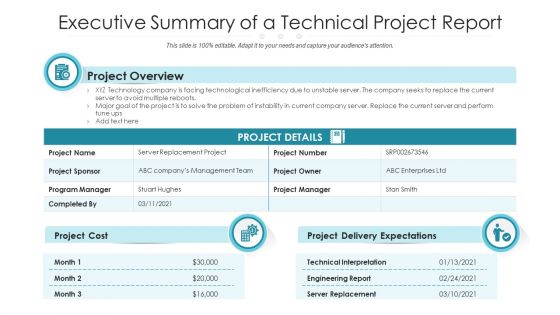
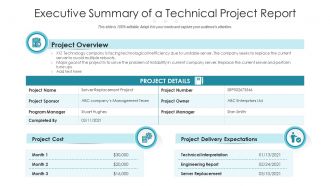
Executive summary of a technical project report




Try Before you Buy Download Free Sample Product
 Impress Your
 Audience
 100%
100% Editable
 Save Hours
 of Time


Our Executive Summary Of A Technical Project Report are topically designed to provide an attractive backdrop to any subject. Use them to look like a presentation pro.
People who downloaded this PowerPoint presentation also viewed the following :
Executive summary of a technical project report with all 2 slides:
Use our Executive Summary Of A Technical Project Report to effectively help you save your valuable time. They are readymade to fit into any presentation structure.
FAQs for Executive summary of a
So here's the deal with executive summaries - you need four key pieces: what problem you're fixing, how you'll fix it, why it matters, and what you want from them (money, approval, etc). Honestly, I always write mine dead last even though it goes first in the document. Makes way more sense once you've figured out your main points. Keep it super tight - one page tops. Most people decide if they give a damn within like 30 seconds of reading. Oh, and don't assume they know anything about your project going in.
Honestly, visuals are a game-changer for executive summaries. Charts and graphs let people absorb key data without wading through paragraphs of numbers - and let's be real, executives are skimming anyway. They break up those intimidating walls of text too. I learned this the hard way after watching someone's eyes glaze over during my first presentation. Most people process visual info faster than written stuff. Just don't go overboard with fancy graphics that don't actually support your points. Pick simple visuals that tell your story. Each one should have a purpose, not just look pretty.
Ugh, the worst thing you can do is write a novel - one page max or people won't read it. Skip all the technical stuff and methodology details (that goes in the actual report). Here's what's weird though - write it LAST, not first. I used to do it backwards and it was terrible. Don't assume anyone knows your industry's weird acronyms either. The thing that kills me is when people forget next steps - like, what do you actually want me to DO with this info? Oh, and it needs to work as a standalone thing. If your boss only reads that part, they should still get it.
Keep your exec summary to 1-2 pages tops - basically 5-10% of whatever your full document is. Twenty-page report? Two pages max for the summary. I swear, some people write these things like they're novels. Your boss isn't gonna sit there for twenty minutes reading your "summary." They've got maybe two minutes to scan it and decide if the full thing's worth their time. Just hit the big stuff: what's broken, how you'll fix it, what you need from them. It's basically your elevator pitch on paper. Don't overthink it.
Dude, you've gotta switch up your exec summary depending on who's reading it. Investors want the money stuff - ROI, market size, financials. Tech people? Give them the nuts and bolts, how you'll actually build it. Board members just care about big picture strategy and what could go wrong. Honestly, using the same summary for everyone is lazy and you're leaving money on the table. Figure out your main audience first. If it's a mixed crowd, write 2-3 different versions. Always open with whatever they care about most - don't bury the lead.
Look, executives have zero attention span these days - literally 2 minutes max. So cut straight to what matters: money, strategy, and anything that needs immediate action. Skip all the background fluff unless it directly impacts the decision they're making. Here's my test: pretend you're stuck in an elevator with them. What would you absolutely have to say? Lead with your main point, then hit them with 2-3 solid reasons why you're right. Don't waste time explaining how you got there - they honestly don't care about your methodology. Just give them what they need to decide and move on.
Okay so here's the thing - executives hate reading boring reports full of charts and bullet points. What actually works? Turn your data into a story. You've got your business problem as the main character, then walk them through what's happening now, the challenges screwing things up, and where you're going next. Problem → solution → outcome, that whole structure. I know it sounds kinda weird but the best exec summaries read like mini-stories that create tension then solve it with your recommendations. Honestly, once you start thinking of your report as having a plot, everything clicks into place way easier.
Honestly, templates are a lifesaver because you don't have to stare at that terrifying blank slide. They come with all the sections execs want - findings, recommendations, metrics, that whole thing. The formatting stays consistent too, which saves me from going insane trying to make everything look decent. You just dump your data in instead of building from zero. Oh, and they actually force you to stay focused instead of rambling (guilty as charged). I'd grab 2-3 good ones and tweak them for your team's style.
Dude, consulting, finance, and tech companies live and die by these things. Investment firms get buried in proposals daily - they're literally speed-reading to survive. Healthcare and biotech need them for grants and FDA stuff too. Basically anywhere executives are slammed or you're asking for money, you better have one. The more complicated your field gets, the more you need it. I learned this the hard way actually - bombed a pitch once because I buried my main point on page 3. Think of it like your elevator pitch but on paper, you know?
So for business pitches, start with the problem you're solving - investors want to see money potential right away. Project reports? Totally different vibe. Jump straight into what you actually accomplished since everyone already knows the backstory. Your pitch should sound exciting and forward-thinking ("we'll grab 15% market share!"). Project summaries are more like... here's what happened, here are the numbers. One sells the dream, the other proves you didn't mess up. Honestly, I'd write the project summary first, then just flip it to future tense for pitches. Way easier than starting from scratch.
Start with your main point - don't bury the lead. Break stuff down with bullets and stick to maybe 3-5 key things max. I pretend I'm pitching my boss in an elevator - you've got 30 seconds, tops. Ditch the jargon that'll confuse people outside your team. Active voice works way better than passive. Keep paragraphs short, use real numbers instead of saying things like "significantly" (honestly, that word drives me nuts). Cut anything that doesn't support your main message. Read it out loud - you'll catch the wordy parts immediately.
Dude, get feedback from your stakeholders before you finalize anything. They'll catch when you're using too much jargon or completely missing what actually matters to them. I've watched so many people write exec summaries that sound smart but answer zero of the questions decision-makers care about. Your audience knows if you've buried the important stuff or picked weird metrics. Plus they'll tell you if your timeline makes sense. Oh, and don't send it to everyone - just grab 2-3 key people and ask what questions your draft doesn't answer. Way more useful than guessing what they want.
Break up that wall of text with bullet points and short paragraphs. Nobody wants to read a novel. Put your biggest findings right up top and bold the key numbers - executives skim everything anyway. White space is clutch here. Try to keep it to one page if possible. The whole goal is getting busy people the highlights fast, so use clear headers and give each section room to breathe. Short sentences work best. Though honestly, even if you follow all this advice perfectly, half the people will still just look at the bolded parts and call it good.
Here's the thing - your exec summary needs to work totally solo. Pack in the problem, findings, and what to do next. I always think of it like a movie trailer that doesn't suck. Someone should read just that and know exactly what you found plus their next steps. Honestly, most people won't even crack open your full report anyway. Write the summary dead last, then test it. Hand it to someone who's never seen your work - if they're confused, you're not done yet. It's gotta answer "so what?" without any backup.
Your opening is make-or-break territory. Seriously, if those first two sentences don't grab someone, they're gone. Lead with your biggest punch - the problem you're solving or the massive opportunity sitting right there. Skip all the boring setup stuff nobody wants yet. I always think of it like scrolling social media - you've got maybe 10 seconds before people move on. Hit them with impact first, then you can build your argument. Most executives won't read past that opening anyway, so those sentences better pack a punch.
-
Great product with effective design. Helped a lot in our corporate presentations. Easy to edit and stunning visuals.
-
Informative presentations that are easily editable.
-
Innovative and attractive designs.
-
Excellent work done on template design and graphics.
-
Enough space for editing and adding your own content.
-
Excellent products for quick understanding.
-
Appreciate the research and its presentable format.
-
Commendable slides with attractive designs. Extremely pleased with the fact that they are easy to modify. Great work!
-
Colors used are bright and distinctive.