


Technical feasibility powerpoint presentation slides




Try Before you Buy Download Free Sample Product
 Impress Your
 Audience
 100%
100% Editable
 Save Hours
 of Time


Assess all the important details of your project making use of these Technical Feasibility PowerPoint Presentation Slides. Discuss with your team the plan to deliver products and services to meet customer expectations. Determine the viability of your business idea and decide whether the project is worth the investment or not by utilizing this technical feasibility study PowerPoint complete deck. Objectively uncover the strengths, weaknesses, threats, and opportunities of your proposed venture by making use of this content ready technical feasibility PowerPoint presentation. Check the feasibility of the project that might fail due to a variety of reasons such as the requirement of too many resources, tax obligations, policies, legal complexities and others that you can easily discuss with your team. Evaluate the expertise of the technical team of converting ideas into working systems. Therefore, you can download our ready-to-use Feasibility analysis ppt to analyze the project deliverables.
People who downloaded this PowerPoint presentation also viewed the following :
Content of this Powerpoint Presentation
Slide 1: This slide introduces Technical Feasibility. State Your Company Name and begin.
Slide 2: This slide shows Agenda of the presentation.
Slide 3: This slide presents Introduction to Industry with related imagery.
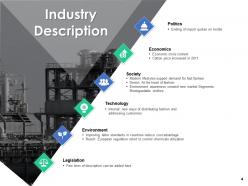
Slide 4: This slide displays Industry Description describing- Legislation, Politics, Environment, Economics, Technology, Society.
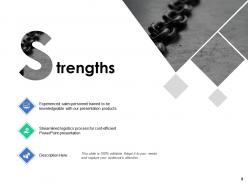
Slide 5: This slide is titled as Strengths. Show your firm's strengths here.
Slide 6: This slide is titled as Weaknesses. Describe your firm's weaknesses here.
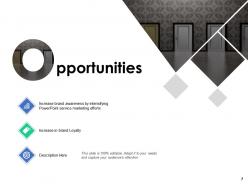
Slide 7: This slide displays Opportunities with related imagery and text.
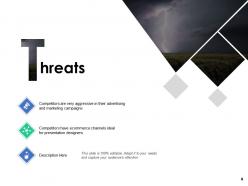
Slide 8: This slide shows Threats with related imagery.
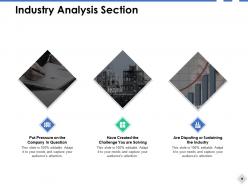
Slide 9: This slide presents Industry Analysis Section describing- Put pressure on the company in question, Have created the challenge you are solving, Are disputing or sustaining the industry.
Slide 10: This slide displays Industry Vertical Description.
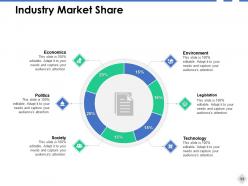
Slide 11: This slide represents Industry Market Share describing- Economics, Environment, Legislation, Politics, Technology, Society.
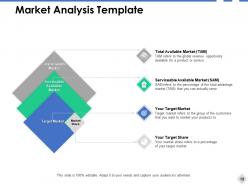
Slide 12: This slide showcases Market Analysis Template describing- Total Available Market (TAM), Serviceable Available Market (SAM), Target Market, Market Share.
Slide 13: This slide shows Market Research Results Template.
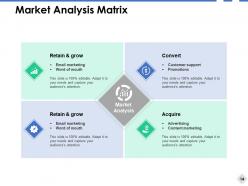
Slide 14: This slide presents Market Analysis Matrix describing- Convert, Retain & Grow, Acquire, Measure & Optimize.
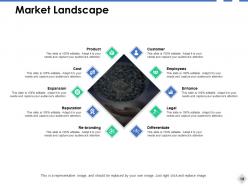
Slide 15: This slide displays Market Landscape describing- Employees, Cost, Enhance, Expansion, Legal, Reputation, Differentiate, Re-branding, Customer, Product.
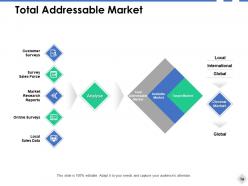
Slide 16: This slide represents Total Addressable Market explaining- Customer Surveys, Survey Sales Force, Market Research Reports, Online Surveys, Local Sales Data.
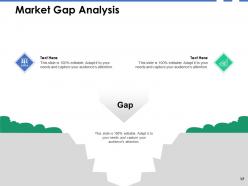
Slide 17: This slide showcases Market Gap Analysis with related imagery.
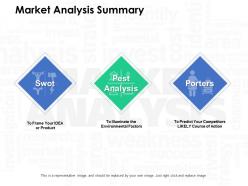
Slide 18: This slide shows Market Analysis Summary with related diagram.
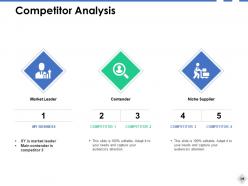
Slide 19: This slide presents Competitor Analysis. Add data as per needs.
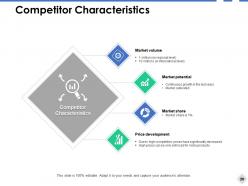
Slide 20: This slide displays Competitor Characteristics describing- Market Volume, Market Potential, Market Share, Price Development.
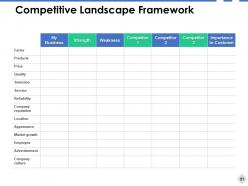
Slide 21: This slide represents Competitive Landscape Framework in tabular form.
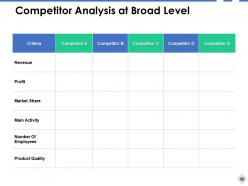
Slide 22: This slide showcases Competitor Analysis at Broad Level.
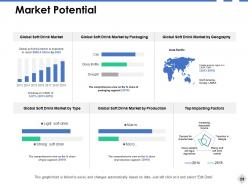
Slide 23: This slide shows Market Potential in graphical forms.
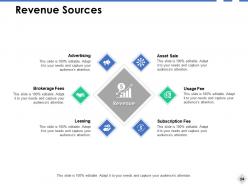
Slide 24: This slide presents Revenue Sources as- Leasing, Advertising, Brokerage Fees, Subscription Fee, Asset Sale, Usage Fee.
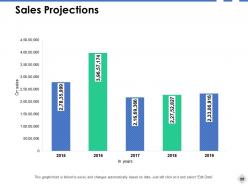
Slide 25: This slide displays Sales Projections in graphical form.
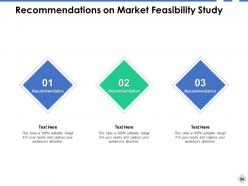
Slide 26: This slide represents Recommendations on Market Feasibility Study.
Slide 27: This slide showcases Technical Feasibility Icons.
Slide 28: This slide reminds about 15 minutes coffee break.
Slide 29: This slide is titled as Additional Slides for moving forward.
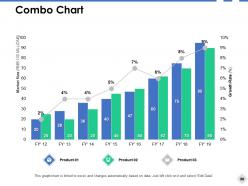
Slide 30: This slide shows Combo Chart with three products comparison.
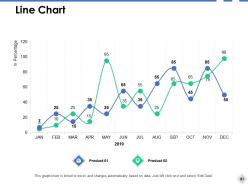
Slide 31: This slide presents Line Chart with two products comparison.
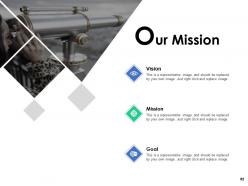
Slide 32: This is Our Mission slide with related imagery and text.
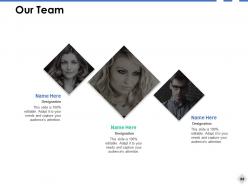
Slide 33: This is Our Team slide with names and designation.
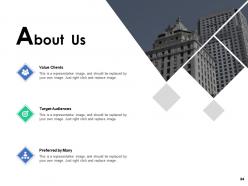
Slide 34: This is About Us slide to show company specifications etc.
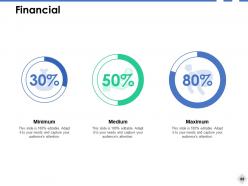
Slide 35: This is a Financial slide. Show your finance related stuff here.
Slide 36: This is Our Goal slide. Show your firm's goals here.
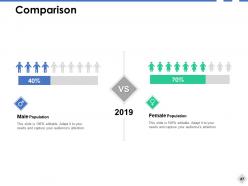
Slide 37: This is a Comparison slide to state comparison between commodities, entities etc.
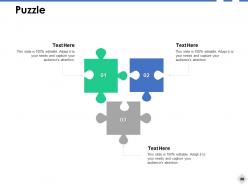
Slide 38: This is a Puzzle slide with text boxes to show information.
Slide 39: This is a Quotes slide to convey message, beliefs etc.
Slide 40: This is an Idea Generation slide to state a new idea or highlight information, specifications etc.
Slide 41: This is a Thank You slide with address, contact numbers and email address.
Technical feasibility powerpoint presentation slides with all 41 slides:
Our Technical Feasibility Powerpoint Presentation Slides are adept at finding appropriate answers. They don't allow you to feel helpless.



FAQs for Technical feasibility
Look, you're basically figuring out "can we actually pull this off?" First thing - map out what tech specs and infrastructure you need. Then check if your team has the skills and tools to handle it. Timeline's huge too because even totally doable projects become impossible with crazy deadlines. I always forget this part, but risk assessment matters - especially dependencies that could screw you over. Honestly, just make a simple checklist for each area so nothing slips through the cracks during your analysis.
First thing - grab a spreadsheet and dump everything you actually need tech-wise vs what you've got. Hardware, software, integrations, the works. Boring? Yeah, but it works. Next up, be brutally honest about your team. Can they actually handle this stuff or are you gonna need training/new hires? Also think ahead about scaling and who's maintaining this mess later. I learned this the hard way on my last project - didn't plan for growth and ended up putting out fires for months. Way better to spot the gaps now and budget properly than panic when everything's falling apart.
Oh man, data security will totally dictate what you can actually build. Like, if you're dealing with sensitive stuff, encryption and compliance aren't optional - they need to be baked in from day one. I made the mistake once of trying to add security later and it was a nightmare. Your whole architecture gets shaped by these requirements. Budget too. Sometimes you'll realize halfway through that your original plan just won't work security-wise and you're back to square one. Honestly, I'd map out all the security stuff first and build around that instead of fighting it later.
Figure out your bottlenecks first - processing power, storage, bandwidth, maybe API limits you haven't thought about. Model what happens at 10x or 100x your current load. I always plan for the Christmas morning disaster scenario because that's when everything goes sideways. Test how well you can scale horizontally vs just throwing more power at it. Don't overlook the human side either - complex maintenance will bite you later. Run load tests early! Finding out you can't scale when you're already live means you'll be getting those fun 3am phone calls.
Ugh, the timeline thing gets everyone - I swear we're all terrible at estimating complexity. Legacy systems are the worst culprits here, they've got weird quirks that'll bite you later. Get your dev team involved way earlier than you think you need to. They catch stuff you miss from the bird's eye view. Security and scalability? Yeah, plan for those from day one instead of scrambling later. Oh and always pad your estimates - seriously, like 30% more time than you think. Get a few different devs to weigh in before you commit to anything.
Standards are like the rules of the game for your feasibility study. You've gotta figure out which safety, quality, and performance requirements apply to your project right from the start. Some are legally mandatory, others are just best practices – but trust me, both can completely derail you if you ignore them. I learned this the hard way once. Map out what standards you need to hit early, then build your solution around those limits instead of scrambling to fit them in later. Way easier to design with constraints than retrofit compliance afterward.
For technical feasibility stuff, I'd start with mapping your actual requirements - like what do you really need this thing to do? Then check if your current tech stack can even handle it. Building a small proof of concept is probably the most useful thing you can do though, way better than just theorizing about it. Risk matrices help catch problems before they bite you. Oh and definitely talk to stakeholders - they always know about weird constraints nobody mentioned. Resource analysis too obviously. Honestly I'd mix like 2-3 of these methods instead of just picking one.
Dude, you absolutely need stakeholder input for technical feasibility - can't just wing it solo. Your actual users and ops people will catch stuff you'd never think of. I've watched "perfect" solutions completely tank because nobody bothered asking the folks who'd use them daily. They know about weird integration issues, performance bottlenecks, security headaches. Plus all the workflow quirks that'll make or break your project. Honestly, some of the most obvious problems only surface when you actually talk to people. Get their feedback early and keep checking back throughout the whole process.
Look at three main things: how complex the tech stuff is, what resources you actually have, and if your timeline makes any sense. Rate complexity 1-10 based on your team's skills and current setup. Then honestly check if you've got the right people, tools, and budget - this is where projects usually crash before they even start. Map out realistic dev time against deadlines. Oh, and do a quick risk check for major technical wildcards. Score these areas honestly and you'll know if it's doable or just pipe dreams. Most people skip the honest part though.
Look, existing tech is basically your roadmap for what's actually doable. Mature stuff gives you solid timelines and people who know how to use it. Shiny new tech? Often a headache in disguise - learned that one the hard way. Map out what's already there first - APIs, frameworks, whatever fits your needs. This stuff directly hits your timeline, budget, and how risky things get. I'd honestly check what's proven in your space before going crazy building from scratch. Way easier than you think.
Ugh, regulations can totally wreck your technical plans if you're not careful. Like, data privacy laws might make your whole architecture impossible, or safety standards could add months of testing you never saw coming. The worst part? You won't always catch these upfront, especially when you're dealing with multiple countries or states. Honestly, I learned this the hard way on a project last year. Loop in your compliance people during design, not after you've already built everything. Trust me - rebuilding sucks way more than planning around constraints from the start.
Honestly, rapid prototyping is a lifesaver - you can test the scary technical stuff before committing to building everything. Like, why spend months developing something only to discover a core piece doesn't actually work? Start with your riskiest assumptions and build just those parts first. You'll catch roadblocks early when they're cheap to fix, plus you get real performance data instead of just guessing. Stakeholders love having something they can actually touch and mess around with too. It's basically a stress test for your idea's feasibility without the full investment.
So basically, technical feasibility is just "can we actually make this thing work?" Like, do we have the skills and tech to build it. Operational feasibility is different - it's more about whether it'll actually work in the real world once you're done. Here's what I mean: sure, your team might be able to code up some fancy AI chatbot. But what if your customer service people have no clue how to use it? Or it doesn't play nice with your existing systems? Then you're kinda screwed operationally. Honestly, I've seen too many projects fail because people only thought about the first part. Check both before you start.
Honestly, compatibility issues are the worst - they'll completely mess up your project timeline. Your tech stack might clash with existing systems, or you'll get stuck using some ancient framework because of legacy requirements. It's such a pain and burns through your budget fast. I've seen teams have to build crazy workarounds or even start over from scratch. The worst part? These problems usually pop up way later than they should. Do yourself a favor and test how everything works together before you get too deep into development. Trust me on this one.
Hey! So for your feasibility study, put the main answer right up front - nobody wants to dig through 10 pages to find out if this thing is even doable. Structure it with an exec summary, tech requirements, your proposed solutions, risks, and what resources you'll need. Write down every assumption you make because trust me, those will definitely come back to haunt you later. Also include the other approaches you looked at and why they sucked. Put numbers on everything - timelines, costs, team size, all that stuff. The whole point is that someone could grab this doc months from now and actually understand your thought process. Keep it tight but detailed enough for real decision-making.
No Reviews