

Determine user persona scrum tools utilized by agile teams it




Try Before you Buy Download Free Sample Product
 Impress Your
 Audience
 100%
100% Editable
 Save Hours
 of Time


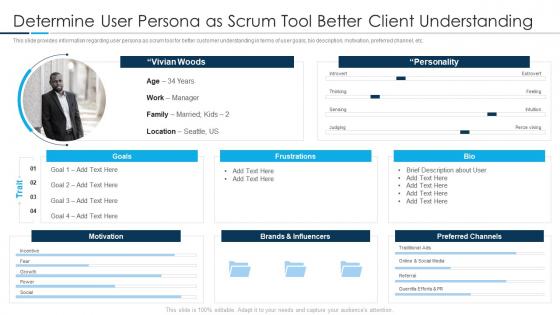
This slide provides information regarding user persona as scrum tool for better customer understanding in terms of user goals, bio description, motivation, preferred channel, etc.
People who downloaded this PowerPoint presentation also viewed the following :
Determine user persona scrum tools utilized by agile teams it with all 6 slides:
Use our Determine User Persona Scrum Tools Utilized By Agile Teams It to effectively help you save your valuable time. They are readymade to fit into any presentation structure.





FAQs for Determine user persona scrum tools utilized by
Effective user personas in agile environments include clear demographic data, specific behavioral patterns, defined pain points, measurable goals, and contextual user scenarios that align with sprint objectives. These elements streamline product development by enabling faster decision-making, focused feature prioritization, and enhanced team collaboration, with many agile teams finding that well-crafted personas ultimately deliver more user-centered solutions and improved product-market fit.
Scrum tools help teams create and manage user personas by centralizing persona data, tracking user story mapping, and facilitating collaborative persona development sessions. Through integrated persona templates and user journey tracking, agile teams streamline persona updates, enhance sprint planning with user-focused insights, and maintain consistent persona alignment across development cycles, ultimately delivering more user-centric products and improved customer experiences.
User personas influence sprint planning by helping teams prioritize features based on user value, identify acceptance criteria that reflect real user needs, and sequence development work according to persona priorities and pain points. During backlog prioritization, personas enable product owners to make strategic decisions about which user stories deliver maximum impact, with many agile teams finding that persona-driven prioritization reduces feature scope creep while ensuring sprints consistently address the most critical user experiences and business objectives.
Agile teams maintain current user personas through regular sprint reviews, continuous user feedback collection, ongoing market research, and iterative persona updates based on real user data. These practices enable teams to adapt personas during retrospectives, validate assumptions through user testing, and incorporate stakeholder insights, ultimately ensuring product development remains aligned with evolving user needs and market conditions.
Teams face challenges including inconsistent persona usage across sprints, difficulty translating personas into actionable user stories, and maintaining persona relevance during rapid development cycles. Many agile teams find that personas become static documents rather than dynamic tools, leading to disconnected product decisions, reduced empathy during sprint planning, and ultimately delivering features that don't align with actual user needs.
User personas significantly enhance team collaboration during daily stand-ups and sprint reviews by providing shared customer context, aligning priorities around user needs, and facilitating more focused discussions about feature impact. These personas enable development teams, product managers, and stakeholders to reference specific user scenarios during updates, ultimately streamlining decision-making and ensuring sprint goals remain user-centered throughout the development process.
Visualization tools enhance user persona understanding by creating shared mental models through persona cards, journey maps, empathy maps, and interactive dashboards that make abstract user data tangible and accessible. These visual representations enable agile teams to quickly reference user needs during sprint planning, maintain consistent user focus across development cycles, and facilitate better stakeholder alignment, ultimately delivering more user-centered products and reducing miscommunication risks.
User persona effectiveness metrics include task completion rates, user satisfaction scores, conversion rates, feature adoption rates, and design iteration cycles. These measurements enable agile teams to track how personas streamline product decisions, reduce development rework, and enhance user experience outcomes, with many organizations finding that well-implemented personas deliver faster development cycles and significantly improved customer engagement.
User personas should be documented using visual templates with key demographics, goals, pain points, and behavioral patterns, then shared through collaborative platforms like Confluence, Miro, or team wikis for easy access. These personas enhance sprint planning, backlog prioritization, and user story creation by ensuring all team members, from developers to product owners, maintain consistent user focus throughout development cycles, ultimately delivering more targeted solutions and improved user experiences.
User research provides the foundational data for creating accurate user personas through methods like interviews, surveys, behavioral analytics, and usability testing. This research enables scrum teams to build evidence-based personas that guide sprint planning, feature prioritization, and acceptance criteria development, ultimately delivering products that align with actual user needs and market demands.
User personas assist in risk identification by revealing user behavior patterns, accessibility requirements, technical constraints, and market assumptions that could derail development efforts. Through persona-driven risk assessment, agile teams can proactively address usability failures, feature misalignment, and user adoption challenges, while identifying potential security vulnerabilities and performance bottlenecks, ultimately delivering more resilient products with reduced development costs.
**INPUT**: Which scrum tools provide features specifically designed for creating and maintaining user personas? **OUTPUT**: Scrum tools with dedicated user persona features include Aha!, ProductPlan, Craft.io, UserVoice, and Miro's agile templates. These platforms enhance sprint planning by integrating persona data directly into user stories, backlog prioritization, and acceptance criteria development, with many agile teams finding that persona-driven tools ultimately deliver more user-focused products and streamlined stakeholder alignment. [Word count: 56 words]
Agile coaches can facilitate user persona workshops by establishing collaborative frameworks that combine stakeholder interviews, data analysis sessions, and cross-functional brainstorming exercises with structured persona templates. Through guided activities like empathy mapping and user journey workshops, teams develop comprehensive personas that inform sprint planning and backlog prioritization, while coaches ensure alignment between user needs and business objectives, ultimately delivering more user-centered products.
Common misconceptions include believing personas are static documents, one-size-fits-all solutions, purely demographic profiles, time-consuming obstacles, or replacements for user research and testing. These misunderstandings often lead agile teams to either abandon personas entirely or implement them ineffectively, while successful organizations find that well-crafted, research-based personas actually streamline decision-making and enhance user-centered development practices.
User personas align with Agile Manifesto principles by prioritizing individuals and customer collaboration over processes and documentation, enabling teams to focus on real user needs rather than assumptions. Through persona-driven development, agile teams respond to changing requirements more effectively, deliver working software that serves actual users, and maintain continuous stakeholder engagement, ultimately creating products with greater market relevance and user satisfaction.
-
Great quality slides in rapid time.
-
Excellent products for quick understanding.
-
Understandable and informative presentation.
-
Best way of representation of the topic.
-
Excellent Designs.