


Digital Marketing Agency Business Plan Powerpoint Presentation Slides





Try Before you Buy Download Free Sample Product
 Impress Your
 Audience
 100%
100% Editable
 Save Hours
 of Time


Starting and operating a digital marketing agency may appear simple. Still, the truth is that if you want to avoid stress, you must make the necessary preparations to ensure that it will withstand the test of time. Therefore, our team has crafted this Digital Marketing Agency Business Plan PPT to provide you with detailed insight into the Digital Marketing Agency. It lists all the essential elements, including market research, industry trends, growth revenue drivers, target market, competitive landscape, etc. In addition, the document also includes porters framework and its impact on the digital marketing industry, market gap, opportunities, market sizing, including TAM, SAM, and SOM, go to marketing strategy, sales funnel, etc. Entity details, executive summary, products and services, mission and vision, exit strategy, etc. are also covered in this business plan. Furthermore, to give users an insight into the financial aspect, the digital marketing agency business plan also portrays a financial summary section in which a detailed 5 year analysis has been executed considering the market scenarios. It covers the revenue model, profit and loss statement, cash flow statement, break-even analysis, DCF valuation, balance sheet, etc. Download our 100 percentage editable digital marketing ppt presentations and get access to our highly researched and skillfully designed product.
People who downloaded this PowerPoint presentation also viewed the following :
Content of this Powerpoint Presentation
Slide 1: This slide introduces Digital Marketing Agency Business Plan. Commence by stating Your Company Name.
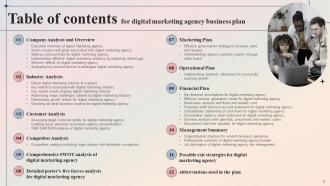
Slide 2: This slide incorporates the Table of contents.
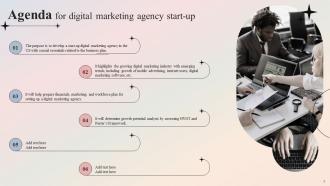
Slide 3: This slide depicts the Agenda of the presentation.
Slide 4: This slide highlights the Title for the Topics to be discussed further.
Slide 5: This slide provides a glimpse of key highlights of the digital marketing agency.
Slide 6: This slide covers the digital marketing agency's vision, mission, and goals.
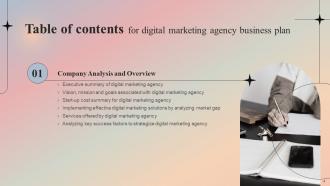
Slide 7: This slide reveals the Start-up cost summary for digital marketing agency.
Slide 8: This slide deals with Implementing effective digital marketing solutions by analyzing market gap.
Slide 9: This slide states the Services offered by digital marketing agency.
Slide 10: This slide continues the Services offered by digital marketing agency.
Slide 11: This slide focuses on Analyzing key success factors to strategize digital marketing agency.
Slide 12: This slide includes the Heading for the Contents to be covered next.
Slide 13: This slide shows Global digital marketing industry at a glance.
Slide 14: This slide depicts the Key statistics associated with digital marketing industry.
Slide 15: This slide continues the Key statistics associated with digital marketing industry.
Slide 16: This is yet another slide continuing the Key statistics associated with digital marketing industry.
Slide 17: This slide highlights the key market trends.
Slide 18: This slide portrays details about various challenges catered by the digital marketing industry.
Slide 19: This slide caters to details about various growth drivers resulting in digital marketing industry progress.
Slide 20: This slide deals with Choosing an ideal business location for digital marketing agency.
Slide 21: This slide reveals the Title for the Ideas to be discussed in the following template.
Slide 22: This slide talks about Assessing target customer profile for digital marketing agency.
Slide 23: This is the extension of Assessing target customer profile for digital marketing agency slide.
Slide 24: This slide focuses on Creating buyer personas to increase agency personalization.
Slide 25: This slide reveals the TAM SAM SOM analysis of digital marketing agency.
Slide 26: This sldie depicts the Heading for the Ideas to be covered in the following template.
Slide 27: This slide shows the Competitive analysis including major players with attributes comparison.
Slide 28: This slide mentions the Title for the Contents to be discussed in the forth-coming template.
Slide 29: This slide elucidates the Comprehensive SWOT analysis of digital marketing agency.
Slide 30: This slide includes the Heading for the Topics to be covered next.
Slide 31: The slide highlights porter’s five forces model and its implications in the US digital marketing agency.
Slide 32: This slide depicts the Title for the Topics to be discussed further.
Slide 33: This slide deals with Effective go-to-market strategy to increase sales and revenue.
Slide 34: This slide continues Effective go-to-market strategy to increase sales and revenue.
Slide 35: This is yet another slide continuing the Effective go-to-market strategy to increase sales and revenue.
Slide 36: This slide further continues Effective go-to-market strategy to increase sales and revenue.
Slide 37: This is an extension of Effective go-to-market strategy to increase sales and revenue slide.
Slide 38: This slide continues Effective go-to-market strategy to increase sales and revenue.
Slide 39: This is yet another slide continuing Effective go-to-market strategy to increase sales and revenue.
Slide 40: This slide is an extesnion of Effective go-to-market strategy to increase sales and revenue.
Slide 41: This sldie extends Effective go-to-market strategy to increase sales and revenue.
Slide 42: This is yet another slide continuing Effective go-to-market strategy to increase sales and revenue.
Slide 43: This slide continues Effective go-to-market strategy to increase sales and revenue.
Slide 44: This is an extesnion of Effective go-to-market strategy to increase sales and revenue slide.
Slide 45: This slide continues Effective go-to-market strategy to increase sales and revenue.
Slide 46: This is yet another slide continuing the Effective go-to-market strategy to increase sales and revenue.
Slide 47: This slide deals with Understanding agency customer journey through sales funnel.
Slide 48: This slide provides information regarding the digital marketing agency’s customer journey mapping to track users' actions and key touch points.
Slide 49: This slide includes the Heading for the Components to be covered in the following template.
Slide 50: The slide covers particular objectives or goals that the organization intends to attain as part of its business plan.
Slide 51: This slide displays the Title for the Ideas to be discussed next.
Slide 52: This slide provides a glimpse of important financial assumptions.
Slide 53: The slide shows the effective revenue model of the digital marketing agency industry.
Slide 54: This slide highlights the break-even analysis of the firm.
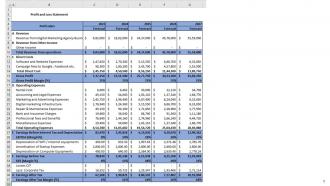
Slide 55: This slide emphasizes on Projected profit and loss account statement for digital marketing agency.
Slide 56: This slide continues Projected profit and loss account statement for digital marketing agency.
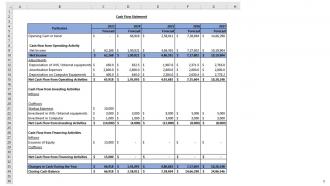
Slide 57: This slide presents Consolidated statements of cash flows for digital marketing agency.
Slide 58: This slide continues the Consolidated statements of cash flows for digital marketing agency.
Slide 59: This slide reveals the Comparative balance sheet statement for digital marketing agency.
Slide 60: This slide continues the Comparative balance sheet statement for digital marketing agency.
Slide 61: This slide exhibits the Scenario analysis with optimistic, pessimistic and realistic cases.
Slide 62: This slide continues the Scenario analysis with optimistic, pessimistic and realistic cases.
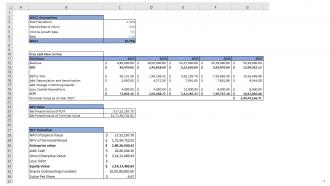
Slide 63: This slide showcases the Discounted cash flow valuation for digital marketing agency.
Slide 64: This slide includes the Heading for the Components to be discussed next.
Slide 65: The slide highlights the organizational hierarchy in the company.
Slide 66: This slide elucidates the Professional summary of digital marketing agency founder.
Slide 67: This slide represents the Job description of digital marketing agency key management.
Slide 68: This slide continues the Job description of digital marketing agency key management.
Slide 69: This is an extension of Job description of digital marketing agency key management slide.
Slide 70: This slide exhibits the Title for the Ideas to be covered in the upcoming template.
Slide 71: This slide represents the Possible exit strategies for digital marketing agency.
Slide 72: This slide contains the Heading for the Ideas to be discussed further.
Slide 73: This slide exhibits the Key abbreviations used in the plan.
Slide 74: This is the Icons slide containing all the Icons used in the plan.
Slide 75: This slide is used for depicting Additional information.
Slide 76: This is the About us slide. State your company-related information here.
Slide 77: This is Meet our team slide for showcasing the information related to team members.
Slide 78: This slide portrays the organization's mission, vision, and values.
Slide 79: This slide contains the Post it notes for reminders and deadlines.
Slide 80: This slide reveals the Clustered column.
Slide 81: This is the Venn diagram slide.
Slide 82: This is the 30 60 90 days plan slide for effective planning.
Slide 83: This is the Thank You slide for acknowledgement.
Digital Marketing Agency Business Plan Powerpoint Presentation Slides with all 88 slides:
Use our Digital Marketing Agency Business Plan Powerpoint Presentation Slides to effectively help you save your valuable time. They are readymade to fit into any presentation structure.


















































































FAQs for Digital Marketing Agency Business Plan
Your business plan needs the usual suspects - executive summary, market analysis, who you're targeting, competition breakdown, your services. But honestly, the pricing and client acquisition parts are where you'll live or die. Financial projections are crucial too since investors want realistic numbers, not pie-in-the-sky stuff. Include startup costs and when you'll break even. Got any case studies? Throw those in to show you actually know what you're doing. Oh, and make that executive summary really pop - it's what gets people to keep reading the rest of your plan.
Honestly, market research is a game changer - it shows you exactly what people need and what your competition isn't doing. Survey some local businesses about their biggest headaches. Maybe they're all struggling with social media but think agencies are too expensive? That's your opening right there. Check out competitor pricing too, because you don't want to be way off base. The whole point is finding those gaps where demand exists but supply doesn't. Oh, and it helps you figure out what clients will actually pay vs what you think they should pay (those are often very different things). Start local and dig into what services are selling best.
Retainer agreements are gold for steady cash flow - seriously game-changing when you're trying to plan ahead. You can mix in project-based stuff for one-off campaigns or website builds too. Performance fees are where the real money is if you're good at what you do, like taking a cut of ad spend or getting paid based on actual results. I'd go after 3-5 solid retainer clients first though. That gives you a safety net to mess around with other pricing models without stressing about rent. Oh and don't put all your eggs in one basket - combining retainers with project work usually works best.
Honestly, you gotta get way more specific about your ideal clients first. Industry, company size, budget - the whole thing. "Small businesses" is useless because it's everyone and no one, you know? Take your best clients right now and figure out what they actually have in common. Yeah, narrowing down feels scary when you're trying to grow, but it works. Build out maybe 2-3 detailed profiles of who these people really are and what keeps them up at night. Then let that guide your website, LinkedIn messages, everything. I used to chase anyone with a pulse and it was exhausting.
Look, first thing - research what competitors are charging, but don't just undercut them like crazy. That's a losing game. Bundle your services so clients can't do easy price comparisons. Most agencies literally destroy themselves racing to the bottom on pricing. Create different package tiers that show off what you're actually good at. Start high when you quote, then negotiate down if needed. Oh, and track which clients stick around longest with different pricing models - that tells you way more than who just says yes initially. Retention beats conversion every time.
Pick one niche and absolutely dominate it - healthcare SaaS, local restaurants, whatever. Don't try being everything to everyone. Most agencies sound identical in their pitch, which is honestly wild to me. Get super specific about your ideal client's actual problems. Maybe switch up your pricing too - performance-based instead of those monthly retainers everyone does. Build killer case studies showing real results in your vertical. Oh, and audit three competitor sites this week to spot gaps you could fill. That's where the magic happens.
Honestly, start with free versions of everything if you can - no point burning cash early on. You'll definitely need project management stuff (Asana's solid), Google Analytics for tracking, and something like Hootsuite for social scheduling. Design tools are pricey though - Adobe Creative Suite will hit your wallet hard but it's pretty much the standard. HubSpot's great for CRM but expensive as hell. Don't sleep on email marketing tools and Slack for team chat. Oh, and you'll want reporting dashboards too. Just remember to factor in all those monthly subscription costs when you're planning - they add up fast once you start scaling.
Look, everyone and their mom is doing "digital marketing" these days. You've gotta get specific about what problem you actually solve. Like, are you the guy who increases e-commerce sales by 40%? Do you respond to client emails in under 4 hours when everyone else takes days? Pick something concrete. The whole "full-service agency" thing is so overdone - clients hear that and their eyes glaze over. Figure out your one thing that makes competitors look generic. Honestly, if you can't finish "Unlike other agencies, we..." then you don't have a value prop yet. What's your specialty?
Honestly, content marketing and LinkedIn outreach work best for getting new clients. Referral programs too - people still trust recommendations more than anything else. Build case studies with actual ROI numbers, not just fluffy metrics that don't mean much. Keep clients happy with regular communication and monthly reports that actually show value. I'd set up quarterly reviews to talk strategy, not just "here's what we did." Being proactive about problems before they blow up is huge. Oh, and start tracking lifetime value now so you know how much you can spend acquiring new clients.
Look, most agencies go crazy with metrics at first - don't do that. Pick like 3-5 things you'll actually check every month instead of creating some massive spreadsheet you'll never touch. I'd focus on monthly revenue targets, keeping client retention above 90%, and tracking billable hours for your team. Oh, and make sure whatever you pick actually connects to your bigger business goals - sounds obvious but you'd be surprised. The financial stuff matters obviously (revenue, profit margins), but don't sleep on client satisfaction scores and how fast you're delivering projects. Review monthly, adjust quarterly based on what's really happening.
Look, branding is huge for agencies - it's literally what makes you stand out from every other marketing shop claiming they're "data-driven" or whatever. Strong branding means you'll charge more, get better referrals, and prospects will trust you way faster. Here's the thing though: clients pick agencies they feel good about first, then figure out if you know Google Ads later. Everyone's doing the same services anyway, so your brand becomes the main thing that separates you. Figure out what makes you different and stick to that voice everywhere. Sounds obvious but most agencies totally phone it in here.
Honestly, the biggest thing is getting invoices out fast and staying on top of late payments - people will pay you last if you let them. Keep at least 3-6 months of expenses saved up because clients are weird about paying on time. I track my numbers every week now, not monthly (learned that one the hard way). For bigger projects, definitely ask for deposits or break payments into chunks. Oh, and get separate business accounts if you haven't already - mixing personal and business money is a nightmare. A simple cash flow spreadsheet will save your sanity.
Show your expertise by actually helping people solve real problems. Case studies with actual numbers work great. Write how-to guides for stuff your prospects struggle with daily. LinkedIn articles are solid for sharing industry takes. Honestly, simple screen recordings explaining your strategies can build way more trust than fancy videos. Lead magnets like free audits or templates (with email capture obviously) pull in quality prospects. Map out 3-4 content themes around what you do best, then batch create everything. I always tell people - be helpful first, pitch second. That approach never fails me.
Dude, you HAVE to nail your own social media game. Think about it - if a potential client creeps your Instagram and it's dead, that's embarrassing as hell. Your accounts are basically proof you know what you're doing. Most of your leads will come from there anyway. I learned this the hard way when we first started out. Budget real money and time for it, just like you would for any big client. Short posts work great, but mix in some longer stuff too. It's literally your best marketing tool.
Dude, finding good people is gonna be your biggest headache - the talent market is absolutely nuts right now. Cash flow gets weird when you're managing multiple retainers too. Standardizing your processes while keeping clients happy? That's the tricky part. Oh, and your communication will fall apart fast without decent project management tools. I learned that one the hard way lol. Start writing down your workflows now before everything gets chaotic. Trust me on that one.
-
“Ample and amazing variety of templates available, really helpful for making professional PPT for day to day workings.”
-
Huge collection of high-quality templates. Worth each penny.