


Digital Twin Technology IT Powerpoint Presentation Slides




Try Before you Buy Download Free Sample Product
 Impress Your
 Audience
 100%
100% Editable
 Save Hours
 of Time


Digital Twin Technology is a top industrial software firm that uses industrial data to help people solve their most challenging problems by simply scaling the customers digital transformation with industrial software that provides breakthrough business outcomes. Here is an entirely designed PowerPoint presentation on Digital Twin Technology that explains its services, implementation methods, and reasons to invest in it. It covers the digital twin mode, usage, key components, types, working, and process flow chart. In addition, this Digital Twins PPT contains the relationship of digital twin technology with Augmented Reality AR, Virtual Reality VR, and Internet of Things IoT and its impact on industries. The Twin Technology template further covers its applications in various sections, such as manufacturing, healthcare, supply chain, and retail. Lastly, this Digital Twins deck comprises procurement options, pricing, training for digital twin technology, a 30-60-90 days plan, a roadmap, and a dashboard for a successful digital twin model. Get access to this powerful template now.
People who downloaded this PowerPoint presentation also viewed the following :
Content of this Powerpoint Presentation
Slide 1: This slide introduces Digital Twin Technology (IT). Commence by stating Your Company Name.
Slide 2: This slide depicts the Agenda of the presentation.
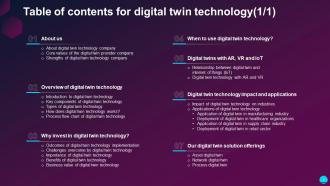
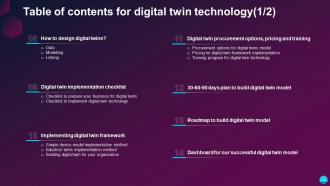
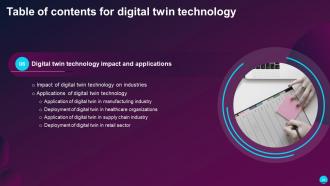
Slide 3: This slide includes the Table of contents.
Slide 4: This is yet another slide continuing the Table of contents.
Slide 5: This slide mentions the Title for the Topics to be covered in the next template.
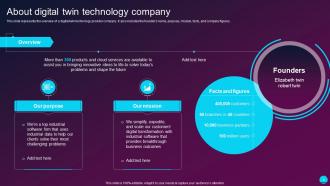
Slide 6: This slide exhibits information about digital twin technology company.
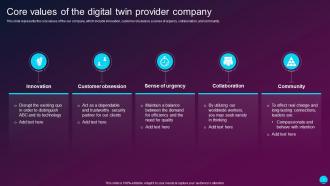
Slide 7: This slide mentions the Core values of the digital twin provider company.
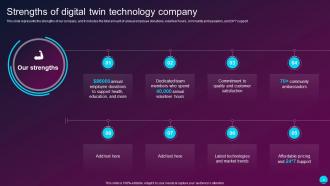
Slide 8: This slide showcases the Strengths of digital twin technology company.
Slide 9: This slide incorporates the Heading for the Contents to be discussed further.
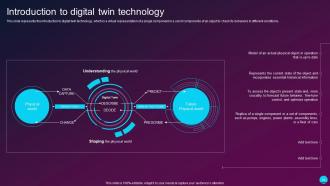
Slide 10: This slide represents the introduction to digital twin technology by virtual representation.
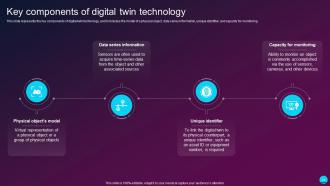
Slide 11: This slide reveals the Key components of digital twin technology.
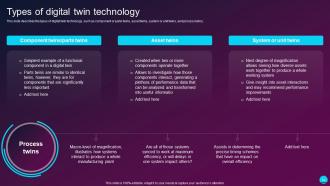
Slide 12: This slide describes the types of digital twin technology, such as component or parts twins, asset twins, etc.
Slide 13: This slide presents the working of digital twin technology through first-principles modeling and data-driven modeling.
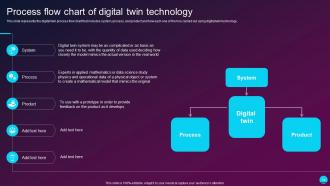
Slide 14: This slide illustrates the Process flow chart of digital twin technology.
Slide 15: This slide exhibits the Title for the Ideas to be covered next.
Slide 16: This slide highlights the Outcomes of digital twin technology implementation.
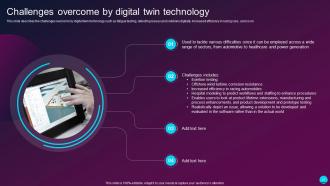
Slide 17: This slide describes the various challenges overcome by digital twin technology.
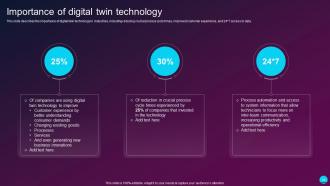
Slide 18: This slide elucidates the Importance of digital twin technology.
Slide 19: This slide showcases the numerous Benefits of digital twin technology.
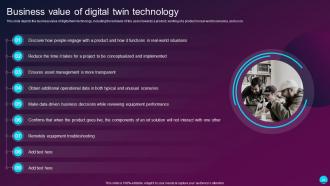
Slide 20: This slide lists the Business value of digital twin technology.
Slide 21: This slide incorporates the Heading for the Ideas to be covered further.
Slide 22: This slide depicts when to use digital twin technology that further includes three types.
Slide 23: This slide shows the Title for the Topics to be covered further.
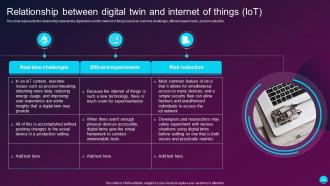
Slide 24: This slide reveals the Relationship between digital twin and internet of things (IoT).
Slide 25: This slide depicts the relationship of digital twin technology with augmented and virtual reality.
Slide 26: This slide presents the Title for the Topics to be discussed next.
Slide 27: This slide highlights the Impact of digital twin technology on industries.
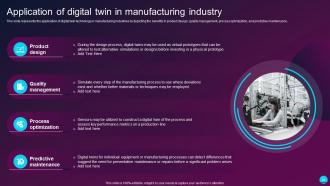
Slide 28: This slide focuses on the Application of digital twin in manufacturing industry.
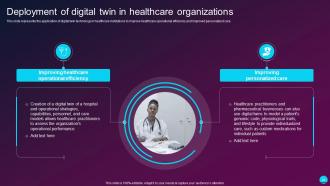
Slide 29: This slide deals with the Deployment of digital twin in healthcare organizations.
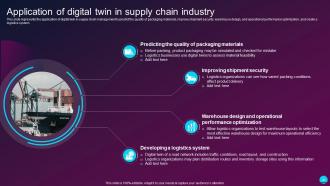
Slide 30: This slide represents the application of digital twin in supply chain management.
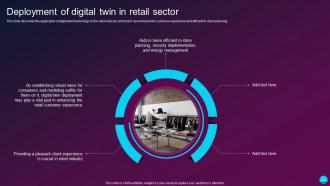
Slide 31: This slide describes the application of digital twin technology in the retail industry.
Slide 32: This slide shows the Heading for the Ideas to be covered in the upcoming template.
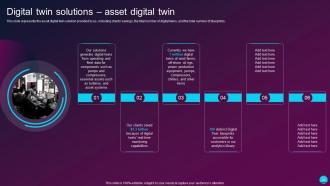
Slide 33: This slide represents the asset digital twin solution provided by the Company.
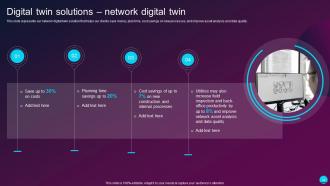
Slide 34: This slide elucidates the network digital twin solution offered by the firm.
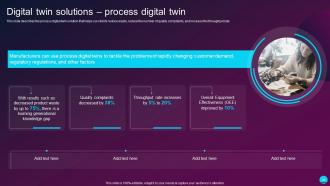
Slide 35: This slide focuses on the process digital twin solution of the organization.
Slide 36: This slide exhibits the Heading for the Contents to be discussed further.
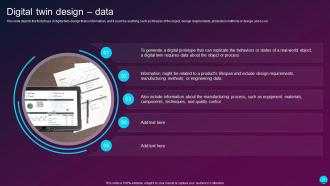
Slide 37: This slide depicts the first phase of digital twin design.
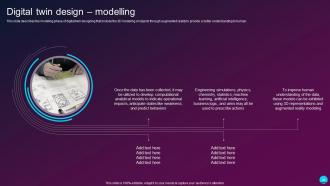
Slide 38: This slide showcases the modeling phase of digital twin designing.
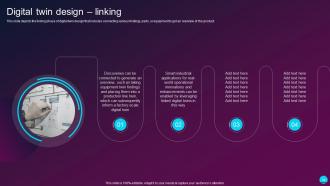
Slide 39: This slide depicts the linking phase of digital twin design.
Slide 40: This slide indicates the Title for the Topics to be covered next.
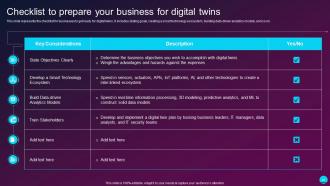
Slide 41: This sldie presents the Checklist to prepare your business for digital twins.
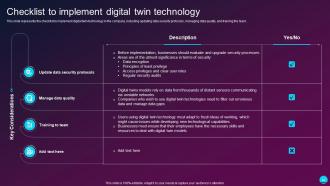
Slide 42: This slide reveals the checklist to implement digital twin technology in the company.
Slide 43: This slide incorporates the Heading for the Contents to be discussed further.
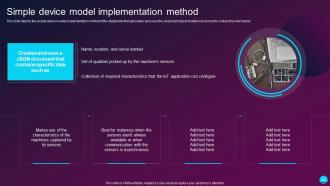
Slide 44: This slide highlights the simple device models implementation method of the digital twin.
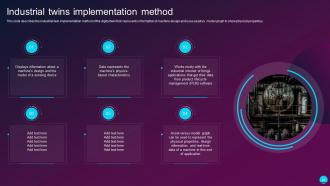
Slide 45: This slide deals with the Industrial twins implementation method.
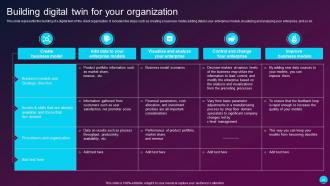
Slide 46: This slide represents the building of a digital twin of the client organization.
Slide 47: This slide incorporates the Title for the Topics to be covered further.
Slide 48: This slide elucidates the Procurement options for digital twins model.
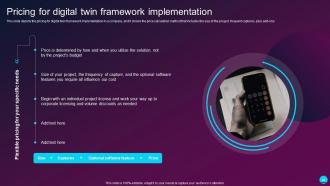
Slide 49: This slide depicts the pricing for digital twin framework implementation in a company.
Slide 50: This slide presents the Training program for digital twin technology.
Slide 51: This slide reveals the Heading for the Contents to be covered further.
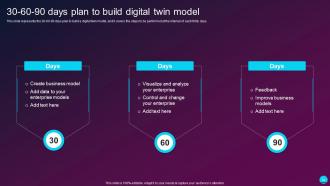
Slide 52: This slide depicts the 30-60-90 days plan to build a digital twin model.
Slide 53: This slide potrays the Title for the Topics to be covered next.
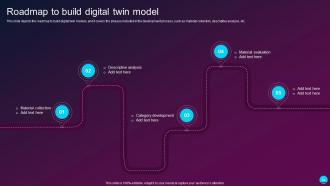
Slide 54: This slide showcases the Roadmap to build digital twin model.
Slide 55: This slide incorporate the Heading for the Contents to be discussed in the forth-coming template.
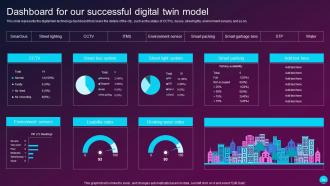
Slide 56: This slide illustrates the digital twin technology dashboard that covers the details of the city, buses, street lights,etc.
Slide 57: This is the Icons slide for digital twin technology showcasing all the Icons used in the plan.
Slide 58: This slide includes the Heading for the Ideas to be covered further.
Slide 59: This is the magnifying glass for depicting some minute details.
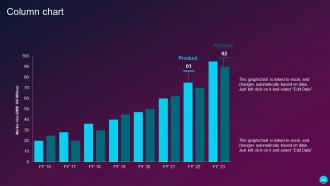
Slide 60: This slide represents the Coloumn chart for some Company related information.
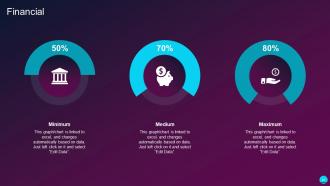
Slide 61: This slide exhibits information on the Financial topic.
Slide 62: This slide displays the Company's Roadmap.
Slide 63: This is the Puzzle slide with related imagery.
Slide 64: This is the Venn diagram slide for revealing Company related information.
Slide 65: This slide includes the Post it notes for reminders and deadlines.
Slide 66: This is Our goal slide. State your Organization's long-term goals here.
Slide 67: This is the Thank You slide for acknowledgement.
Digital Twin Technology IT Powerpoint Presentation Slides with all 72 slides:
Use our Digital Twin Technology IT Powerpoint Presentation Slides to effectively help you save your valuable time. They are readymade to fit into any presentation structure.

















FAQs for Digital Twin Technology IT
Honestly, the coolest part is how you can run "what if" scenarios without messing with your actual equipment. Real-time monitoring keeps tabs on everything, plus it'll catch maintenance issues before they shut you down. Quality control gets way better too since it spots weird patterns people miss. My buddy's company started with just one machine - probably smart since the tech can be overwhelming at first. ROI comes from less surprise breakdowns and not wasting resources. The whole digital simulation thing sounds super futuristic but it actually works.
So you get this virtual copy of your equipment that's constantly getting fed sensor data. Pretty wild stuff honestly - it's like x-ray vision for machines. When components start wearing down or acting weird, you'll spot it way before anything actually breaks. No more waiting for failures or doing maintenance just because the calendar says so. The system runs simulations and catches patterns to predict exactly when you need to fix something. Saves money and prevents those surprise breakdowns that always happen at the worst time. I'd start with your most critical equipment first and test it out there.
Look, digital twins basically let you mess around with designs on a computer before you waste money building the real thing. Super helpful for catching problems early - way better than finding out your prototype sucks after spending thousands on it. You can run crazy stress tests and try out different scenarios without breaking anything. The coolest part? Running tons of simulations at once to see what works best. I'd start with whatever physical testing costs you the most right now. That's probably where you'll see the biggest savings. It's honestly pretty game-changing once you get it set up right.
Yeah so manufacturing is crushing it with digital twins right now - they're simulating whole production lines and catching equipment failures before stuff breaks. Aerospace and automotive are right there too, which makes sense since nobody wants planes falling out of the sky lol. Healthcare's doing some cool personalized treatment stuff, and cities are using them for traffic flow and energy systems. Oh and if you're thinking about doing this at your company, definitely look at manufacturing case studies first. They've been at it the longest so their frameworks are pretty solid to build off.
Look, data security for digital twins is huge because you've got tons of sensitive stuff flowing between your physical assets and virtual copies. Real-time sensor feeds, proprietary processes, predictive analytics - competitors would kill for this intel. The attack surface is massive too with all those IoT devices and APIs everywhere. You'll need solid encryption, tight access controls, plus constant monitoring since one breach exposes everything from trade secrets to infrastructure weak spots. Honestly, I'd start by mapping your data flows first. Find the most sensitive touchpoints and lock those down hard.
For enterprise stuff, you're looking at Microsoft Azure Digital Twins, AWS IoT TwinMaker, and GE's Predix - those are the big names everyone talks about. Ansys Twin Builder works great if you need heavy simulation. PTC ThingWorx is solid for industrial IoT. Honestly, this whole space moves crazy fast with new companies popping up all the time. If it's a smaller project, maybe check out Unity 3D or Unreal Engine for the visual side - those are actually pretty decent for prototyping. Really depends what you're trying to do though. Predictive maintenance? Process optimization? Figure that out first, then match your budget and tech stack to whatever platform makes sense.
Okay so digital twins basically let you build a virtual copy of your whole supply chain that updates in real time. Pretty wild, right? You can test out different scenarios - like what if this supplier crashes or a hurricane hits your warehouse. The system pulls live data from sensors and IoT stuff to mirror what's actually happening. I'd honestly start small though, maybe just one segment first because it can get overwhelming fast. But once you've got it running, you'll spot problems before they happen and optimize routes without the usual scrambling. Way better than playing catch-up all the time.
Dude, the data integration alone will make you want to pull your hair out. Your current IT setup definitely wasn't designed for this real-time stuff, so you'll uncover all sorts of technical debt. Costs add up fast too - sensors, cloud services, hiring people who actually know this stuff. Security gets messier when you're connecting everything together. Oh, and honestly? It's like trying to rebuild a car engine while you're driving down the highway. My advice: pick one small process first instead of going nuts and doing everything at once.
So real-time data is what makes digital twins actually work - without it you're stuck with a useless 3D model that looks cool but does nothing. Sensors grab stuff like temperature, pressure, vibration and feed it straight to your virtual twin so it mirrors reality. That's where things get interesting though. Your twin can start predicting when equipment might fail or figure out how to run more efficiently because it knows exactly what's happening right now. I'd honestly focus on figuring out which sensors you really need first - way too easy to go nuts collecting data you'll never touch.
So basically, AI is what makes your digital twin actually smart instead of just a pretty 3D model sitting there. It crunches all that sensor data streaming in and catches patterns you'd miss. The predictive stuff is where it gets interesting - it'll tell you when equipment's gonna fail before it actually does. Plus it automatically tweaks things like manufacturing settings or energy use based on what it learns. Without AI you're just staring at a digital copy that can't think. Oh, and definitely make sure whatever platform you pick has AI built in from the start.
So digital twins are basically virtual copies of real stuff that let you test things without screwing up the actual environment. Think of it like a video game version of your factory or building. You can mess around with energy settings, predict when machines might break, optimize processes - all without wasting materials or power in real life. Manufacturing companies use them to cut down on waste, cities figure out better traffic patterns, buildings dial in their heating systems. Honestly, it's pretty genius. I'd say look at whatever's costing you the most resources first and see if you can model it digitally before making changes.
So basically, physical twins are just your actual stuff - machines, buildings, cars, whatever you've got. Digital twins? They're like virtual copies that live in software and get fed real-time data from sensors. Picture having a 3D model of your equipment that actually mimics what's happening in real life. You can mess around with simulations and spot problems before they happen without breaking anything. Honestly, it's pretty cool tech. I'd say start with whatever equipment costs you the most when it breaks down - that's your sweet spot.
So basically, you build a virtual copy of how customers use your stuff and it predicts what they want next. Pretty cool, right? The best part is customizing everything - recommendations, timing, all of it. When problems pop up, you've already modeled them in the digital version so fixes happen way faster. You can even test changes virtually first (saves so much headache later). Oh, and don't try to do everything at once - pick one customer journey to start with. That's honestly the smartest move.
Digital twins are getting crazy autonomous - like, they'll run simulations and make decisions without anyone babysitting them. AI integration is the big driver here, plus edge computing makes everything way snappier. The coolest part? Different systems will actually communicate with each other instead of being these isolated islands. Manufacturing was just the start - now we're seeing healthcare, smart cities, personal fitness stuff. It's kind of wild how fast it's expanding. My advice? Start messing around with basic pilots now. Your team will thank you later when this stuff becomes standard and you're not scrambling to catch up.
So digital twins are basically virtual copies of city stuff that update live - traffic lights, water pipes, power grids, all that. You can watch everything from one dashboard which is honestly pretty cool to see. When problems pop up, you'll catch them early and the system can auto-fix things like redirecting traffic or balancing electricity loads. I mean, most of the time it runs itself without people having to jump in. Your maintenance crews just focus on the big issues instead of chasing every little thing around town.
-
I am really satisfied with their XYZ products. Used their slides for my business presentations and now I am taking their help for my son's high-school assignments. Super satisfied!!
-
Eye-catching PPT designs, outstanding team, and best customer service. I’m a super satisfied customer here!