


Modern Technologies Powerpoint Presentation Slides




Try Before you Buy Download Free Sample Product
 Impress Your
 Audience
 100%
100% Editable
 Save Hours
 of Time


One of the newest technological revolutions, AI, is already well known for being superior to humans. Check out our professionally designed Modern Technologies template. It briefly overviews Artificial Intelligence AI and Machine Learning. In our Cutting-edge technologies deck, we have demonstrated Extended Reality, which refers to all simulation-based technologies, including Virtual Reality, Augmented Reality, Mixed Reality, and Everything in between. Prototyping with 3D printing is a crucial breakthrough and technological trend which has Impacted biomedical and industrial fields. In addition, our Emerging Technologies PPT contains Robotic Process Automation RPA with its market study and growth. Also, the New Technology PPT includes Quantum Computing, a type of computation that uses quantum phenomena like quantum entanglement and superposition. Lastly, it exhibits topics like Blockchain Technology, the Internet of Things IoT, 5G, Hyper automation technology, Cognitive computing, Cyber security, Everything as a Service XaaS, and Edge Computing. Download our 100 percent editable and customizable template, also compatible with Google Slides.
People who downloaded this PowerPoint presentation also viewed the following :
Content of this Powerpoint Presentation
Slide 1: This slide introduces Modern Technologies. Commence by stating Your Company Name.
Slide 2: This slide depicts the Agenda of the presentation.
Slide 3: This slide incorporates the Table of contents.
Slide 4: This is yet another slide continuing the Table of contents.
Slide 5: This slide highlights the Title for the Topics to be covered further.
Slide 6: This slide explains overview of various latest technologies with its description and use case.
Slide 7: This slide states the Key statistics associated with latest technologies.
Slide 8: This slide continues the key statistics associated with latest technologies.
Slide 9: This slide presents the Heading for the Contents to be discussed next.
Slide 10: This slide showcases the Global market overview of quantum computing.
Slide 11: This slide explains overview of quantum computing and its application such as artificial intelligence, machine learning, etc.
Slide 12: This slide depicts the Quantum computing elements and working.
Slide 13: This slide showcases types of quantum computing systems.
Slide 14: This slide elaborates on how quantum computing transforms businesses in different sectors.
Slide 15: This slide displays the implementation checklist for quantum computing in the workplace.
Slide 16: This slide portrays the Title for the Ideas to be covered in the following template.
Slide 17: This slide shows Market overview of hyper automation technology covering year from 2022 till 2030 with estimated compound annual growth rate.
Slide 18: This slide gives an overview of hyperautomation technology which covers various technology.
Slide 19: This slide explains use cases of hyperautomation in various industries sector.
Slide 20: This slide shows predicted market growth of artificial intelligence by providing insights on customer satisfaction.
Slide 21: This slide gives an overview of artificial intelligence with its working.
Slide 22: This slide explains two major types of artificial intelligence (AI) which are strong and weak artificial intelligence.
Slide 23: This slide presents the Artificial intelligence use case in business.
Slide 24: This slide outlines the global market overview of machine learning.
Slide 25: This slide briefly talks about machine learning and its working.
Slide 26: This slide talks about the Applications of machine learning in different domains.
Slide 27: This slide showcases the Role of machine learning in business transformation.
Slide 28: This slide discusses the Global robotic process automation market overview.
Slide 29: This slide gives a glimpse of robotic process automation with its working and benefits.
Slide 30: This slide explains the important business impact of robotic process automation.
Slide 31: This slide includes the Heading for the Ideas to be discussed in the upcoming template.
Slide 32: This slide discusses the Global market overview of cognitive computing.
Slide 33: This slide gives an overview and working of cognitive computing.
Slide 34: This slide explains important features of cognitive computing.
Slide 35: This slide indicates the Title for the Contents to be covered further.
Slide 36: This slide explains the Global market overview of 5G networks from 2022 to 2030.
Slide 37: This slide showcases 5 Generation network in telecommunication.
Slide 38: This slide explains the use cases of 5G network across different sectors.
Slide 39: This slide explains global economic impact of 5G network in various industries.
Slide 40: This slide contains the Heading for the Topics to be discussed next.
Slide 41: This slide explains the Market overview of internet of things.
Slide 42: This slide provides an overview of the internet of things and its components.
Slide 43: This slide explains the Use case of internet of things in various industries in various industries.
Slide 44: This slide presents the Title for the Contents to be covered next.
Slide 45: This slide explains global market overview of extended reality (XR) for the year 2021.
Slide 46: This slide reveals the Introduction to extended reality (XR) technology.
Slide 47: This slide explains the journey of extended reality technology using a timeline from 1968 to 2020.
Slide 48: This slide depicts the Roadmap to implement extended reality technology.
Slide 49: This slide gives an overview of virtual reality technology with its three types non-immersive, semi-immersive and full immersive.
Slide 50: This slide gives a brief overview of augmented reality technology and how it works.
Slide 51: This slide explains the difference between augmented reality and virtual reality.
Slide 52: This slide displays the Overview of mixed reality(MR) technology.
Slide 53: This slide incorporates the Heading for the Topics to be discussed further.
Slide 54: This slide gives an idea about the size of the global 3D printing market along with the market's value in recent years.
Slide 55: This slide provides an introduction to three-dimensional printing in detail.
Slide 56: This slide states the Various types of 3D printing technology.
Slide 57: This slide talks about the 3D printing applications in various industry.
Slide 58: This slide displays the Title for the Contents to be covered next.
Slide 59: This slide explains Cyber security technology market overview with top players in the year 2021.
Slide 60: This slide gives an overview of cyber security technology.
Slide 61: This slide explains the objectives of cyber security technology such as confidentiality, integrity and availability.
Slide 62: This slide states the Various types of cyber attacks on system.
Slide 63: This slide includes the Heading for the Contents to be discussed further.
Slide 64: This slide showcase market overview of blockchain from year 2022 till 2030 with compound annual growth rate.
Slide 65: This slide gives an introduction and working of blockchain technology.
Slide 66: This slide explains various types of blockchain technology such as public, private, hybrid and consortium.
Slide 67: This slide displays the Title for the Ideas to be covered in the following template.
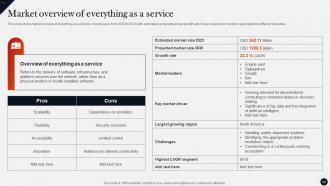
Slide 68: This slide shows market overview of Everything as a Service covering year from 2022 till 2030 with estimated compound annual growth rate.
Slide 69: This slide states the Various components of everything as a service (xaas).
Slide 70: This slide exhibits the Benefits of everything as a service technology.
Slide 71: This slide shows the timeline of Everything as a Service.
Slide 72: This slide portrays the Heading for the Ideas to be discussed in the next template.
Slide 73: This slide shows market overview of edge computing covering year from 2022 till 2027 with estimated compound annual growth rate.
Slide 74: This slide gives the introduction to edge computing with its working.
Slide 75: This slide describes the cloud architecture in edge computing, including its three layers: cloud, fog, and edge.
Slide 76: This slide explains business use-case of different segments of edge computing.
Slide 77: This is the Icons slide containing all the Icons used in the plan.
Slide 78: This slide is used for depicting some Additional information.
Slide 79: This slide illustrates the Emerging technology hype cycle.
Slide 80: This slide exhibits the company's Timeline.
Slide 81: This slide represents the SWOT analysis.
Slide 82: This is Our team slide. State your team-related information here.
Slide 83: This is the Venn diagram slide.
Slide 84: This is the Idea generation slide for encouraging fresh ideas.
Slide 85: This is the Target slide. State your organziation's targets here.
Slide 86: This is the 30,60,90 days plan slide for effective planning.
Slide 87: This slide contains the Post notes for reminders and deadlines.
Slide 88: This is the Magnifying glass with minute details.
Slide 89: This is the Thank You slide for acknowledgement.
Modern Technologies Powerpoint Presentation Slides with all 97 slides:
Use our Modern Technologies Powerpoint Presentation Slides to effectively help you save your valuable time. They are readymade to fit into any presentation structure.















FAQs for Modern Technologies
Honestly, modern tech boils down to three things: everything connects to everything else, AI is everywhere personalizing stuff, and interfaces don't suck anymore. Your phone talks to your car talks to your smart fridge - it's wild how seamless it's gotten. Real-time processing is just expected now too. When you're checking out new tech for work, see if it hits those marks. Oh, and make sure it's actually cloud-based, not some old system pretending to be modern. That's usually the dead giveaway for legacy stuff dressed up fancy.
Look, traditional industries are basically getting forced to evolve or die right now. AI's automating manufacturing, blockchain is changing how supply chains work, IoT is hitting everything from farms to hospitals. It's honestly crazy how quick this shift is happening. Companies jumping on these technologies early are cutting costs and beating their competition, while the slow movers are getting crushed. My advice? Figure out what tech might hit your industry hardest and start running some small tests now. Don't wait until you're playing catch-up - that never ends well.
Honestly, AI is everywhere now and you probably don't even realize it. Those Netflix suggestions that are weirdly spot-on? AI. Amazon somehow knowing exactly what you want to buy next? Same thing. Chatbots have gotten way less annoying too - they actually help instead of just pissing you off. Your Alexa handles shopping lists, prices change based on demand, and those creepy targeted ads that stalk you across websites. Everything's getting personalized to how you behave online. Pay attention to what actually saves you time vs. what feels invasive though.
Honestly, the right tech stack makes all the difference for remote work. Cloud storage means you can grab files from anywhere. Video calls don't suck as much as they used to (though my WiFi still has other plans sometimes). Project management apps keep everyone from going completely off the rails together. Real-time editing is pretty sweet - feels like you're working side by side. AI tools handle the repetitive garbage nobody wants to do anyway. The trick is finding stuff that plays nice together. Otherwise you'll go insane juggling twelve different apps just to get one thing done.
So basically your city becomes this huge network of connected sensors and devices. Traffic lights adjust to real-time congestion, waste bins ping crews when they're full, air quality monitors help you figure out if it's worth going for that run. Pretty wild honestly. All this data gets fed to city planners who use it to optimize energy, emergency response, whatever. The sensors are everywhere - kinda creepy but also convenient? You'll probably notice better services and way less waiting around for stuff. It's like living in the future but without flying cars unfortunately.
Look, the big issues are privacy and discrimination stuff. Your fingerprints can't be changed like a password if someone steals them - you're just screwed. Facial recognition is especially sketchy since it works way worse on certain ethnic groups, which is honestly messed up. Organizations basically own your data once they have it. I always skim those terms before agreeing to anything biometric (ok fine, I usually just scroll through quickly). But seriously, think about whether the convenience is actually worth giving up that much privacy. Most of the time it probably isn't.
Big data lets you catch patterns in customer habits and market shifts that you'd never spot by hand. Start with specific questions though - don't just hoard data randomly, that's a waste. Set up dashboards so you can see what's happening in real time. Your team needs proper training to actually understand the results (this part gets overlooked way too often). You'll be able to predict demand better, tweak pricing, and find new revenue streams. It's like having a crystal ball that actually works. Multiple data sources give you the full picture for reducing risks too.
Dude, 5G is insane - like 100x faster than 4G. Movies download in seconds now instead of forever. Gaming and video calls barely lag anymore, which is honestly a game changer. Your phone handles everything way smoother, plus streaming actually works without buffering every two seconds. The really wild stuff though? It's powering autonomous cars and smart cities since they need instant data. I was skeptical at first but the difference is noticeable. Check if your carrier has coverage in your area - totally worth switching if they do.
So VR's pretty cool for training stuff - med students can do virtual surgeries, pilots practice flying without crashing actual planes. Way better than just reading about it, you know? You can basically visit ancient Rome or shrink down and explore inside a human body (which is wild when you think about it). Fire departments use it for dangerous rescue scenarios too. The whole point is getting real practice without screwing up for real. Oh, and if your company wants to try it - don't go crazy at first. Pick one thing and test it out.
So blockchain basically lets you track products from start to finish - no more guessing where stuff came from. Great for stopping fakes and handling recalls way faster. Customers dig being able to verify what they're buying too. But here's the thing - it's expensive as hell to set up right now. Everyone in your chain has to be on board or you're screwed. Some networks still can't handle massive volume either, which is annoying. My advice? Test it out small first, maybe just your biggest sellers. Don't go all-in until you know it actually works for your situation.
Honestly, the clean tech stuff happening right now is pretty wild. Solar panels and wind turbines keep getting better, plus these smart grids can actually figure out where energy needs to go. EVs are obviously everywhere now, but there's also this carbon capture tech that literally sucks CO2 out of the air - sounds like sci-fi but it's real. Companies are using AI to track their emissions, and you can even get apps that show your own carbon footprint (though I'm not sure how accurate those are). Green hydrogen's becoming huge for manufacturing too. If you're thinking about jumping into this space, definitely look up clean tech companies nearby - they're hiring for all kinds of roles, not just engineering.
Honestly, social media companies are getting crazy good at this stuff. They've got AI algorithms pushing content you actually want to see, plus all those interactive features like polls and live streams. The gamification thing is huge too - streaks, badges, creator funds that make you feel like you're "winning" something. AR filters are everywhere now, and real-time comments make everything feel more immediate. Oh, and they're big on community spaces where people with similar interests can hang out. If you're trying to build any kind of online community yourself, definitely steal these ideas. Make participation feel rewarding instead of just scrolling mindlessly.
Look, everything's gone digital now so hackers have way more ways to mess with your business. Customer info, payment systems - it's all online and these attacks are getting crazy sophisticated. One breach can tank your reputation overnight, not to mention cost you a fortune to fix. I'd honestly treat it like insurance at this point, not just some tech thing your IT guy handles. Get your team trained on spotting sketchy emails and definitely set up two-factor authentication everywhere. Sounds annoying but trust me, it's worth the extra 30 seconds of login time.
Dude, hospitals are going crazy with digital stuff right now. When you do a telehealth call, your doctor can pull up your entire medical history instantly and update everything while you're talking. Pretty cool, right? Remote monitoring gadgets now sync directly with digital records too - no more shuffling papers between departments like it's 1995. Everything's connecting automatically these days. Honestly, if your company's thinking about this, just check what systems you already have first. Way easier than starting over. The whole workflow thing is becoming super streamlined.
Honestly, your biggest headache will be employees freaking out about new systems. People hate change, especially when they don't understand the tech. Budget's another killer - these tools cost way more than just the initial price tag. Oh, and connecting new stuff to your old systems? Total nightmare every single time. Your IT team's gonna be stressed about security vulnerabilities too. Data breaches are no joke these days. I'd definitely start with small pilot tests first - don't go all-in company-wide right away. Way too risky.
-
I want to express my gratitude to SlideTeam’s presentation design services team for helping me create the best presentation of my life!
-
“There is so much choice. At first, it seems like there isn't but you have to just keep looking, there are endless amounts to explore.”