

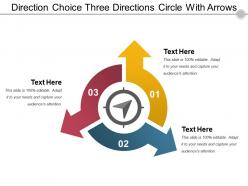
Direction choice three directions circle with arrows





Try Before you Buy Download Free Sample Product
 Impress Your
Audience
 100%
Editable
 Save Hours
of Time


Our Direction Choice Three Directions Circle With Arrows belong to another dimension. They believe in being a class apart.
People who downloaded this PowerPoint presentation also viewed the following :
Direction choice three directions circle with arrows with all 5 slides:
Fruits are forever with our Direction Choice Three Directions Circle With Arrows. Your efforts will always come good.


FAQs for Direction choice three directions
Key factors include market dynamics and competitive landscape analysis, resource allocation and organizational capabilities assessment, customer needs and behavior patterns, regulatory environment considerations, and financial constraints evaluation. These strategic elements work together by enabling informed decision-making, minimizing operational risks, and maximizing growth opportunities, with many organizations finding that systematic evaluation ultimately delivers sustainable competitive advantage and enhanced market positioning.
Cultural influences significantly impact directional choices through varying communication styles, decision-making processes, hierarchical structures, risk tolerance levels, and market preferences across different regions. Companies expanding globally must adapt their strategic approaches by understanding local consumer behaviors, business etiquette, regulatory environments, and cultural values, with many multinational organizations finding that culturally-informed directional strategies ultimately deliver enhanced market penetration and sustainable competitive advantage.
Data analytics plays a crucial role in shaping directional choices for marketing campaigns by providing audience insights, performance metrics, competitive intelligence, and predictive modeling capabilities. Through advanced analytics platforms, marketing teams can identify high-converting customer segments, optimize channel allocation, and refine messaging strategies, with many retail and e-commerce organizations finding that data-driven directional choices deliver significantly higher ROI and customer engagement rates.
Organizations balance short-term and long-term directional choices by implementing dual-horizon planning, establishing clear priority frameworks, and maintaining flexible resource allocation strategies. Through strategic portfolio management, companies like Amazon and Microsoft successfully pursue immediate operational needs while investing in future technologies, ultimately delivering sustained growth and competitive advantage in an increasingly dynamic business environment.
**INPUT**: What tools are most effective for visualizing directional choices in a presentation? **OUTPUT**: Effective directional choice visualization tools include flowcharts, decision trees, pathway diagrams, arrow-based graphics, and branching templates that clearly map multiple options and outcomes. These presentation elements streamline complex decision-making processes by highlighting key decision points, potential consequences, and strategic pathways, with many organizations finding that visual frameworks enhance stakeholder understanding and accelerate consensus-building. [Word count: 55 words]
Leadership styles significantly influence directional choices through decision-making approaches, risk tolerance, communication patterns, and stakeholder engagement methods. Autocratic leaders often drive rapid directional shifts in manufacturing and retail, while collaborative leaders in healthcare and financial services build consensus for strategic pivots, ultimately delivering more sustainable organizational alignment and employee buy-in across implementation phases.
Consumer trends significantly influence directional choices by shaping feature priorities, design aesthetics, sustainability requirements, and technology integration decisions throughout development cycles. Companies like Apple, Nike, and Tesla continuously analyze purchasing behaviors, lifestyle shifts, and demographic preferences to guide product roadmaps, with many organizations finding that trend-responsive development delivers higher market acceptance and competitive positioning.
Risk mitigation strategies for directional choices include diversification, scenario planning, phased implementation, continuous monitoring, and maintaining strategic flexibility through reversible decisions. Through robust analytics and stakeholder input, organizations can minimize exposure by testing approaches in pilot programs, establishing clear success metrics, and building adaptive frameworks, ultimately enabling faster course corrections while preserving competitive advantage in dynamic market conditions.
Feedback loops enhance directional choices by providing continuous data for course correction, enabling real-time adjustments, and validating strategic decisions through measurable outcomes. Through systematic monitoring and analysis, organizations can identify inefficiencies, adapt to market changes, and optimize resource allocation, ultimately delivering improved performance and competitive advantage in increasingly dynamic business environments.
Ethical considerations include stakeholder impact assessment, transparency in decision-making processes, long-term consequence evaluation, fairness in resource allocation, and accountability for outcomes. These principles enable organizations to balance profitability with responsibility, ensuring decisions enhance stakeholder trust, minimize negative externalities, and deliver sustainable competitive advantage while maintaining ethical integrity across operations.
Teamwork and collaboration enhance directional choices by leveraging diverse perspectives, reducing individual bias, and combining specialized expertise from different departments or functions. Through collaborative frameworks, organizations can evaluate strategic options more comprehensively, identify potential blind spots earlier, and build stronger consensus around implementation, ultimately delivering more robust decisions and higher stakeholder buy-in across the organization.
Effective methodologies include scenario planning, SWOT analysis, competitive benchmarking, stakeholder feedback loops, and data-driven decision matrices. These approaches streamline strategic evaluation by analyzing market conditions, assessing organizational capabilities, and measuring performance indicators, with many organizations finding that combining quantitative metrics with qualitative insights ultimately delivers more agile directional adjustments and sustained competitive advantage.
Technological advancements significantly reshape directional choices by enabling data-driven decision-making, automating strategic processes, and creating new market opportunities across industries. In healthcare, AI guides treatment protocols, while in manufacturing, IoT sensors optimize supply chains, and in finance, blockchain technology streamlines transactions, ultimately delivering enhanced operational efficiency and competitive advantage.
Common pitfalls include overwhelming audiences with too many options, presenting choices without clear criteria or consequences, failing to provide sufficient context for decision-making, and using biased language that steers toward preferred outcomes. Organizations find that successful directional presentations balance comprehensive options with digestible frameworks, ultimately enabling stakeholders to make informed strategic decisions while maintaining engagement and clarity throughout the process.
Storytelling within presentations enhances directional choice understanding by creating emotional connections, illustrating consequences through relatable scenarios, and demonstrating cause-and-effect relationships across different pathways. Through narrative frameworks, organizations can showcase how strategic decisions unfold in sectors like retail expansion or product development, ultimately enabling stakeholders to visualize outcomes and make more informed, confident choices.
-
Easy to edit slides with easy to understand instructions.
-
Great quality slides in rapid time.