

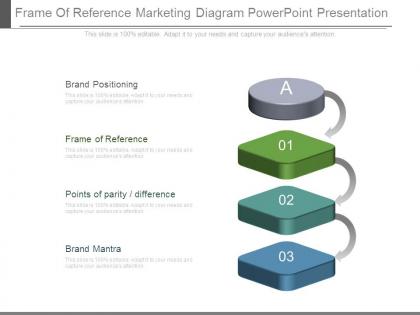
Frame of reference marketing diagram powerpoint presentation




Try Before you Buy Download Free Sample Product
 Impress Your
 Audience
 100%
100% Editable
 Save Hours
 of Time


Generate awe with our Frame Of Reference Marketing Diagram Powerpoint Presentation. The audience will be completely astounded.
People who downloaded this PowerPoint presentation also viewed the following :
Frame of reference marketing diagram powerpoint presentation with all 7 slides:
Our Frame Of Reference Marketing Diagram Powerpoint Presentation encourage the development of creative ideas. It is ideal for brainstorming.
FAQs for Frame of reference marketing
Frame of reference marketing includes competitive positioning, category definition, target audience identification, value proposition differentiation, and contextual messaging strategies. These components work by establishing clear market boundaries, highlighting unique advantages against specific competitors, and creating memorable associations, with many brands finding that strategic framing significantly enhances customer understanding and accelerates purchase decisions.
Frame of reference marketing enhances customer understanding by providing familiar context points, establishing clear competitive positioning, and creating relatable comparison frameworks that simplify decision-making processes. Through strategic positioning against known alternatives, businesses streamline customer evaluation journeys, reduce cognitive load, and accelerate purchase decisions, with many retail and financial services companies finding significantly improved conversion rates.
Brands can effectively identify their target frame of reference through comprehensive market research, competitive analysis, customer journey mapping, brand positioning audits, and direct consumer feedback sessions. These strategic approaches enable companies to understand how customers categorize their products, what alternatives consumers consider, and which competitive sets matter most, ultimately delivering clearer positioning strategies and enhanced market differentiation.
Cultural differences significantly influence frame of reference in marketing by shaping consumer perceptions, values, purchasing behaviors, and communication preferences across different regions and demographics. Marketing teams must adapt their messaging, visual elements, and positioning strategies to align with local cultural contexts, with many global brands finding that successful campaigns require region-specific customization rather than universal approaches.
Competitive analysis helps establish a brand's frame of reference by identifying direct and indirect competitors, analyzing their positioning strategies, messaging approaches, and market perceptions. Through comprehensive competitor research, businesses can pinpoint market gaps, differentiation opportunities, and strategic positioning angles that resonate with target audiences, ultimately enabling more effective brand positioning and competitive advantage in crowded markets.
Businesses can adapt their messaging by researching target audience values, cultural backgrounds, past experiences, and current mindsets, then tailoring language, visuals, and positioning accordingly. Through market segmentation and consumer insights, companies in retail, healthcare, and financial services customize campaigns that resonate with specific reference points, ultimately enhancing engagement and conversion rates.
Marketers should avoid overly broad positioning that lacks specificity, choosing irrelevant competitive sets, ignoring customer perceptions of category boundaries, and failing to validate their frame through market research. Many retail and financial services companies find that misaligned frames dilute brand messaging, confuse target audiences, and ultimately weaken competitive positioning, making strategic differentiation significantly more challenging.
Emotional responses significantly amplify frame of reference marketing by creating stronger mental associations, deeper brand connections, and enhanced memory retention through psychological anchoring. When consumers feel positive emotions toward reference points, like luxury brands or trusted institutions, they transfer those feelings to new products, with studies showing emotionally-engaged customers demonstrating 23% higher purchase intent and brand loyalty.
Frame of reference marketing adapts seamlessly across digital platforms, traditional media, social channels, email campaigns, and in-store experiences by establishing consistent comparative positioning. This strategic approach enables brands to maintain unified messaging while leveraging each medium's unique strengths, with many companies finding that cross-platform consistency amplifies recognition and ultimately delivers stronger competitive differentiation.
Companies should track brand perception shifts, competitive positioning scores, message clarity ratings, customer acquisition costs, and market share changes within target segments. These metrics enable organizations to measure how effectively their positioning resonates, with many finding that improved frame of reference clarity directly correlates with enhanced customer understanding and accelerated sales cycles.
Changes in consumer behavior significantly impact established frames of reference by shifting expectations, preferences, and decision-making criteria, requiring brands to continuously adapt their positioning strategies. As digital natives prioritize sustainability, personalization, and social responsibility over traditional value propositions, companies must evolve their reference points, with many retail and technology brands finding that outdated comparisons lose effectiveness, ultimately necessitating fresh competitive frameworks that resonate with contemporary consumer values.
Successful frame of reference marketing cases include Netflix positioning against Blockbuster's inconvenience, Tesla comparing electric vehicles to gas-powered inefficiency, and Dollar Shave Club contrasting with overpriced razor giants. These strategic repositioning efforts streamlined customer decision-making by highlighting clear differentiators, cost advantages, and superior experiences, ultimately delivering market disruption and competitive advantage across consumer technology, automotive, and personal care industries.
Visuals and presentations enhance brand frame of reference understanding by simplifying complex positioning concepts, creating memorable visual associations, and demonstrating competitive differentiation through infographics, comparison charts, and brand mapping exercises. Through strategic visual storytelling, companies can effectively communicate their market category, target audience, and unique value proposition, with many organizations finding that visual presentations accelerate stakeholder alignment and customer comprehension.
Brands face significant challenges including entrenched customer perceptions, competitive positioning conflicts, internal alignment issues, and resource allocation complexities when shifting their frame of reference. These obstacles require strategic communication, consistent messaging across touchpoints, and sustained investment, with many companies finding that successful repositioning demands patience, as market acceptance and competitive differentiation ultimately deliver enhanced brand equity and expanded market opportunities.
Emerging technologies influence frame of reference marketing by enabling real-time personalization, predictive analytics, and dynamic competitive positioning across multiple touchpoints. Through AI-driven insights and automation platforms, businesses can continuously adjust their reference points based on shifting market conditions, customer behaviors, and competitive landscapes, ultimately delivering more relevant messaging and stronger market differentiation in increasingly complex digital environments.
-
The Designed Graphic are very professional and classic.
-
Excellent Designs.