


Discussion ppt slides show





Try Before you Buy Download Free Sample Product
 Impress Your
 Audience
 100%
100% Editable
 Save Hours
 of Time


Come up with any challenge for our Discussion Ppt Slides Show. They will accept every dare.
People who downloaded this PowerPoint presentation also viewed the following :
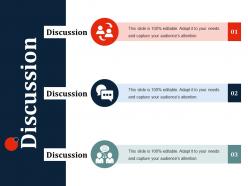
Discussion ppt slides show with all 5 slides:
Indulge in a bit of humour with our Discussion Ppt Slides Show. Drive home your ideas with a grin.
FAQs for Discussion
Key elements that make discussions effective in presentations include clear objectives, structured facilitation, active participant engagement, relevant question frameworks, and designated time boundaries. These components work together by encouraging meaningful dialogue, maintaining focus on core topics, and ensuring balanced participation, with many presenters finding that strategic question preparation and inclusive moderation techniques ultimately deliver enhanced audience understanding and stronger stakeholder buy-in.
Visual aids enhance discussion quality by clarifying complex concepts, providing shared reference points, stimulating engagement, and accommodating different learning styles. These tools streamline communication by making abstract ideas tangible, encouraging audience participation through interactive elements, and maintaining focus on key topics, ultimately delivering more productive conversations and better audience comprehension across diverse professional settings.
Effective participation strategies include open-ended questions, small group discussions, interactive polls, designated speaking opportunities, and creating psychological safety for diverse perspectives. These approaches work by reducing social barriers, accommodating different communication styles, and building engagement momentum, with many organizations finding that structured interaction techniques ultimately deliver more inclusive discussions and better collective outcomes.
Managing differing opinions effectively involves active listening, acknowledging all perspectives, establishing ground rules for respectful dialogue, finding common ground, and focusing on shared objectives rather than personal positions. These approaches streamline conflict resolution by encouraging collaborative problem-solving, maintaining professional relationships, and ultimately delivering more comprehensive solutions, with many organizations finding that structured discussion frameworks enhance decision-making outcomes.
Body language plays a crucial role in facilitating productive discussions by establishing trust, conveying engagement, and creating psychological safety through open postures, active listening cues, and mirroring behaviors. These non-verbal signals enhance communication effectiveness by reducing misunderstandings, encouraging participation, and building rapport, with many organizations finding that training teams in positive body language techniques ultimately delivers more collaborative outcomes and stronger stakeholder relationships.
Presenters can transition smoothly by summarizing key points, explicitly signaling the shift with phrases like "Now let's discuss," and posing open-ended questions that invite participation. Effective techniques include acknowledging the audience's expertise, moving physically closer to participants, and creating psychological safety through inclusive language, with many successful facilitators finding that asking for initial reactions or personal experiences generates immediate engagement and establishes collaborative momentum.
Common discussion pitfalls include dominating conversations, interrupting others, making assumptions, avoiding difficult topics, and failing to listen actively. These challenges can be avoided by establishing clear ground rules, encouraging equal participation, asking clarifying questions, and creating psychological safety, with many organizations finding that structured facilitation and active listening training ultimately enhance collaboration and decision-making outcomes.
Presenters should acknowledge the question's value, then gently redirect by connecting it to the main topic or suggesting offline discussion for detailed exploration. Effective techniques include saying "That's an interesting point that relates to our topic through..." or "Let's discuss that fascinating question after the session," which maintains audience engagement while preserving presentation flow and ensuring key messages reach all attendees within the allocated time.
Technology can foster better discussions through video conferencing platforms, collaborative whiteboards, real-time polling tools, breakout room features, and AI-powered moderation systems. These solutions enhance engagement by enabling visual collaboration, gathering instant feedback, and facilitating smaller group interactions, while many organizations find that structured digital environments ultimately deliver more inclusive participation and measurable outcomes.
Presenters can ensure effective capture through real-time documentation, designated note-takers, digital collaboration tools, visual summaries on whiteboards, and structured recap sessions. These methods streamline information retention by organizing insights systematically, facilitating immediate clarification of complex points, and creating actionable documentation, with many organizations finding that combining multiple capture techniques ultimately delivers comprehensive meeting outcomes and enhanced team alignment.
Cultural considerations for leading discussions include understanding communication styles, power distance dynamics, nonverbal cues, time orientation preferences, and conflict resolution approaches across diverse backgrounds. These factors significantly influence participation patterns, decision-making processes, and group dynamics, with many international organizations finding that culturally-aware facilitation enhances collaboration, increases engagement, and ultimately delivers more inclusive outcomes and innovative solutions.
**INPUT**: How can a presenter balance time management while promoting an engaging discussion? **OUTPUT**: Effective presenters balance time and engagement by setting clear discussion boundaries, using structured techniques like timed breakouts and focused question formats, and designating specific moments for interaction. Through strategic facilitation methods, organizations find that presenters can maintain schedule adherence while fostering meaningful participation, ultimately delivering both informative content and collaborative value that enhances audience retention and meeting effectiveness. [Word count: 60]
Effective discussion formats include panel discussions for multi-perspective topics, Q&A sessions for technical presentations, breakout groups for collaborative problem-solving, fishbowl conversations for sensitive issues, and structured debates for decision-making scenarios. These formats enhance audience engagement by encouraging active participation, facilitating knowledge exchange, and creating interactive experiences, with many organizations finding that matching format to content ultimately delivers more memorable and actionable outcomes.
Presenters can enrich discussions through storytelling by incorporating personal anecdotes, case studies, real-world scenarios, and relatable examples that make abstract concepts tangible and memorable. These narrative techniques enhance audience engagement, facilitate deeper understanding, and encourage participation, with many organizations finding that story-driven presentations generate more meaningful dialogue and strategic insights.
Metrics for assessing discussion effectiveness include audience participation rates, question quality and relevance, response engagement levels, time allocation balance, and actionable outcomes generated. Through feedback surveys, participation tracking, and follow-up assessments, organizations can measure knowledge retention, decision-making acceleration, and stakeholder buy-in, with many finding that structured evaluation frameworks ultimately enhance presentation impact and business outcomes.
-
Presentation Design is very nice, good work with the content as well.
-
Excellent Designs.