


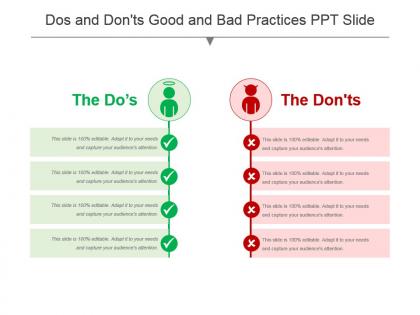
Dos and donts good and bad practices ppt slide





Try Before you Buy Download Free Sample Product
 Impress Your
 Audience
 100%
100% Editable
 Save Hours
 of Time


Appreciate efforts to do a good job with our Dos And Donts Good And Bad Practices Ppt Slide. Applaud attempts to be innovative.
People who downloaded this PowerPoint presentation also viewed the following :
Dos and donts good and bad practices ppt slide with all 5 slides:
Fasten your gaze with our Dos And Donts Good And Bad Practices Ppt Slide. Keep your eyes focused ahead.

FAQs for Dos and donts good and bad
Show up early and test your tech - trust me on this one. Dress for your audience, make eye contact, and whatever you do, don't just read off your slides. It's painful to watch. Practice out loud the day before so you're not stumbling over words. Answer questions respectfully even when they're weird or totally random. Oh, and actually stick to your time because everyone's got back-to-back meetings these days. The rehearsing thing sounds obvious but it really does make you sound way more polished.
Dude, body language literally makes or breaks presentations. I bombed a client pitch once because I was fidgeting like crazy - learned that lesson fast. Stand tall, make eye contact, move your hands when you talk. Don't be a statue behind the podium though, that's equally awkward. Walk around with purpose. Short movements work better than pacing back and forth like you're anxious. Oh, and definitely practice in front of a mirror first - you'll catch weird habits you didn't know you had. Trust me on this one.
Honestly, eye contact makes such a difference! It stops you from looking like you're just reciting to a wall. People actually feel like you're having a conversation with them instead of just... talking at them, you know? Plus it keeps everyone on their toes - nobody wants to get caught scrolling their phone when you look their way. I learned this the hard way after spending an entire presentation staring at the exit sign like an idiot. Try to hold eye contact for maybe 3-5 seconds per person or section. Don't forget the people sitting on the sides either - they always get ignored but they're paying attention too.
Okay so first thing - tell people upfront if you're taking questions during or after. When someone jumps in mid-speech, just acknowledge them but redirect like "good question, let me wrap this up first." Trust me, I had someone completely derail my whole presentation once and it was brutal. For hostile people? Stay calm and say you'll chat more afterward. Oh and always repeat their question so the back row can hear too - half the room probably missed it anyway. You're running the show, so be nice but don't let people walk all over your flow.
Just keep it simple - name, your role, and why you actually know what you're talking about. Like "I'm Sarah, I run marketing here and spent the last three years figuring out why customers stick around." Add your company if it's fancy/formal. The whole point is showing people you're worth listening to without reading your entire LinkedIn profile out loud. Nobody cares where you went to school honestly. Connect your background to whatever you're about to tell them. Short and sweet wins every time.
Only plan content for about 80% of your time slot - trust me on this one. You'll want that buffer for questions or when you inevitably go off-script. Practice with a timer first! I scribble little notes like "15 min - start section 3" to keep myself on track. Build in spots where you can skip stuff if you're running behind without it sounding weird. Oh, and finish a couple minutes early instead of rushing your ending. Your audience will love you for it and honestly? You'll look way more professional than the person frantically speed-talking through their last slide.
Don't read straight off your slides - it's so cringe. Test your tech early because Murphy's law is real with presentations. Also avoid cramming tiny text on slides that nobody can actually see from the back. Speaking too quietly is another big one. Oh and stop apologizing for being nervous! It just makes everyone notice. Practice your transitions so you're not saying "um" constantly - honestly that's what separates good speakers from awkward ones. Show up early, rehearse out loud at least once, and chill. Your audience isn't rooting against you.
Know your crowd first - that's everything. Executives want the big picture and ROI numbers, skip the technical stuff or you'll lose them. Tech people are totally different though, they'll tear you apart if you dumb things down too much. Mixed groups are honestly the trickiest - I usually start broad then go deeper for whoever wants details. Most people screw this up trying to make everyone happy at once. Ask the organizer beforehand what the audience does and what they're looking for. Oh, and definitely prep for harder questions if it's a technical crowd.
Ok so honestly, body language makes or breaks presentations. Three things that actually matter: eye contact, posture, and gestures. Look at different parts of the room - builds connection and keeps people awake. Stand with shoulders back and arms open. You'll look way more confident than you feel (trust me on this one). Your hand movements should match what you're saying, not just random flailing around. Oh, and don't pace back and forth like a caged animal - move with purpose. Match your face to your content too. Practice beforehand so it doesn't feel weird during the real thing.
Tech should help your presentation, not kill it. Simple slides work best - ditch the crazy animations and keep text minimal. Test everything beforehand because I swear, Murphy's Law lives for presentations. Your phone needs to be completely silent (not just vibrate). Practice with whatever clicker you're using so you're not clicking around like an idiot. Make fonts big enough for people in the back to actually read. Oh, and have a backup plan ready. The whole point is getting your audience focused on what you're saying, not watching you troubleshoot frozen slides for five awkward minutes.
Dude, you gotta rehearse - it's a game changer for your confidence. Practice out loud at least 3-4 times (not just thinking through it). You'll spot those weird transitions and figure out where you might trip up. Everyone runs long on their first attempt, so timing it helps too. The more you run through it, the smoother you'll sound when curveballs come up - like tech failing or random questions. Oh and honestly? Your key points will feel way more natural instead of like you're reading a script. Makes such a difference.
Here's what works for me - big fonts and way less text than you think you need. I used to jam everything onto slides and nobody paid attention to what I was actually saying. Now I stick to maybe 3 bullet points max per slide. High contrast colors are clutch, and honestly? Half the images people use are just filler anyway. Practice beforehand so you're not turning around every two seconds. Oh, and if people are reading your slides instead of listening, that's your cue you've written too much. Trust me on this one.
Oh dude, definitely look up their cultural stuff first! Eye contact rules are weird - some places it's rude, others think you're sketchy without it. Personal space varies like crazy too. I bombed a presentation in Japan because I didn't get their whole formal hierarchy thing. Also check if your jokes will actually land or just make things awkward. Religious holidays matter for scheduling, and apparently certain colors mean bad luck in some cultures? Who knew. My advice - go more formal than you think you need. Find someone local to give you the quick rundown if you can.
Honestly, stick with self-deprecating humor about your topic - way safer. Don't touch politics, religion, or anything about how people look. Major landmines there. I bombed a presentation once doing exactly that! Run your jokes by someone you trust first. Technology fails always get laughs - like when your laptop freezes right before presenting. Those universal "oh crap" moments work great. If you're second-guessing a joke even a little? Just cut it. Better to play it safe than have awkward silence in the room. Keep everything light and tied to what you're actually talking about.
Honestly, the secret is just not letting them zone out. I throw in questions every few minutes or have them turn to someone next to them - breaks up that lecture vibe. Stories beat boring statistics every time, no contest. Watch their faces though - if you're getting blank stares, switch gears fast. Move around, change your voice up, whatever keeps it fresh. Oh and give people mental breaks every 5-7 minutes or so. Their brains need it. Eye contact helps too but don't be weird about it. The moment I see people checking phones, I know it's time for audience participation.
-
Great designs, really helpful.
-
Top Quality presentations that are easily editable.