

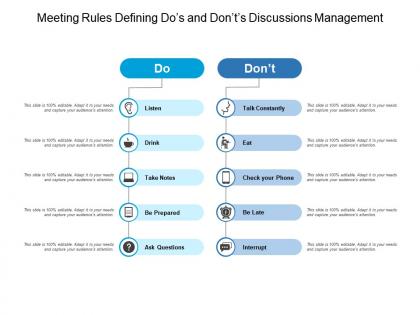
Meeting rules defining dos and donts discussions management




Try Before you Buy Download Free Sample Product
 Impress Your
 Audience
 100%
100% Editable
 Save Hours
 of Time


Effectively argue your case with our Meeting Rules Defining Dos And Donts Discussions Management. Folks are bound to give consent.
People who downloaded this PowerPoint presentation also viewed the following :
Meeting rules defining dos and donts discussions management with all 5 slides:
Add to your impressive credentials with our Meeting Rules Defining Dos And Donts Discussions Management. Improve your ability to guide folks.

FAQs for Meeting rules defining dos and
Honestly, just show up ready and actually pay attention. I always check the agenda beforehand - saves me from looking clueless when someone asks my opinion on something. Mute when you're not talking (please), and don't try multitasking because trust me, everyone knows when you're checking email. Actually contribute something useful instead of just nodding along. Quick heads up if you need to step out. Oh, and whatever you say you'll do afterward? Actually do it. The whole thing becomes so much smoother when people aren't half-checked out. Start with maybe two of these - don't overwhelm yourself.
Ugh, yeah I hate when meetings get hijacked by the same 2-3 people who love hearing themselves talk. What's worked for me is calling on specific people - like "Hey Marcus, what do you think about this?" instead of just asking if anyone has thoughts. Sometimes I'll have everyone write down ideas for a minute first, then go around the room. That way the quiet ones can't chicken out lol. Also watch body language - you'll notice people who look like they want to jump in but keep getting steamrolled. Honestly, you have to be pretty deliberate about it or the loud voices always win.
Yeah, being on time really matters - people notice when you're consistently late and it's honestly kind of disrespectful. You're basically saying their time doesn't matter as much as yours. Plus you miss all the important stuff at the beginning and then everyone has to stop and catch you up, which is awkward for everyone involved. I always try to join like 2-3 minutes early in case my wifi decides to be terrible or something. Shows you actually care about being there, you know?
Oh this used to happen to me constantly - I'd just freeze up and lose my train of thought completely. What works is acknowledging them but not stopping: "Hold that thought, let me just finish this point." Don't get defensive (easier said than done, I know). Sometimes I'll say "I'll tackle your question in a sec" then wrap up what I was saying. The trick is staying calm and actually following through - circle back with "okay, what were you thinking?" It sounds simple but honestly took me forever to get the hang of it.
Okay so first thing - make an agenda and actually follow it. Give each topic a time limit. Pick someone to be the timekeeper (trust me, this works). When people go off track, just say "let's circle back to that later" - saves so much drama. Start every meeting by going over what you're trying to get done, then wrap up with who's doing what. Oh and if someone's constantly derailing things? Don't call them out in front of everyone. Pull them aside after and have that awkward conversation privately.
Honestly, your body language is like 80% of the battle before you even open your mouth. Lean in, make eye contact, nod when people talk - suddenly everyone's way more engaged. But slouch back or scroll through your phone? You're basically telling the room this is a waste of time, and they'll match that energy instantly. I swear people are like mirrors sometimes. Even just sitting up straight with your hands on the table shows you actually care. Oh and definitely don't cross your arms - makes you look checked out. Mirror whatever vibe you want back.
Honestly, just stick with business casual for most internal stuff - khakis and a decent shirt work fine. Client meetings though? Definitely suit up. Video calls are weird because everyone's staring at your torso, so throw on something nice up top (pajama pants below are totally fair game lol). Casual Friday vibes work for team hangouts, but skip anything too revealing or with random graphics. I always go slightly overdressed if I'm unsure - better safe than sorry. Your company probably has its own vibe, so ask your manager if you're confused about specific situations.
Okay so here's the thing - use tech to actually help your meeting, not just because it's there. Screen sharing and polls are great for getting stuff done. Recording means people can actually listen instead of frantically scribbling notes. But seriously, laptops open the whole time? Energy killer. Only use devices when you actually need them for whatever you're discussing. Oh and set up shared docs ahead of time so you're not stuck doing the whole "can everyone see this?" dance for five minutes. Basically if the tech isn't helping you hit your goals, skip it.
Okay so first - test everything beforehand because tech always fails at the worst moment. Mute yourself when not talking, nobody wants to hear you chewing. Good lighting is clutch so people can actually see your face. I always join like 5 mins early but honestly? You don't need to fill every silence with small talk, it's fine to just wait quietly. Keep your camera on if you can, it really does help. Oh and look at the camera when you speak, not at yourself - I still mess this up constantly. Clean background or just blur it. Most important thing though: speak up if you can't hear someone instead of pretending you can follow along!
Dude, follow-ups literally make or break meetings. Like, without them you're just burning time talking about stuff that never happens. I always send a recap within 24 hours - people forget everything otherwise. The key is being super specific about who's doing what and when. Can't tell you how many "great" meetings I've been in that went absolutely nowhere because nobody wrote anything down after. Once you start documenting decisions and actually assigning owners with real deadlines, those conversations suddenly turn into actual progress. It's wild how much difference it makes for keeping momentum going.
Honestly, direct questions are your best bet - skip the "any thoughts?" and go straight to "Sarah, what do you think about this?" Breaking into smaller groups helps too since some people freeze up in big rooms. I always give people a heads-up before meetings like "we're covering X and I'd love your input on Y." Also - and this feels awkward at first - pause way longer after questions. People need time to think. Oh, and flip your usual order next meeting. Ask the quiet ones first before the chatty people jump in.
Honestly, you've gotta send out an agenda beforehand - like at least a day ahead. People need time to prep, otherwise you'll just have everyone staring at each other confused. Even just a basic bullet-point list works. It keeps everyone focused instead of wandering off into weird tangents (which always happens). I learned this the hard way after sitting through way too many pointless meetings that went nowhere. The agenda basically becomes your roadmap when discussions get derailed. Trust me, it's the difference between actually getting stuff done and wasting everyone's time.
Honestly, people can totally tell when you're multitasking in meetings - even on Zoom it's super obvious. Your coworkers will think you don't care about what they're saying, which is gonna hurt how they see you professionally. I've seen people get left out of big projects because they seemed checked out during meetings. It just comes across as disrespectful, you know? Everyone notices when you're scrolling or answering emails instead of listening. If something's actually urgent, just step out for a minute rather than half-assing both things at once.
Focus on process over content - that's your main job here. Ask stuff like "what else should we consider?" instead of leading questions. I know you probably have great ideas (you always do), but don't jump in with them! Just reflect back what people say without adding your spin. Use neutral language too - "some people think" works better than "the right approach is." Honestly, if you start getting emotionally invested in one solution, just step back. Your role isn't steering toward your favorite outcome. Guide the conversation so they explore everything thoroughly. Short sentences help. So does staying curious rather than pushy.
Honestly, the trick is staying out of the drama and sticking to facts, not who said what. I usually jump in with "I can see both sides here" - works like magic to cool things down. Bring it back to what you're all trying to accomplish together. Ask questions to make sure you're not having two different conversations (happens more than you'd think). Things getting messy? Call a quick break or move it offline. Don't just sit there hoping it'll fix itself - it won't. Address it directly before the whole meeting goes sideways.
No Reviews