


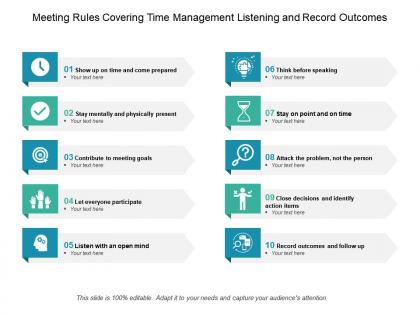
Meeting rules covering time management listening and record outcomes




Try Before you Buy Download Free Sample Product
 Impress Your
 Audience
 100%
100% Editable
 Save Hours
 of Time


Identify every ingredient with our Meeting Rules Covering Time Management Listening And Record Outcomes. Include all the information about each element.
People who downloaded this PowerPoint presentation also viewed the following :
Meeting rules covering time management listening and record outcomes with all 5 slides:
Include all the information about each element with our Meeting Rules Covering Time Management Listening And Record Outcomes. Be able to identify every ingredient.

FAQs for Meeting rules covering time management listening
You need a clear objective and time slots for each topic - seriously, without timing meetings turn into black holes. Assign someone to lead each item and put the biggest priorities first while everyone's still awake. Also specify what kind of discussion you want: are we deciding something, just sharing info, or brainstorming? Include any prep materials upfront. Send everything at least 24 hours ahead so people can actually read it and tell you if something doesn't belong. Trust me, front-loading the important stuff works way better than hoping people stay engaged for two hours.
Honestly, meetings don't have to suck if you use the right tech. Polling tools like Mentimeter are game-changers - people actually stay awake when they can vote on stuff in real-time. Miro's great for brainstorming because everyone throws ideas up at once instead of waiting their turn awkwardly. Oh, and those automated transcription tools? Life-saver. I used to miss half the meeting trying to write everything down. For virtual stuff, breakout rooms help break up the monotony. Just don't go crazy - pick one tool and get comfortable with it first.
Honestly, just start on time even if people are still trickling in - they'll figure it out fast. Send the agenda beforehand with actual times listed. I learned this the hard way after waiting around for stragglers and watching meetings turn into these endless time sucks. When you're running it, do little time checks like "10 minutes left, let's land this." Build buffer time between back-to-backs so you're not stressed. Here's the thing though - end when you said you would, period. Didn't finish everything? Whatever, schedule another meeting. People respect boundaries way more than you'd think.
Honestly? Just check if people actually do what they said they'd do afterward. That's the real test. Look at whether you made the decisions you came there to make, and if everyone knows their next steps with clear owners. Also - were people paying attention or scrolling their phones the whole time? Because engagement matters more than we admit. Track your action items over the next week or so. If stuff keeps falling through the cracks, you probably need tighter agendas and better accountability. Low follow-through usually means your meetings are too vague.
Dude, body language is honestly huge in meetings. Lean forward and make eye contact - people feel heard and actually want to participate. But cross your arms or scroll your phone? Meeting's basically dead. Your posture totally changes how people receive your ideas too. Stand confident and they'll buy what you're selling. I learned this the hard way after slouching through presentations for years lol. Try mirroring the engaged people in the room. Position yourself where you can see everyone's faces - you'll catch so many nonverbal cues that way.
Honestly, virtual meetings are tricky - you've gotta be way more deliberate about everything. First thing: make everyone turn their cameras on. Yeah, I know people hate it, but you can't read the room otherwise. Set some basic rules like muting when you're not talking and dropping questions in chat. Here's the big one though - you have to actively pull people in. Pause and actually say "what do you think about this, Sarah?" People won't just interrupt like they would sitting around a table. Oh, and always send a recap after because let's be real, half the people are probably checking email during the call anyway.
Honestly, I'd start by putting people on the spot a bit - like "Hey Sarah, what do you think about this?" Works every time. Round-robin stuff is pretty effective too where everyone has to share at least one idea. Oh, and definitely give the quiet ones a heads up beforehand so they're not caught off guard. Something like "I'll ask for your thoughts on the budget thing later." For touchy subjects, those anonymous polling apps are a lifesaver because people actually say what they're thinking. Really though, the biggest thing is just making sure nobody feels like they'll get roasted for speaking up.
Ugh, been there! I usually jump in with something like "Hold on John, let's hear what Sarah thinks about this" - works pretty well. Some people honestly have no clue they're hogging all the airtime. You could set ground rules at the start too, maybe give everyone 2 minutes to share before the free-for-all begins. Round-robin style discussions help a ton. Or just directly ask the quiet ones what they think - they're usually dying to contribute but can't find an opening. Main thing is being deliberate about making space for everyone.
Ugh, so many ways meetings go wrong! People start without any real agenda, then everything spirals into random tangents. Don't invite half the company either - honestly, most people don't need to be there anyway. The worst thing though? Ending without actual next steps. Like, what was the point then? Also skip the back-to-back scheduling - bladders exist, people need a minute to breathe between calls. Keep it tight, only bring essential folks, and always wrap up with who's doing what by when. Your team will literally love you for making meetings shorter and actually useful.
Okay so first thing - get super specific about who's doing what and by when. None of that "we should explore this" nonsense that goes nowhere. Within 24 hours, shoot everyone an email with the actual tasks and deadlines. Here's what I learned the hard way: check in before your next meeting, don't just assume people remembered. Send that summary to the whole team too, even people without tasks - keeps everyone in the loop. Honestly, most follow-up failures happen because we're too vague upfront about what we actually expect.
Dude, Calendly and When2meet are lifesavers - no more back-and-forth email hell trying to find a time that works. I personally love Notion for keeping everything organized, though honestly a simple Google Doc works too if you just need somewhere to dump agenda items and track what people need to do. Zoom and Teams are solid for the actual meetings, plus they have decent scheduling built in that most people ignore for some reason. Pick whatever and stick with it though - jumping between tools is worse than using a mediocre one consistently. Start basic with your phone's calendar app, then upgrade when you're actually bumping into limitations.
Oh totally! I started using presentation templates and meetings actually stay on topic now. Everyone's looking at the same info instead of zoning out or getting confused about what we're discussing. People remember visual stuff way better than just talking - though honestly, half my coworkers still forget everything anyway lol. The templates force me to plan ahead too, which is huge since I used to just wing it and ramble. Just throw your agenda on a slide next time. You'll notice the difference immediately.
Okay so the trick is separating what people *talked* about from what they actually *decided* - trust me, those are totally different things. Bullet points work great for discussion topics. Then highlight the real decisions with who's doing what and by when. I always bold the decisions because honestly, people will debate for hours then completely forget what they agreed on. Send it out within 24 hours while everything's still fresh in your head. Oh and here's something that saves me so much drama later - read the key decisions out loud before everyone leaves. Prevents those annoying "wait that's not what we decided" emails.
Oh man, this was such a learning curve for me too! Different cultures handle meetings completely differently. Some people are super direct and want fast decisions. Others need time to build consensus and give feedback more indirectly. You'll see it in everything - like who interrupts, how people disagree (or if they even speak up), and punctuality stuff. I'd honestly just ask your team straight up what they prefer. Maybe send agendas way earlier for people who like prep time, or leave more room for discussion if some folks need that consensus-building thing.
Oh man, feedback in meetings is a total game-changer! When people feel heard, they actually pay attention instead of mentally checking out. Quick polls work great - or even just asking "are we on track time-wise?" catches problems before they snowball. I learned this the hard way after a project went sideways because nobody spoke up about being confused. Anonymous suggestion boxes are clutch too. Honestly, picking just one feedback method per meeting makes a huge difference. Your team will thank you for it.
No Reviews