


Dos and donts to consider while appearing for group discussion




Try Before you Buy Download Free Sample Product
 Impress Your
 Audience
 100%
100% Editable
 Save Hours
 of Time


Our Dos And Donts To Consider While Appearing For Group Discussion are topically designed to provide an attractive backdrop to any subject. Use them to look like a presentation pro.
People who downloaded this PowerPoint presentation also viewed the following :
Content of this Powerpoint Presentation
Description:
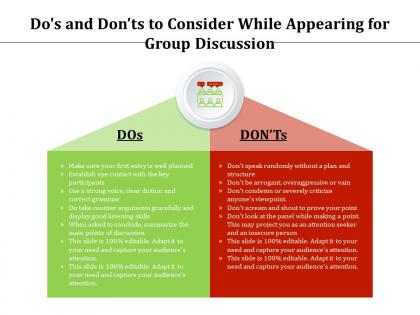
The image shows a PowerPoint slide titled "Do's and Don'ts to Consider While Appearing for Group Discussion". This slide is divided into two sections, with a green column on the left outlining the "DOs" and a red column on the right listing the "DON'Ts". Each column has bullet points with specific behaviors to adopt or avoid during a group discussion.
Under "DOs":
Plan your first entry in the discussion.
Make eye contact with key participants.
Speak with a strong voice and use correct grammar.
Handle counterarguments with grace and show good listening skills.
Summarize the main points effectively when concluding.
Under "DON'Ts":
Avoid speaking without a plan.
Don't be arrogant or overly aggressive.
Don't harshly criticize others' viewpoints.
Avoid shouting to make your point.
Don't look at the panel excessively, which can be seen as seeking attention or showing insecurity.
The slide emphasizes adaptability and capturing the audience's attention, indicating that these tips are for effective communication and presentation skills in a group discussion context.
Use Cases:
This type of slide can be useful in a variety of industries:
1. Education:
Use: Training students for group discussions and interviews.
Presenter: Career Counselor.
Audience: Students, job seekers.
2. Corporate Training:
Use: Enhancing employee communication skills.
Presenter: HR Professional.
Audience: Employees, management trainees.
3. Consulting:
Use: Preparing consultants for client workshops.
Presenter: Senior Consultant.
Audience: Consulting staff.
4. Public Relations:
Use: Media training for spokespeople.
Presenter: PR Trainer.
Audience: Company representatives, media spokespeople.
5. Healthcare:
Use: Training for patient-provider communication.
Presenter: Medical Educator.
Audience: Healthcare providers, medical staff.
6. Legal:
Use: Preparing lawyers for collaborative legal discussions.
Presenter: Senior Partner.
Audience: Lawyers, paralegals.
7. Non-Profit Sector:
Use: Building advocacy and negotiation skills.
Presenter: Advocacy Trainer.
Audience: Activists, NGO workers.
Dos and donts to consider while appearing for group discussion with all 2 slides:
Use our Dos And Donts To Consider While Appearing For Group Discussion to effectively help you save your valuable time. They are readymade to fit into any presentation structure.
FAQs for Dos and donts to consider while appearing
Honestly, good group discussions come down to actually listening and not just waiting for your turn to talk. Ask follow-up questions when someone shares something interesting. Try not to interrupt people - though I'm definitely guilty of this when I get excited lol. Watch for the quiet ones and pull them in. Someone's always got great ideas but won't speak up unless you ask directly. Stay focused instead of going off on random tangents. If you're running it, throw in quick summaries so everyone stays on the same page. It's really about creating space where the best ideas can bubble up naturally.
Honestly, you've got to be way more intentional about it. Go around the room or call on people directly - don't wait for them to jump in. I always watch body language too; if someone's leaning forward they probably want to say something but can't get a word in. It's so annoying when the same loud people dominate everything while others mentally check out. Maybe set ground rules like no interrupting, or have everyone jot down ideas first before sharing. Oh and pause frequently to ask "anyone who hasn't talked yet want to chime in?" Works every time.
So there's a bunch of ways you can jump in and help. Be the person who keeps everyone focused, or draw out the quiet people who actually have good ideas but won't speak up. Someone needs to be the timekeeper too - seriously, groups will talk in circles for hours otherwise. You could also connect different people's points together or play devil's advocate (but like, nicely). Don't feel locked into just one thing though. I usually end up switching between roles depending on what's happening. Just pick whatever feels right for your personality and what the group needs at that moment.
Honestly, body language is like 50% of communication in groups. Lean in a bit, make eye contact with whoever's talking, nod when they make good points - shows you're actually listening. Don't cross your arms or scroll your phone though, instant conversation killer. I learned this the hard way lol. Open posture works way better, and throw in some natural hand gestures when it's your turn. Match everyone's energy too. People can tell when they're being heard just from how you position yourself. Next time you're in a meeting, watch one person's movements - you'll notice so much more than you expect.
Okay so first thing - make a clear agenda and pick someone to wrangle people back on track. I always say "let's park that and circle back later" because nobody feels dismissed but you don't lose momentum. Time limits are huge, and you actually have to enforce them or people will ramble forever. Try the one-conversation rule too - no side chats while someone's talking. Honestly, those derail meetings faster than anything. When people go off on tangents (and they will), just acknowledge it quick then redirect with "so back to the main thing..." Works every time.
Honestly, the biggest thing is attacking ideas, not the person. So like "I see it differently because..." instead of "you're wrong." Let them actually finish talking before you jump in - I know it's hard when you have the perfect comeback ready! Ask stuff like "help me understand your thinking" to keep it collaborative. When things get heated, throw them a bone even if you disagree: "That's interesting, though I'd probably approach it this way..." And honestly? Sometimes you just need to suggest a bathroom break or something if it's getting too intense.
Honestly, I just take notes during the meeting so I don't look like an idiot later asking "wait, what did we actually decide?" Focus on the big stuff - recurring themes, actual decisions, who's doing what. Don't quote people word for word, just paraphrase. Group similar points together so it's not all scattered. Before wrapping up, ask if you missed anything major (people love adding "oh yeah, one more thing"). Your summary should be readable in 30 seconds max. Always confirm next steps and assignments - that's where things usually fall apart if you're not clear.
Honestly, templates are a game changer for meetings. You know how discussions can just spiral into random tangents? Having that visual structure keeps people on track. I always set up my talking points ahead of time now - saves so much headache later. Plus the quiet people on your team actually speak up more when they can see what's coming next and prep their thoughts. Even something super basic like an agenda template makes a huge difference. Trust me, your next meeting will actually get stuff done instead of being one of those "this could've been an email" situations.
Oh yeah, definitely set some ground rules first! Mute yourself when you're not talking - seriously, nobody wants to hear your dog barking or whatever's happening in the background. Try using the raise hand thing or just wait for natural breaks instead of everyone talking at once. Keep your camera on if you can since it makes everything way less awkward. I'd also pick someone to run the meeting so it doesn't turn into chaos. Oh and decide upfront if people can multitask or not - some groups are cool with it, others aren't.
Oh man, I've been there! Try calling on them directly but make it gentle - "Sarah, what do you think about this?" Works way better than waiting. Break people into smaller groups first too since some folks just freeze up in big crowds. Here's what really helps though - after you ask a question, actually wait before letting the loud ones jump in. Those quiet people? They're usually processing something really good, they just need a sec. Don't make it feel like you're putting them on the spot - more like you genuinely want their input.
Ugh, interrupting is SO tempting when you have the perfect comeback, right? But honestly, try to hold back unless it's super urgent or someone's totally hogging the conversation. Jot your idea down so you don't lose it - that's what I do. When you do need to jump in, try "Can I add something real quick?" or wait for them to breathe and say "Building on that..." If someone cuts YOU off though? Just say "Let me finish this thought" and keep rolling. Don't let them steamroll you!
Honestly, prepping beforehand makes such a huge difference. Like, you actually have stuff to contribute instead of just nodding along awkwardly. I usually spend maybe 10-15 minutes jotting down my main points and what I'm hoping we'll decide on. Makes the whole thing way more focused. Also saves everyone from those painful moments when someone asks something super basic and kills the momentum - you know what I mean? When people come ready to talk, you actually get somewhere instead of just spinning your wheels. It's kinda crazy how much smoother everything goes when you're not just winging it completely.
Oh man, timing in meetings is everything! I used to be terrible at this - would jump in way too fast. Now I pause after questions so quieter people can think. Watch for those moments when someone's trying to speak but can't get in. Also redirect the talkers who go on forever (we all know who they are lol). Set ground rules upfront about sharing airtime and stick to them. The whole point is making space where everyone feels comfortable jumping in naturally.
Talk about what they actually did, not who they are as a person. Like "you cut off Sarah twice" instead of calling them dominating. Always start with something they did well first - trust me, people tune out otherwise. I made this mistake once and the person just completely checked out on me. Ask stuff like "what would you handle differently?" so it feels more like a conversation. Don't sit on things for weeks either, that's awkward for everyone. The whole sandwich thing works but honestly? Only if you mean the nice parts, otherwise it sounds fake as hell.
Oh man, cultural differences totally flip group dynamics. Some people jump right in with ideas while others need time to think first - honestly, the quiet ones usually have the best input. You'll notice certain team members always defer to whoever's in charge, others question everything. Direct communication feels rude in some cultures but necessary in others. Try mixing things up - give processing time before expecting answers, maybe throw in some written brainstorming alongside the verbal stuff. Makes such a difference when everyone feels heard.
-
Unique design & color.
-
Colors used are bright and distinctive.