


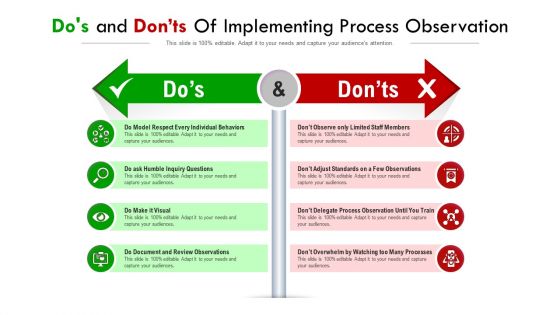
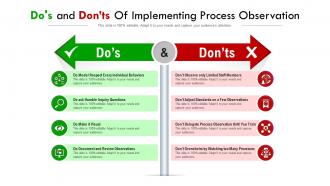
Dos and donts of implementing process observation




Try Before you Buy Download Free Sample Product
 Impress Your
 Audience
 100%
100% Editable
 Save Hours
 of Time


Our Dos And Donts Of Implementing Process Observation are topically designed to provide an attractive backdrop to any subject. Use them to look like a presentation pro.
People who downloaded this PowerPoint presentation also viewed the following :
Dos and donts of implementing process observation with all 2 slides:
Use our Dos And Donts Of Implementing Process Observation to effectively help you save your valuable time. They are readymade to fit into any presentation structure.
FAQs for Dos and donts of
You're basically trying to figure out where things are breaking down and spot ways to make stuff better. Pick a process that's been driving everyone crazy and just watch it for a week - you'll be shocked at how different reality is from what you think happens. Look for bottlenecks, mistakes that keep happening, things like that. The best part? You get actual data instead of guessing what's wrong. Once you see patterns, you can fix the real problems and maybe even find some best practices to roll out everywhere else.
Process observation is honestly a game-changer - you'll see bottlenecks and redundancies that completely disappear when you're just staring at spreadsheets. Things like people sitting around waiting for approvals, or these weird handoffs between teams that make no sense. It's wild how much time gets wasted on steps that add literally zero value. Don't jump in trying to fix stuff right away though. Just watch how things actually work versus how they're supposed to work on paper. Once you map that out, you can focus your improvements where they'll actually move the needle instead of just... I dunno, rearranging deck chairs.
Focus on cycle time, error rates, and resource utilization first - they'll show you what's really going on. Handoff delays are huge too, plus any rework that happens. I swear, every company I've worked at has some random step that just murders the whole flow. Queue times and throughput rates are also solid metrics to watch. Don't go crazy though - stick to maybe 5-7 metrics or you'll drown in spreadsheets. Start with these basics, then layer on specific stuff once you figure out your biggest pain points.
Culture totally changes how people react when you're watching their work processes. Some places are super hierarchical - people won't speak up if you're observing. Others are way more open about feedback and questions. Power dynamics matter a lot too. Like, in some cultures asking direct questions during observations feels rude, while others expect it. Oh, and communication styles are all over the place - some want sugar-coated feedback, others prefer you just tell them straight. I'd definitely spend time figuring out your company's vibe first, then adjust how you approach observations.
Honestly, just grab a pen, paper, and stopwatch first - that combo covers most of what you need. Your phone's camera works great too (just ask before recording people lol). Lucidchart is solid for mapping things out digitally. There's fancier workflow software out there, but it can get overwhelming fast. I'd skip the complex stuff initially. The whole point is watching what actually happens, not getting distracted by your tools. Start basic, then you'll figure out what's missing after doing a few observations. Sometimes the simple approach ends up being the best one anyway.
Honestly, you gotta frame this as fixing broken processes, not spying on people. Be super upfront that you're hunting for system problems, not rating anyone's work. I've watched this blow up when managers skip explaining the why. Get your team involved in planning what to observe - maybe even let volunteers go first to build trust. Timing matters too; give them some control when you can. Here's the big one though: never, ever mix this data with performance reviews. Keep those worlds totally separate. Oh, and always circle back with findings afterward. People hate feeling like lab rats.
Oh man, the worst thing you can do is rush to conclusions after like 30 minutes of watching. Take way longer than you think - at least a full cycle of whatever they're doing. And don't be that creepy person hovering behind someone's shoulder, nobody wants that energy. Write stuff down instead of trusting your brain because you'll definitely forget the good details later. Also try not to walk in thinking you already know how things should work. Save the "here's how to fix it" suggestions for after you've actually figured out what's really happening. Basically just be invisible for a while.
Honestly, watching your processes in real-time is a game changer. You'll see what's actually going down vs what you think is happening. Reports don't catch everything - sometimes you need to literally watch stuff unfold to spot the bottlenecks and weird inefficiencies. It's basically detective work but way less exciting lol. When you document what you observe, you're building solid evidence for improvements later. Problems get caught early before they blow up. Plus you'll notice opportunities that would've stayed hidden otherwise. My advice? Pick one important process and just observe it for a few rounds.
You HAVE to write everything down during process observations - don't trust your memory on this one. Get timestamps, specific behaviors, anything that looks off from normal procedures. Real-time notes are key here. I learned this the hard way when I tried remembering details later and totally blanked on important stuff. Make it objective and detailed enough so another person could picture exactly what went down. Oh, and use whatever forms your company wants - they're picky about that. Just finish writing it up within 24 hours while it's still fresh in your head.
Hit them with the big stuff first - don't make people dig through pages to find what matters. Honestly, I've read way too many reports that put me to sleep within the first paragraph. Keep it simple and give actual examples instead of fluffy observations. Different people need different approaches though. Your CEO probably just wants the highlights in an email, but the team doing the actual work? They'll need all the details plus your suggestions for fixing things. Oh, and always tell them exactly what to do next and when. Nobody wants feedback that just sits there looking pretty.
In manufacturing you're basically watching machines, workflows, and safety stuff - pretty straightforward with concrete metrics like defect rates and cycle times. Services are way trickier though. You're dealing with interactions and customer touchpoints that are super subjective. How do you even measure "good communication" consistently? Manufacturing runs continuously, but service moments happen in episodes. The whole vibe is different - one's about tangible outputs, the other's about experience quality. Honestly, I'd figure out which bucket you're in first, then build your observation approach around that. Makes the whole thing way less overwhelming.
Honestly? Monthly if you can swing it, but quarterly's the bare minimum. Processes go sideways way faster than people realize - especially with new hires or when you're rolling out different software. For stuff that's been running smooth forever, maybe you can stretch it to every 3-4 months. But here's the thing: being consistent beats being perfect every time. Oh, and write everything down right after you observe! I learned that one the hard way when I forgot half of what I noticed by the next day. Just set those calendar reminders now or you'll definitely forget.
So you'll want to get trained on observation techniques and data collection first. Learn the evaluation criteria and note-taking systems they use. Safety protocols too if that's relevant. The tricky part? Staying objective instead of judging - honestly it's brutal watching someone fumble through something you know how to do. People get super weird when they know they're being observed, so having decent people skills helps. Oh and definitely shadow someone experienced for a few sessions before they throw you in solo. Trust me on that one.
Just take whatever you're seeing in those process observations and treat it like real data - because it is. Bottlenecks that keep popping up? Communication breakdowns happening repeatedly? That stuff becomes your strategic priorities, not whatever you *thought* was important. Most strategic plans honestly just fail because they're built on assumptions instead of what's actually going down day-to-day. So challenge your current thinking with these findings. Build your improvement efforts around the biggest gaps you've documented. Oh, and make sure your metrics actually connect back to the problems you observed - otherwise you're just tracking random stuff that doesn't matter.
Get permission first - always. Tell people exactly what you're doing and why. Nobody wants some weirdo just hanging around watching them work, you know? Be totally upfront about it. Don't mess with their normal routine or make things weird. If you see sensitive stuff, keep it to yourself. This isn't about rating people's performance anyway - you're looking at processes. When you're done, actually tell them what you found out. Focus on improving systems, not calling out individuals. Pretty basic stuff but people forget sometimes.
-
Unique design & color.
-
Easy to edit slides with easy to understand instructions.
-
Amazing product with appealing content and design.