


Education timeline for self introduction presentation images




Try Before you Buy Download Free Sample Product
 Impress Your
 Audience
 100%
100% Editable
 Save Hours
 of Time


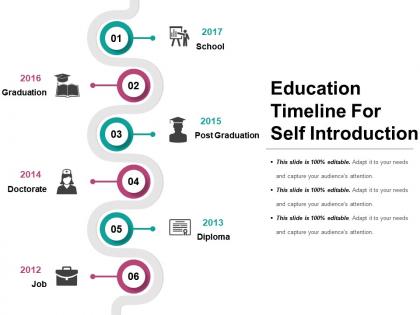
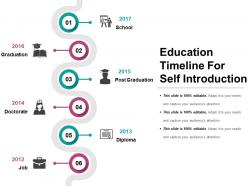
Access our education timeline for self introduction presentation image design. This PowerPoint slide has been designed creatively by our team of experienced and skilled designers for your use. You can use this PPT template to highlight information about your education in your resume and present it in an innovative way among employers. Digital resume is the new way to make an impression on the job providers as it helps to show your creative side to them. Using this presentation diagram, you can show your education timeline from your graduate school to college and even your last work experience. When you are working on the education section of your resume then it is important that you list your qualifications in order of the most recent and most relevant first. Our PowerPoint layout helps you give details about the title of your qualification, where you have studied, the grade you achieved and the date on which you achieved it. Besides this, you can also highlight details about previous employment which includes your job title, key responsibility areas, start and end dates. Build the framework with our Education Timeline For Self Introduction Presentation Images. Create a bridge to carry your thoughts across.
People who downloaded this PowerPoint presentation also viewed the following :
Education timeline for self introduction presentation images with all 5 slides:
Give your ideas a firm footing to grow with our Education Timeline For Self Introduction Presentation Images. They help fabricate a good framework.
FAQs for Education timeline for self
Okay so basically education started with ancient schools around 3000 BCE, then Greece and Rome got more organized with actual curricula. Universities popped up in medieval times - Bologna, Paris, Oxford in the 1000s. The printing press was a game changer in the 1400s for obvious reasons. Public education really took off in the 1800s, which was huge because before that only rich kids got schooling. Then the 20th century brought standardized testing (ugh). Now we're dealing with online learning and AI taking over everything. For your project, I'd focus on how tech keeps making education more accessible to regular people - that's been the biggest theme throughout history honestly.
Dude, it's wild how much has changed since we were in school! Back in the 80s/90s computers were this big novelty - maybe you'd get 30 minutes of "computer time" for basic math drills. The internet totally blew everything open in the 2000s with online courses and endless resources. COVID was honestly a mess but it forced everyone to figure out remote learning super fast. Now kids have AI tutors, take virtual field trips, and work with students across the world like it's nothing. When you're updating your curriculum though, just make sure the tech actually helps kids learn better - half of it is just shiny bells and whistles.
So basically, we're still using blueprints from thousands of years ago. Greeks invented the whole "different subjects, formal schools" thing. Romans figured out how to structure curricula by age groups - pretty smart honestly. China's examination systems? That's literally where standardized testing comes from. Crazy that we're still doing the same stuff, right? Mesopotamians and Egyptians had specialized schools for different jobs, which is why vocational programs feel so natural today. When you're designing educational stuff, it helps to know this history exists. Makes you realize why certain structures just... make sense, you know?
So the Industrial Revolution basically flipped education on its head. Public schools became a thing because factories needed workers who could read and do basic math - before that, only rich kids got schooled. The whole curriculum shifted from fancy classical stuff to practical skills that'd actually help you get a job. It's crazy how much we still organize classrooms like little factories today. Oh, and governments finally started paying for regular kids to learn instead of leaving it to wealthy families. Pretty much shaped how we think about education even now.
So basically three huge things happened. Mass public education became the norm everywhere, plus those old-school drilling methods got replaced by Dewey's "learning by doing" approach - way better honestly. Technology started creeping in toward the end too. Compulsory schooling laws finally stuck around this time. After WWII the feds got super involved with stuff like the GI Bill and pushing desegregation. Oh and here's the weird part - most "modern" teaching methods we use now? They actually started back then in the 1900s. It's like everything old becomes new again or whatever.
Look, every major crisis basically forces schools to completely reinvent themselves on the fly. World Wars turned classrooms into shelters and curriculums into propaganda machines. Then 2020 hit - honestly still can't believe how fast billions of kids went remote overnight. What's wild is how these disasters always speed up changes that were already brewing (like digital learning) but also expose how unequal access really is. Schools that bounce back best? They're the ones with backup plans and flexible setups. Because let's be real, history keeps throwing curveballs at education.
So ESSA in 2015 was huge - basically ditched No Child Left Behind and let states call their own shots on accountability. Race to the Top from 2009 was all about competitive grants and tying teacher evals to test scores (super divisive, honestly). Then COVID hit and the CARES Act plus American Rescue Plan threw tons of money at schools for tech and catching kids up. Oh, and if you're doing policy work, you'll want to really understand how ESSA shifted things back to state control - that's still driving most decisions now.
Honestly, lifelong learning isn't optional anymore if you want to stay relevant career-wise. Your degree used to be enough - get it, maybe learn some stuff on the job, then cruise to retirement. Not happening now. Technology moves so fast that skills become outdated crazy quickly. Companies are actually investing in upskilling programs because they have to, and everyone's chasing certifications left and right. The trick is making learning part of your regular routine instead of this huge overwhelming project you'll "get to someday." I mean, even my dad's taking online courses now and he's been an accountant for 20 years.
Okay so cultural stuff matters way more than people think when it comes to teaching. Like, you can't just take what works in America and drop it into a classroom in Japan - totally different ball game. Western kids are used to speaking up and debating, but in cultures that prioritize group harmony? That approach bombs hard. Your students' families, how they communicate, their views on authority - it all affects how they'll respond to your teaching style. I found this out when I tried the whole "question everything" Socratic method with kids from traditional backgrounds. Awkward silence central! Do your homework on where your students come from first, then adjust.
Hey! So education timelines are honestly all over the place depending where you are. Nordic countries let kids just play until they're 7 - which honestly makes sense to me. Meanwhile Singapore has structured academics way earlier, like 4 or 5. Germany's wild too, they split kids into vocational vs academic tracks around 10. Gap years? Totally normal in Australia, basically unheard of in East Asia. Some cultures also prioritize helping family over staying in school continuously. If you're thinking about international stuff, definitely look up their system first because what seems "normal" to us might be completely backwards there.
Ugh, the digital divide is literally splitting schools into haves and have-nots. Kids without decent internet or laptops are getting left behind hard - especially with remote learning and online assignments. We really didn't realize how unequal tech access was until COVID hit, did we? Poor students are stuck dealing with both crappy devices AND not knowing how to use them properly. Schools need to get serious about lending out equipment and fixing internet gaps. Otherwise these achievement differences just keep getting worse. It's frustrating watching this happen when the solutions aren't even that complicated.
Honestly, blended learning is huge now - kids are doing virtual museum tours from their bedrooms which is pretty wild. Your local schools probably use AI platforms that adapt to each kid's learning speed. Flipped classrooms flip everything backwards (hence the name lol) - watch lectures at home, do the "homework" part in class with teachers. Project-based stuff connects to actual real-world problems instead of random worksheets. Schools now teach mindfulness and emotional skills too. If you're looking to learn something yourself, those microlearning apps are actually decent for busy schedules.
Okay so teaching has totally changed - it used to be this one-way thing where teachers just lectured at kids who sat there quietly. Now? Way more collaborative. Teachers are more like coaches helping students figure things out instead of just dumping info on them. They're using all this tech too, which is cool but also... they're basically expected to be therapists and social workers on top of everything else. That's a lot. Anyway, if you're working with teachers just know they've got like 50 things going on, so don't make their lives harder with rigid stuff.
Dude, education's gonna be wild in the next few years. AI tutors will figure out exactly how you learn best, and VR will let you literally walk through ancient Rome for history class. Traditional degrees? They're getting replaced by these micro-credentials that actually prove you can do stuff. Remote learning stuck around after COVID - honestly wasn't surprised since it was heading that way anyway. Schools will focus way more on specific skills instead of random general knowledge. Oh, and feedback will be instant, so you'll know right away if you're getting it. Classrooms will still exist but look completely different. Start messing around with online platforms now so you're not behind later.
Honestly, knowing the education timeline is huge for curriculum planning. You can figure out what skills need to come first and spot where kids might struggle. Plus it helps with pacing - like, you'll know when they're ready for abstract concepts instead of just concrete stuff. I always map my curriculum against developmental milestones first. Cross-curricular connections become way more obvious too, which is where the real learning happens. The whole thing just makes so much more sense when you align everything with how kids actually develop cognitively.
-
Topic best represented with attractive design.
-
Informative design.
-
Easy to edit slides with easy to understand instructions.
-
Helpful product design for delivering presentation.