

Electrical maintenance contract proposal powerpoint presentation slides




Try Before you Buy Download Free Sample Product
 Impress Your
 Audience
 100%
100% Editable
 Save Hours
 of Time


Our Electrical Maintenance Contract Proposal Powerpoint Presentation Slides are topically designed to provide an attractive backdrop to any subject. Use them to look like a presentation pro.
People who downloaded this PowerPoint presentation also viewed the following :
Content of this Powerpoint Presentation
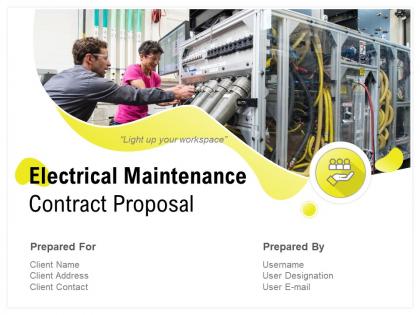
Slide 1: This slide introduces Electrical Maintenance Contract Proposal. State Client details, User details and begin.
Slide 2: This slide displays Cover Letter for Electrical Maintenance Contract Proposal
Slide 3: This slide displays Table of Content of the presentation.
Slide 4: This slide describes Project Context for Electrical Maintenance Contract Proposal.
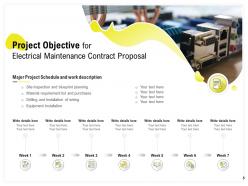
Slide 5: This slide showcases Project Objective for Electrical Maintenance Contract Proposal.
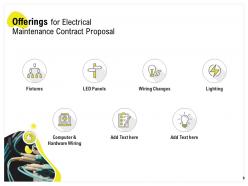
Slide 6: This slide presents Offerings for Electrical Maintenance Contract Proposal.
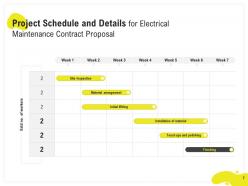
Slide 7: This slide showcases Project Schedule and Details contaning- Estd no. of workers, Site Inspection, Material arrangement, Initial Wiring, Installation of material, Touch ups and polishing, Finishing.
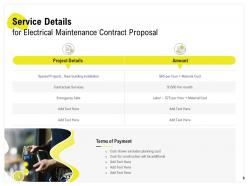
Slide 8: This slide depicts Service Details with- Project Details, Amount, Terms of Payment, Cost shown excludes planning cost, Cost for construction will be additional.
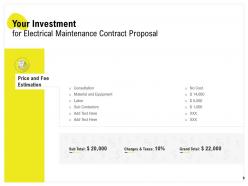
Slide 9: This slide displays Investment details.
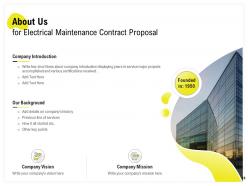
Slide 10: This is About Us slide to showcase Company specifications. Write few short lines about company introduction displaying years in service major projects accomplished and various certifications received .
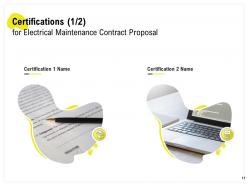
Slide 11: This slide displays Certifications.
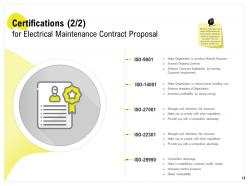
Slide 12: This slide also shows Certifications. We have listed down the major certifications wrt to the quality standards which an organization can attain. You can choose the relevant one and grey out the rest.
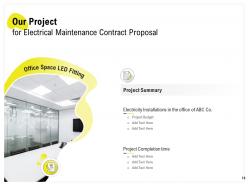
Slide 13: This slide shows Our Project with- Project Summary, Project Completion time, Project Budget.
Slide 14: This is Our Team slide. Write key credentials and major highlights of the team member”
Slide 15: This is Our Team slide. Write key credentials and major highlights of the team member”
Slide 16: This slide shows Client Testimonial with names and designations.
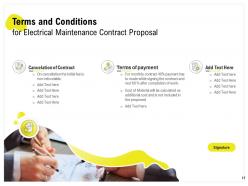
Slide 17: This slide shows Terms and Conditions.
Slide 18: This is Contact Us slide with Company address, Email ID and Company logo.
Slide 19: This is Icons Slide for Electrical Maintenance Contract Proposal.
Slide 20: This slide is titled as Additional Slides for moving forward.
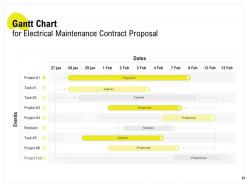
Slide 21: This slide represents Gantt Chart for Electrical Maintenance Contract Proposal
Slide 22: This slide shows Our Mission, Vision and Goal.
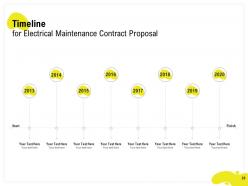
Slide 23: This slide shows Timeline process.
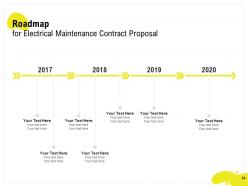
Slide 24: This slide showcases Roadmap process.
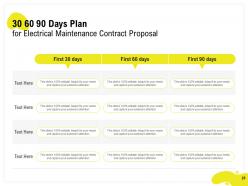
Slide 25: This is 30 60 90 Days Plan slide.
Electrical maintenance contract proposal powerpoint presentation slides with all 25 slides:
Use our Electrical Maintenance Contract Proposal Powerpoint Presentation Slides to effectively help you save your valuable time. They are readymade to fit into any presentation structure.



FAQs for Electrical maintenance contract proposal
Start with scope of work and response times - that's your foundation. Pricing is where most people screw up, so be crystal clear about hourly rates, trip charges, and after-hours stuff. Include what's covered vs. what isn't, emergency procedures, inspection schedules. Don't skip the boring stuff like liability insurance and contract length either. Oh, and if you've got good client references, definitely add those. I learned the hard way that being vague upfront just creates billing nightmares later.
Start by walking through your place and documenting everything electrical - panels, motors, lighting, whatever could break down. Prioritize based on what'll actually shut you down vs. what's just annoying. Honestly, talking to your ops team about past headaches is probably the most valuable step. They know where the real problems are. Once you've got that mapped out, figure out specific tasks and how often they need doing. Don't overthink the frequencies at first - you can always adjust. Match everything to your budget and how much risk you're comfortable with.
Start with your labor, materials, and overhead - that's your foundation. Factor in complexity, any special equipment you need, and definitely don't underestimate travel time between jobs. It adds up crazy fast. After-hours work? Charge more. Risky clients with tight SLAs? Same deal. Location matters too - some areas just cost more to service. I always pad estimates by 15-20% because something will go wrong. Trust me on that one. Price it competitive but profitable, and be super clear about what's included so you don't eat costs later.
Honestly, just track three main things: how much downtime you're preventing, what you're saving money-wise, and safety incidents. Compare your unplanned outages now vs before you started the program. Calculate savings from avoiding big equipment failures instead of just fixing stuff when it breaks - that's where the real money is. Safety numbers are huge too. Fewer electrical incidents = your program's actually working. Oh, and definitely baseline everything first or you'll have no clue if you're improving. I'd set up a monthly dashboard to watch these metrics. Don't forget energy efficiency gains either - well-maintained equipment just runs better.
So you'll need to hit the big stuff - NEC codes, local building requirements, and OSHA workplace safety rules. Make sure your contract says all work meets current codes and that their techs are actually licensed (this gets messy fast depending where you are). Don't forget liability coverage, emergency protocols, and inspection documentation. They should provide insurance and bonding proof upfront. Oh, and definitely get a lawyer to check the regulatory language before signing - I learned that one the hard way on a different project.
Dude, skip the whole "fix it when it breaks" thing - that's how you end up with expensive emergencies. Do predictive maintenance instead. Schedule your inspections during downtime like weekends so you're not stopping production. Thermal imaging catches problems early, same with vibration checks. Lockout/tagout procedures are non-negotiable, obviously. Oh and map out which systems are actually critical first - don't waste time checking random stuff when your main equipment needs attention. Build in buffer time too. Most places just wing it until something explodes, which is honestly pretty stupid.
Yeah, definitely put in workmanship warranties - usually 12 months works. Match your parts warranties to whatever the manufacturer offers. Response times are huge too. Like 4-hour emergency response, next day for regular stuff. I've watched so many deals blow up because the warranty section was super vague, so spell out exactly what you'll cover and what you won't. Performance guarantees around uptime percentages can be solid if you're confident. Just don't promise anything you can't actually pull off - missing your own deadlines is the fastest way to torch a relationship. Start conservative with timeframes you know you'll beat.
Look into what each industry actually cares about first. Manufacturing hates downtime - they'll pay good money to avoid production shutdowns. Healthcare needs bulletproof backup systems and has to follow crazy strict safety codes. Restaurants? Don't mess with their fridges, seriously - one outage and they're throwing away thousands in food. Build your pricing and response times around their pain points. Quote OSHA standards for manufacturers, FDA stuff for medical facilities. I'd start with maybe 3 industry templates you can tweak fast. Way easier than starting from scratch every time.
Honestly, tech makes or breaks electrical maintenance contracts these days. The good contractors use IoT sensors for predictive stuff - catches problems before your equipment dies on you. Real-time reporting through mobile apps means you actually know what's happening instead of waiting for some paper report. Thermal imaging is pretty slick too, though I've seen some companies go overboard with fancy gadgets they barely use. Short version: make sure their systems work with what you already have and you're not paying for unnecessary tech bells and whistles.
Okay so first thing - nail down who's responsible for what and make sure your insurance covers their minimums (usually $1M for general liability and professional). Workers' comp too if you've got staff. The real pain is getting them to agree to reasonable liability caps, especially for stuff that's totally out of your hands like sketchy existing wiring or code problems. Try to get mutual indemnification if you can swing it - honestly, big companies hate that but it's worth asking. Definitely run this by your insurance guy first though, because missing something here can absolutely wreck you financially.
Start with monthly check-ins from day one - or quarterly if it's a smaller job. After every visit, shoot them a quick update even when nothing's wrong. Trust me, clients get weird when they don't hear from you. Flag problems early before they turn into disasters, and don't sugarcoat your repair timelines. Figure out how they like to communicate too - some want emails, others prefer texts or calls. Honestly, half of good service is just staying consistent with your updates. Create a basic template so you don't forget anything important.
Dude, just bake the green stuff right into your proposal - LED swaps, smart controls, energy audits. Clients are obsessed with this ESG nonsense right now so you're golden. Regular HVAC cleaning and motor tune-ups are huge energy savers that actually make sense. Oh and definitely throw in quarterly reports showing their energy use - numbers don't lie. The whole pitch is about ROI through lower bills. Find their biggest energy hogs first, then position your maintenance as the fix that pays for itself. It's honestly pretty straightforward once you get the hang of it.
Dude, scope creep will kill you - clients always want "just one more small thing." Emergency calls turn into arguments about what counts as urgent. Parts prices jump around like crazy too. Get super specific contracts upfront, none of that vague "general maintenance" stuff. Write out exactly what emergencies you'll handle and when. Build in clauses for material cost changes because lumber isn't getting cheaper anytime soon. Document literally everything and talk money before issues blow up. Those conversations suck but they're way better than fighting later when someone's already pissed.
Start with figuring out what standards actually apply to your setup - OSHA, NFPA 70E, whatever your local codes require. Build actual checklists your techs will use, not some binder that collects dust. Training's huge, especially when rules change (which feels like constantly these days). Set up quarterly check-ins to spot issues early. Honestly, the trick is making it feel normal instead of this massive pain. Track everything too - inspectors get weirdly excited about good documentation. Makes the whole compliance thing way less stressful when it's just part of your routine.
Dude, just talk to your clients regularly - not only when stuff breaks. Most contractors suck at this so you'll stand out easily. Check in every few weeks, follow up after jobs to make sure everything's good. Be super transparent with pricing and show them exactly what you did. Oh and here's something random but it works - track their birthdays or when you finished big projects. Those little touches matter way more than you'd think. Getting ahead of problems before they turn into expensive disasters? That's how you build real trust and keep people calling you back.
-
Qualitative and comprehensive slides.
-
Thanks for all your great templates they have saved me lots of time and accelerate my presentations. Great product, keep them up!
-
Excellent design and quick turnaround.
-
Easily Editable.