


Engineering project proposal template powerpoint presentation slides





Try Before you Buy Download Free Sample Product
 Impress Your
 Audience
 100%
100% Editable
 Save Hours
 of Time


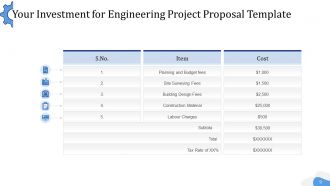
Every business needs a great architecture to establish its foundation in the marketplace. It is important to ensure an attractive and creative outlook for your company as well as a firm base and structure. Assembling an infrastructure from scratch requires a skillfully trained and professional team who knows all the essential elements needed. It completely relies on the contractor to develop an amazing super structured building. Therefore, utilize our Engineering Project Proposal Template PowerPoint Presentation Slides to propose your company's services in an alluring manner and generate more clients. Promise your clients the best service and mention your key deliverables like highly qualified human capital, a global consultancy, efficient management, and maintenance of critical infrastructure with this construction service PPT template. Use this infrastructure management PPT slide to define the scope of your services like design drafts, site survey, construction strategies, and construction documents. Employ our building project PPT layout to display the activity schedule for site survey, site preparation, site designs, construction, and technical interpretations. Highlight clearly the labour charges, planning, designing, and resources fees in a well-organized manner by taking the help of this expertly created PPT slideshow. Prove your worth to your clients by exhibiting your honour certificates for the past projects that will provide you with accreditation in the field of construction services through this visually appealing architectural service PPT proposal. Educate your audience about the additional services which you render like plant engineering service, energy modelling service, renewable energy systems, and energy auditing with the assistance of this PPT theme. Use these business development PPT graphics, to break-down the cost changing factors according to all the elements involved. Convey your mission, vision, and goals clearly and in a simplified manner with our professionally created infrastructure services PPT presentation. Download our ready-to-use Project Proposal ppt and create an informative presentation depicting your company's background, awards, and achievements.
People who downloaded this PowerPoint presentation also viewed the following :
Content of this Powerpoint Presentation
Slide 1: This slide introduces Engineering Project Proposal Template. State User name, Company name, Client name and Address.
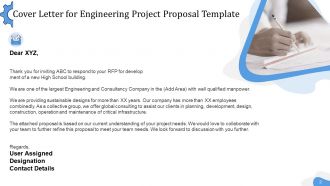
Slide 2: This slide displays Cover Letter for Engineering Project Proposal Template
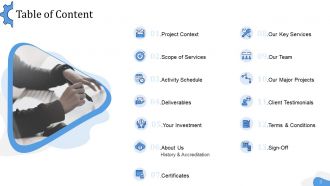
Slide 3: This slide shows Table of Content of the presentation.
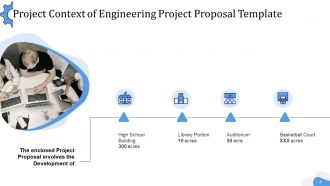
Slide 4: This slide describes Project Context of Engineering Project Proposal Template
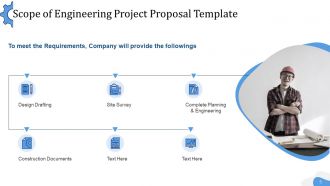
Slide 5: This slide displays Scope of Engineering Project Proposal Template
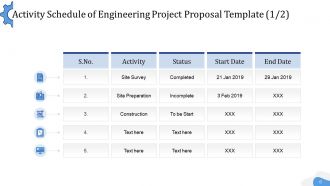
Slide 6: This slide represents Activity Schedule of Engineering Project Proposal Template.
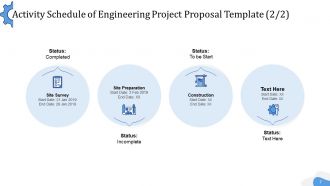
Slide 7: This slide represents Activity Schedule of Engineering Project Proposal Template.
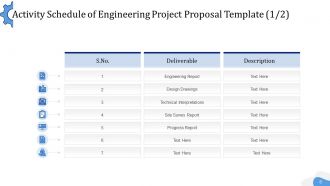
Slide 8: This slide represents Activity Schedule of Engineering Project Proposal Template.
Slide 9: This slide depicts Investment details.
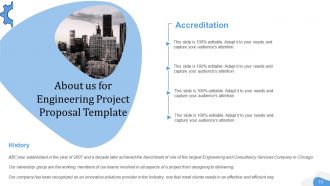
Slide 10: This is About us slide to showcase Company specifications.
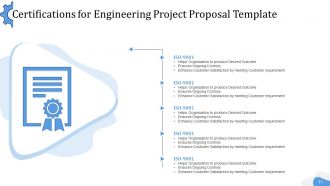
Slide 11: This slide displays Certifications for Engineering Project Proposal Template
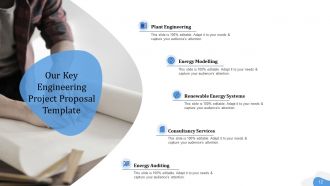
Slide 12: This slide displays Our Key Engineering Project with- Plant Engineering, Energy Modelling, Renewable Energy Systems, Consultancy Services, Energy Auditing.
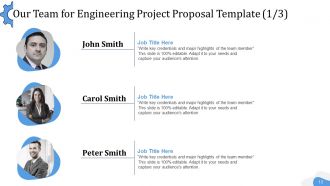
Slide 13: This is Our Team slide with Names and Designations.
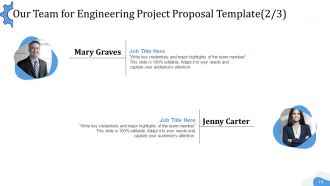
Slide 14: This is also Our Team slide with Names and Designations.
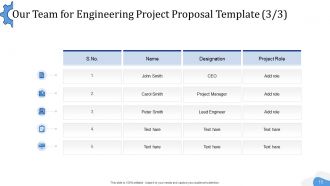
Slide 15: This is Our Team slide.
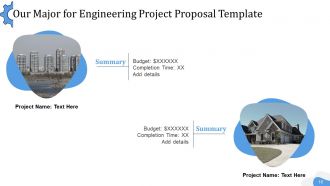
Slide 16: This slide showcases Our Major for Engineering Project Proposal Template
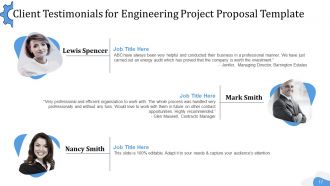
Slide 17: This slide represents Client Testimonials.
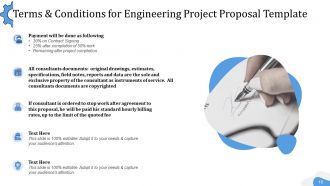
Slide 18: This slide showcases Terms & Conditions.
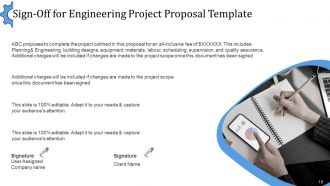
Slide 19: This is Sign-Off slide.
Slide 20: This is Contact us slide with Address, and Contact details.
Slide 21: This is Icons Slide for Engineering Project Proposal Template
Slide 22: This slide is titled as Additional Slides for moving forward.
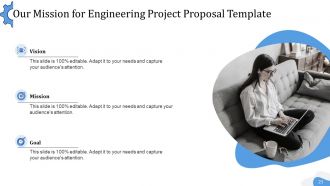
Slide 23: This is Our Mission slide with Goal, Vision and Mission.
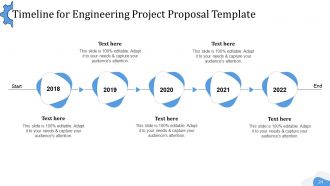
Slide 24: This slide shows Timeline process.
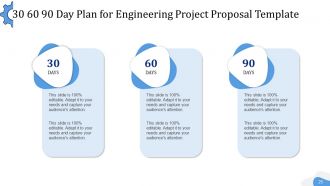
Slide 25: This is 30 60 90 Day Plan slide.
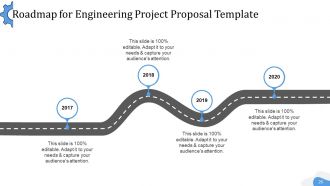
Slide 26: This slide displays Roadmap process.
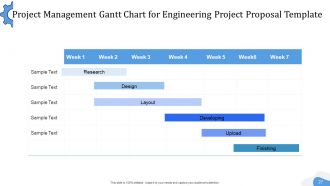
Slide 27: This slide shows Project Management Gantt Chart.
Engineering project proposal template powerpoint presentation slides with all 27 slides:
Use our Engineering Project Proposal Template Powerpoint Presentation Slides to effectively help you save your valuable time. They are readymade to fit into any presentation structure.
FAQs for Engineering project proposal template
Hit the basics first: project overview, technical approach, timeline with milestones, and resource needs (people, equipment, money). Risk assessment is huge - honestly wish I'd learned that earlier. Throw in a background section if your stakeholders aren't super familiar with the project. Success criteria are clutch so everyone agrees on what "finished" actually means. Oh, and don't forget deliverables. I'd start simple with a one-page template, then beef it up based on how complex your project gets. Way easier than starting with some massive template you'll never use.
Honestly, templates are lifesavers because they force you to hit all the boring but necessary stuff - budget, timeline, deliverables, you know the drill. Without one you'll either ramble forever or forget something obvious that makes you look unprofessional. I've watched great ideas tank just because the presentation was messy. The consistent formatting also makes your whole team look like they have their act together. Think of it like training wheels - once you get the hang of structuring proposals, it becomes automatic. Grab a basic template and tweak it based on what actually gets approved in your company.
Your exec summary is basically what makes or breaks the whole thing - decision-makers read it first and honestly, sometimes it's all they'll read. Pack everything important into 1-2 pages max: what you're doing, why it matters, timeline, budget. I always write mine last even though it goes up front (weird but it works). Make it punchy enough that someone could skip the rest and still get your whole pitch. It's kinda like writing a movie trailer that has to sell the entire film. If this section doesn't grab them, you're probably screwed regardless of how brilliant the rest is.
Honestly, visuals are a game-changer for proposals. People skim everything anyway, so charts and diagrams actually get looked at while text blocks get ignored. Timeline charts beat paragraph explanations every time. Budget breakdowns are way clearer as graphs than buried in sentences. I always throw in workflow diagrams and site photos too – makes complex stuff instantly understandable. Just don't go overboard with decorative nonsense. Each visual should actually help your case, not just fill space. Makes the reviewer's life easier, which is really what you want.
Definitely go with a Gantt chart or timeline - people eat that visual stuff up. Don't just say "development: 3 months" though. Break it down with real deliverables and actual dates. I learned the hard way to always pad your estimates by like 15-20% because literally everything takes longer than you think it will. Show the dependencies too so everyone knows what might screw things up. Oh, and mark those client approval points clearly - you don't want them surprised when you need sign-offs. Just keep it realistic enough that your team won't hate you later.
So for your proposal, split costs into these main buckets: personnel (salaries, benefits, contractors), equipment/materials, software licenses, and testing. Travel too if you're doing site visits - that gets expensive quick. Honestly, the contingency fund is crucial - budget 10-15% extra because projects never go perfectly. Separate your one-time purchases from ongoing costs, and be super clear about your timeline since that drives labor expenses. You want enough detail so people get it, but don't go crazy with every tiny line item or you'll lose them.
Put a risk section right after your project scope - seriously, don't hide it in the back where no one looks. Create a simple matrix showing probability vs impact, then list how you'll actually tackle each big risk. Timeline, budget, and tech issues are good starting points since they mess with every project. The trick is getting specific about your solutions, not just pointing out problems. Oh, and make sure those mitigation costs show up in your budget too. Reviewers eat that stuff up.
Don't dumb down the technical stuff - your audience already knows their IEEE 802.11 standards from basic "wireless protocols." Be specific with metrics and methodologies. I've watched proposals crash because they either oversimplified everything or went completely overboard with jargon (both are annoying). Focus on quantifiable outcomes and real implementation details instead of marketing BS. Your technical audience wants to see you actually get the complexity. Oh, and include proper risk assessments - that's huge. Write like you're talking to other engineers, not pitching to the C-suite. They'll appreciate the straight technical talk.
Yeah, you really can't wing this one - different audiences want completely different things. Clients care about ROI and how you'll fix their problems. Grant committees? They're all about technical merit and whether your budget makes sense. I made this mistake once submitting a super client-focused proposal to researchers (so embarrassing). Your whole tone needs to shift depending on who's reading. Even the order of sections should change based on what they actually care about. Honestly, just spend ten minutes googling what that specific group usually funds before you start writing.
Honestly, just start with Word or Google Docs - they handle technical stuff fine and your team probably already knows them. Notion's pretty cool if you want reusable blocks and better collaboration. I've watched people waste weeks researching the "perfect" proposal software when Word would've worked perfectly. LaTeX is overkill unless you're doing something super complex. Oh, and Canva can make your proposals look way less boring if that matters to clients. Don't overthink it - use what you've got first, then upgrade if it's actually holding you back.
Mix hard numbers with softer stuff that actually matters to your project. Timeline hits, budget staying on track, user adoption - those are your bread and butter metrics. But don't forget stakeholder happiness and whether you're dodging risks properly. Make everything super specific though, none of that fluffy "we improved things" nonsense. Each metric needs a starting point and target, plus you gotta explain how you'll track it. Honestly, I've watched so many good projects tank because their metrics were way too vague. Pick maybe 3-5 that really prove you solved what you said you'd solve.
Here's the thing - don't just list what your project does. Show them why they should care about it. Start with the actual problem you're fixing, then hit them with real numbers if you've got them. I swear, half the proposals I see read like instruction manuals instead of making a case. Tell it like a story: here's what sucks now, here's how I'll fix it, here's what happens after. Oh, and be super clear about what you're asking for. Give them obvious next steps so they don't have to guess what you need from them. Address the big concerns upfront too.
Number your sections and make the flow logical - exec summary, problem, solution, timeline, budget, team stuff. Don't use boring headers like "Section 3." Call it "Technical Approach" or whatever makes sense. Reviewers are rushing through tons of these things. Page numbers and a table of contents help, even for short proposals. Each section should work on its own since different people read different parts. Oh, and your exec summary? Two pages max. Pack all your best selling points up front - that's honestly where you'll win or lose most of the time.
Honestly, the worst thing you can do is be vague about your tech approach. Reviewers want specifics, not "we'll design a solution" BS. Also don't promise crazy timelines - I've seen people say they'll build everything in 6 weeks which just screams amateur hour. Your team needs to actually match what they're asking for, and yeah, do the risk assessment even though it's boring. Oh and please don't use the same template for everyone. Spend that extra day customizing it. Makes a huge difference, trust me.
Honestly, just bake feedback tracking into your proposal process right from the start. I keep a shared doc (way better than digging through emails forever) where our whole team dumps reviewer comments, rejection reasons, client questions - whatever comes back. Short sentences work. Then every few months we'll sit down and look for patterns, update our templates based on what we're seeing. Don't wait for rejections to start paying attention to this stuff. Track everything and your win rate will get better pretty quickly - I've seen it happen.
-
Attractive design and informative presentation.
-
Much better than the original! Thanks for the quick turnaround.
-
Understandable and informative presentation.