


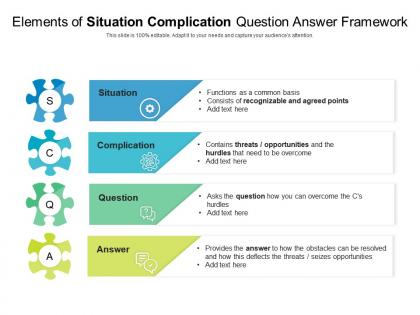
Elements of situation complication question answer framework




Try Before you Buy Download Free Sample Product
 Impress Your
 Audience
 100%
100% Editable
 Save Hours
 of Time


Our Elements Of Situation Complication Question Answer Framework are topically designed to provide an attractive backdrop to any subject. Use them to look like a presentation pro.
People who downloaded this PowerPoint presentation also viewed the following :
Elements of situation complication question answer framework with all 2 slides:
Use our Elements Of Situation Complication Question Answer Framework to effectively help you save your valuable time. They are readymade to fit into any presentation structure.
FAQs for Elements of situation complication
So SCR is basically storytelling for work stuff. Start with Situation - just paint the picture of what's happening now. Then hit them with the Complication, which is whatever problem popped up that needs fixing. Resolution is where you drop your actual solution. Honestly, it works way better than just diving into your idea cold. People need that setup first or they won't get why they should care. I've been using it for project proposals and even random emails when I need buy-in. Sounds kinda formulaic but it actually makes everything clearer. Try it next time you're pitching something.
Honestly, SCR is a game changer for presentations. Start with the situation - like what's happening in your business right now. Then hit them with the complication, which is basically the messy problem you're dealing with. Finally, boom - here's how we fixed it (the resolution). Your audience actually follows along instead of zoning out during another boring slide deck. Movies work the same way, right? There's always setup, conflict, then payoff. I started doing this with my quarterly reviews and people actually stay awake now lol. Next time you're prepping slides, just think: context first, then the drama, then how you saved the day.
Honestly, SCR is a game-changer for organizing messy info. You dump everything into three buckets: what's happening (Situation), what's broken (Complication), and how to fix it (Resolution). No more word vomit everywhere. Your audience can actually follow your thinking instead of getting lost in random details. I used to ramble through updates until I started this - now people know exactly where I'm heading. Think of it like telling a story with purpose. The whole thing builds toward your solution naturally. Next time you're prepping a project update, give it a shot. You'll wonder why you ever did it differently.
Okay so the "situation" part is basically just describing what's happening right now - the current state that everyone already knows and accepts as fact. Don't make it dramatic yet! You're literally just setting up the scene before you drop the bomb. I see people mess this up all the time by jumping straight into problems. But you want your audience nodding along like "yeah, that's exactly how things are." Keep it neutral and factual. Once you've got that solid foundation down, the complication you reveal next will pack way more punch. It's kinda like building up suspense in a good story.
You've got to make the problem feel urgent and real. Don't just say "sales are down" - get specific like "sales dropped 23% in Q3, putting us $2M behind target." That hits different, right? Use transitions like "but here's the problem" or "what we discovered was" to create that pivot moment. Show the gap between where you are vs where you need to be with actual data. Then paint the picture of what happens if nothing changes. Honestly, I think too many people stay vague here when concrete consequences are what really grab attention. End with stating exactly what needs to shift.
So basically, SCR throws you right into the drama instead of building up to it slowly. You skip all that background setup stuff and jump straight to the problem that creates tension. Traditional stories take forever developing characters and setting the scene - honestly, ain't nobody got time for that in business presentations. With SCR, you're assuming people already know the context. Just get to the point, hit them with the complication, then wrap it up fast. It's perfect when you need to grab attention quickly without boring everyone to death with unnecessary details.
Look, if your audience checks out mentally, your whole thing crumbles. They need to actually care about the problem you're setting up, feel that tension when things get complicated, and want to hear your solution. Miss any of those beats and it's like - you know when someone tells a story but skips the important part? Yeah, that. The cool thing is this framework matches how our brains naturally work through problems anyway. Just watch faces in the room. If people look confused or bored, slow down before jumping to your next point. You'll know pretty quick if they're following.
Honestly, visuals can make your SCR framework way more compelling if you do it right. Start with charts or data diagrams for the Situation part - show where things stand now. Complication is where you want those dramatic before/after shots or problem visuals that really hit people. For Resolution, go with process flows or timelines to map out your solution. One thing though - don't go overboard. I'd stick to one solid visual per section max, and make sure they're actually doing work, not just looking pretty. Keep them clean and tied directly to what you're saying.
Honestly, most people mess up by flying through the Situation part. You need to set up context or nobody cares about your problem. Then they make the Complication super vague - like, pick ONE issue, not five different disasters (I've watched so many presentations crash and burn this way). Your Resolution has to actually solve the specific problem you just described. Don't randomly pivot to some other solution. Oh, and here's the thing that drives me crazy - spending 15 minutes on setup then blazing through the actual answer in 30 seconds. People showed up for your solution, so don't shortchange that part.
Yeah, it's super flexible actually. Start by figuring out what your typical "situations" look like in your field - so like patient symptoms in healthcare, or bugs/user complaints in tech. The tricky part (complication) works the same everywhere, but you'll want to customize the resolution bit for whatever processes your industry actually uses. I've honestly seen this thing work in manufacturing, education, you name it. Keep that three-step structure but just swap in examples that make sense to your team. Oh and definitely use language they'll actually connect with - don't make it sound all corporate-y or people will zone out.
Oh totally! SCR works great for pitches. So you'd frame their current situation as the "Situation" part, then all their pain points become the "Complication," and boom - your solution is the "Resolution." People actually respond way better to stories than boring feature dumps (learned this the hard way lol). Paint where they're at now first. Then dive into what's going wrong or what they're missing out on. Finally hit them with your solution as the obvious fix. Honestly beats other sales frameworks by a mile - feels way more natural when you're presenting.
Honestly, you'll know if SCR worked by watching people's faces. During the setup, look for nods - are they following? When you drop the complication, people should literally lean forward if it's good. Then see how they react to your solution. I always ask something direct afterward like "does this actually make sense for your situation?" because sometimes you can just tell when people are lost. The real test though? Whether they bring up your ideas in later conversations or actually use what you suggested. That's when you know it stuck.
Oh totally! The iPhone launch is probably the best example - Jobs basically went "smartphones are trash, they're all clunky with those awful tiny keyboards, boom here's the iPhone with a touchscreen." Netflix presentations about ditching DVDs for streaming work really well too. Companies use it all the time for crisis stuff, like explaining how they dealt with data breaches. Honestly, once you notice it you can't unsee it. Go back and watch any TED talk you liked - I bet you'll spot it immediately. It's wild how common this pattern actually is.
Honestly, peer feedback is a game-changer for SCR stories. Other people catch stuff you're totally blind to - like when your complication sounds weak or your resolution doesn't actually fix anything. I've definitely been saved from awkward rambling presentations because someone pointed out my story made zero sense to fresh ears. Here's the thing though - don't just ask "what do you think?" You'll get useless feedback. Ask specific stuff like "does this complication feel urgent enough?" or "is my resolution too vague?" Way better responses that way. Trust me on this one.
Honestly, whatever you've got works fine - PowerPoint, Google Slides, Keynote, they're all pretty much the same for SCR stuff. The framework's more about how you organize things anyway. I usually just grab a clean template and make sure the three sections are super obvious. Oh, and if you're like me and need to think through the logic first? Miro's actually clutch for mapping everything out before you even touch slides. Some friends swear by Prezi because it's more "story-like," but I think that's kinda overkill. Good headings and smooth transitions beat fancy animations every time. Just pick whatever doesn't make you want to pull your hair out and focus on getting that situation-complication-resolution thing right.
-
Easy to edit slides with easy to understand instructions.