

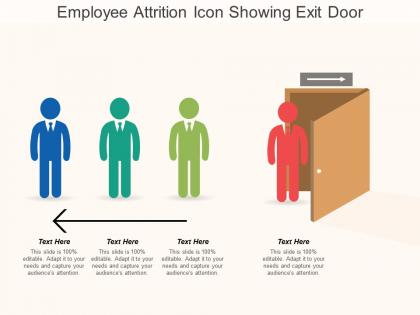
Employee attrition icon showing exit door




Try Before you Buy Download Free Sample Product
 Impress Your
 Audience
 100%
100% Editable
 Save Hours
 of Time


Bolster your company's image. Employee Attrition Icon Showing Exit Door are a fast affordable way to lend high design to your business presentations.
People who downloaded this PowerPoint presentation also viewed the following :
Employee attrition icon showing exit door with all 5 slides:
Impress folks with your inherent cleverness through our Employee Attrition Icon Showing Exit Door. It helps display your ingenuity.




FAQs for Employee attrition icon
Primary causes of employee attrition include inadequate compensation, limited career advancement opportunities, poor work-life balance, insufficient recognition, and toxic workplace culture. These factors significantly impact retention across industries, with healthcare facilities experiencing burnout-related departures, tech companies losing talent to competitive offers, and retail organizations struggling with scheduling flexibility, ultimately driving increased recruitment costs and operational disruptions.
Organizations can identify early warning signs through declining performance metrics, reduced engagement in meetings, decreased collaboration with colleagues, increased absenteeism patterns, and changes in communication frequency. Through predictive analytics and regular pulse surveys, companies in sectors like retail and healthcare track these indicators, enabling proactive retention strategies that reduce turnover costs and maintain institutional knowledge.
Company culture significantly influences retention by shaping workplace environment, employee engagement, leadership practices, communication standards, and career development opportunities. Organizations with positive cultures experience lower turnover through enhanced job satisfaction, stronger team cohesion, and improved work-life balance, with many companies finding that investing in culture delivers competitive advantage and reduced recruitment costs.
Leadership styles significantly impact attrition through communication approaches, decision-making processes, recognition practices, and team development strategies. Autocratic leadership often increases turnover in creative sectors, while transformational leadership reduces attrition in technology and healthcare organizations by fostering engagement, career growth opportunities, and psychological safety, ultimately delivering stronger retention rates and improved team performance.
Effective retention strategies include competitive compensation packages, flexible work arrangements, professional development opportunities, recognition programs, and transparent communication channels. These approaches enhance engagement by addressing career growth, work-life balance, and job satisfaction, with many organizations finding that strategic combinations of these elements significantly reduce turnover while building stronger, more committed teams.
Exit interviews should include structured questions about management quality, career development opportunities, compensation satisfaction, work-life balance, and organizational culture, using both rating scales and open-ended discussions. Many companies find that conducting these interviews with HR rather than direct supervisors encourages more honest feedback, ultimately delivering actionable insights for retention strategies and workplace improvements.
Organizations should track turnover rate, time-to-fill positions, exit interview feedback, employee engagement scores, and cost-per-hire metrics to effectively monitor attrition patterns. These measurements enable companies to identify retention challenges early, streamline recruitment processes, and enhance workplace satisfaction, with many finding that proactive monitoring ultimately delivers reduced hiring costs and improved organizational stability.
Employee attrition disrupts team dynamics through knowledge loss, decreased morale, and increased workloads for remaining staff, while creating communication gaps and reduced collaboration. Organizations experience declining productivity, higher recruitment costs, and compromised customer service quality, with many companies finding that retention strategies focusing on engagement, career development, and competitive compensation ultimately deliver stronger team cohesion and sustained performance.
High employee attrition creates significant financial burdens through recruitment costs, training expenses, lost productivity, knowledge transfer gaps, and reduced operational efficiency. These costs often reach 50-200% of departed employees' salaries, with sectors like healthcare and technology experiencing particularly steep impacts, while businesses increasingly recognize that retention investments deliver substantially better returns than constant rehiring cycles.
Effective onboarding processes can be improved through comprehensive orientation programs, structured mentorship systems, clear role expectations, regular check-ins, and skills development opportunities. Organizations increasingly find that extending onboarding beyond the first week, incorporating feedback mechanisms, and connecting new hires with company culture ultimately reduces early turnover while enhancing long-term employee engagement and productivity.
Remote work significantly reduces employee attrition by enhancing work-life balance, eliminating commute stress, and providing greater flexibility, though it can increase turnover when workers feel isolated or disconnected. Many organizations find that hybrid models deliver optimal retention rates, with companies like tech firms and financial services seeing 20-30% lower attrition while maintaining productivity and employee satisfaction.
Feedback mechanisms enable organizations to identify attrition risks through regular pulse surveys, exit interviews, stay interviews, and performance discussions that reveal employee concerns early. By systematically analyzing feedback patterns, companies can address workplace issues, improve management practices, and enhance career development opportunities before valuable talent decides to leave, ultimately reducing turnover costs and maintaining institutional knowledge.
Career development opportunities play a crucial role in reducing employee turnover by enhancing job satisfaction, increasing employee engagement, and providing clear advancement pathways that retain top talent. Organizations investing in training programs, mentorship initiatives, and skill development find significantly lower attrition rates, ultimately delivering improved retention and competitive advantage in talent acquisition.
Organizations can tailor compensation packages by conducting market benchmarking, offering performance-based bonuses, providing equity participation, implementing flexible benefits, and creating clear advancement pathways. Companies in tech and finance increasingly combine competitive base salaries with stock options, professional development budgets, and personalized perks, ultimately delivering retention rates above industry averages while attracting high-caliber talent.
Diversity and inclusion initiatives significantly enhance employee retention by creating inclusive cultures, reducing workplace discrimination, improving career advancement opportunities, and fostering psychological safety. Organizations implementing comprehensive D&I programs often experience 22% lower turnover rates, with employees from underrepresented groups finding greater engagement, belonging, and long-term career satisfaction.
-
Professional and unique presentations.
-
Use of icon with content is very relateable, informative and appealing.