

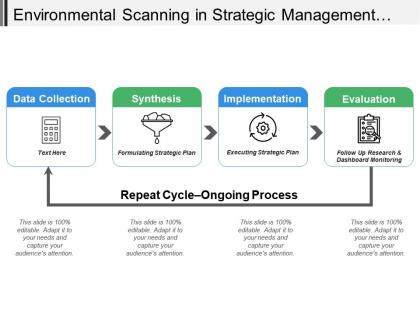
Environmental scanning in strategic management data collection and synthesis




Try Before you Buy Download Free Sample Product
 Impress Your
 Audience
 100%
100% Editable
 Save Hours
 of Time


Display customer friendliness with our Environmental Scanning In Strategic Management Data Collection And Synthesis. They establish your actual concern.
People who downloaded this PowerPoint presentation also viewed the following :
Environmental scanning in strategic management data collection and synthesis with all 5 slides:
Get intensely involved with our Environmental Scanning In Strategic Management Data Collection And Synthesis. Delve deep into the details of any investment.



FAQs for Environmental scanning in strategic management data
Key components of an effective environmental scanning process include systematic data collection, trend analysis, stakeholder mapping, competitive intelligence gathering, and regular monitoring cycles. These elements work together by identifying emerging opportunities and threats, analyzing market shifts and regulatory changes, and enabling proactive strategic planning, with many organizations finding that comprehensive scanning delivers enhanced decision-making and sustained competitive advantage.
Environmental scanning enhances strategic planning by identifying emerging trends, competitive threats, regulatory changes, and market opportunities before they fully materialize. Through systematic monitoring of external factors, organizations can anticipate shifts in consumer behavior, technology adoption, and industry dynamics, ultimately enabling proactive decision-making and sustainable competitive advantage in increasingly volatile markets.
**INPUT**: What tools and techniques are commonly used for conducting environmental scans? **OUTPUT**: Environmental scanning tools include PESTLE analysis, competitor intelligence platforms, trend monitoring software, stakeholder surveys, and scenario planning frameworks. These techniques streamline strategic planning by identifying market shifts, regulatory changes, and emerging opportunities, with many organizations finding that systematic environmental scanning delivers enhanced competitive positioning and proactive decision-making capabilities. **Word count: 50 words**
Organizations effectively monitor external environmental changes through systematic environmental scanning, competitive intelligence gathering, stakeholder feedback analysis, trend monitoring systems, and regular SWOT assessments. These approaches enable businesses to track regulatory shifts, market dynamics, and emerging technologies across sectors like healthcare, finance, and retail, ultimately delivering strategic foresight and competitive advantage in an increasingly volatile business landscape.
Technology revolutionizes environmental scanning through artificial intelligence, data analytics, social media monitoring, automated news aggregation, and predictive modeling tools. These technologies streamline information gathering by processing vast datasets, identifying emerging trends, and delivering real-time insights, with many organizations finding that automated scanning enables faster strategic responses and competitive advantage.
Organizations balance proactive and reactive environmental scanning by establishing continuous monitoring systems alongside rapid response capabilities, integrating predictive analytics with real-time threat assessment. This strategic combination enables companies to anticipate market shifts while maintaining agility for unexpected disruptions, with many financial services and retail organizations finding that dual-approach frameworks deliver both competitive foresight and crisis resilience.
Stakeholder feedback can be integrated through structured surveys, focus groups, advisory panels, regular consultation meetings, and digital feedback platforms that capture diverse perspectives on emerging trends. These engagement mechanisms enable organizations to identify blind spots, validate assumptions, and gain early insights into market shifts, regulatory changes, and competitive dynamics, ultimately enhancing strategic decision-making and environmental awareness.
Cultural factors significantly influence environmental scanning by shaping how organizations interpret data, prioritize threats and opportunities, and make strategic decisions based on local values, communication styles, and business practices. Companies operating globally find that cultural context affects scanning focus areas, with organizations in relationship-focused cultures emphasizing stakeholder dynamics while task-oriented cultures prioritize competitive intelligence, ultimately requiring culturally-adapted scanning approaches for accurate strategic insights.
PESTLE analysis provides a structured framework for environmental scanning by systematically examining Political, Economic, Social, Technological, Legal, and Environmental factors that impact business operations. This comprehensive approach enables organizations to identify emerging opportunities, anticipate regulatory changes, and assess market shifts, ultimately delivering strategic insights that enhance competitive positioning and inform long-term planning decisions.
Small businesses can implement environmental scanning through cost-effective methods like monitoring industry publications, utilizing free government databases, engaging with local business networks, and leveraging social media insights. While resource constraints present challenges, many small retailers, service providers, and manufacturing firms find that systematic competitor observation, customer feedback analysis, and trend monitoring through digital tools ultimately deliver strategic awareness and competitive positioning essential for sustainable growth.
Environmental scanning contributes to risk management by identifying emerging threats, monitoring regulatory changes, tracking competitive movements, and detecting market shifts before they impact operations. Through systematic analysis of political, economic, social, and technological factors, organizations can develop proactive mitigation strategies, enhance contingency planning, and maintain competitive positioning, with many companies finding that early threat detection significantly reduces potential business disruptions.
Global trends significantly influence local environmental scanning by requiring organizations to monitor international developments, regulatory changes, technological innovations, and economic shifts that impact local markets. Companies increasingly integrate global intelligence with local insights, adapting international best practices while addressing regional specifics, ultimately delivering more comprehensive strategic planning and competitive advantage in interconnected business environments.
Environmental scanning presents ethical considerations including data privacy protection, transparent information gathering practices, respect for competitive boundaries, accurate analysis without bias, and responsible use of collected intelligence. Organizations must balance comprehensive market research with ethical data collection methods, ensuring they respect stakeholder privacy and intellectual property rights while maintaining competitive advantage through legitimate environmental monitoring and strategic analysis.
Social media enables effective environmental scanning by providing real-time market intelligence, customer sentiment analysis, competitor monitoring, and emerging trend identification across multiple platforms simultaneously. Through automated monitoring tools and strategic hashtag tracking, organizations can detect shifting consumer preferences, regulatory discussions, and industry disruptions early, while gaining competitive insights that inform strategic planning and risk management decisions.
Common pitfalls include focusing too narrowly on immediate competitors, relying on outdated data sources, overlooking emerging technologies, ignoring regulatory changes, and failing to involve diverse stakeholders. These oversights often lead organizations to miss critical market shifts, technological disruptions, or regulatory developments, with many companies finding that systematic scanning processes across multiple timeframes and sectors deliver more comprehensive strategic insights.
-
Awesome use of colors and designs in product templates.
-
Visually stunning presentation, love the content.