

ESG Sustainability Powerpoint Ppt Template Bundles





Try Before you Buy Download Free Sample Product
 Impress Your
 Audience
 100%
100% Editable
 Save Hours
 of Time


Our ESG Sustainability Powerpoint Ppt Template Bundles are topically designed to provide an attractive backdrop to any subject. Use them to look like a presentation pro.
People who downloaded this PowerPoint presentation also viewed the following :
Content of this Powerpoint Presentation
Slide 1: This slide introduces ESG Sustainability. State your company name and begin.
Slide 2: This slide shows Three pillars of ESG sustainability for businesses.
Slide 3: This slide presents ESG sustainability communication strategies to enhance investor interest.
Slide 4: This slide displays Steps to implement ESG sustainability framework.
Slide 5: This slide represents ESG sustainability framework in financial institutions.
Slide 6: This slide showcases KPI’s to measure ESG sustainability in organizations.
Slide 7: This slide shows ESG sustainability framework to enhance automation process.
Slide 8: This slide presents ESG sustainability for banking industry.
Slide 9: This slide displays Applications of ESG sustainability in real estate.
Slide 10: This slide represents Different elements for ESG sustainability framework.
Slide 11: This slide showcases Best practices for corporate ESG sustainability.
Slide 12: This slide shows ESG sustainability governance for credit approval.
Slide 13: This slide presents ESG sustainability reporting and data challenges.
Slide 14: This slide represents ESG sustainability icon for corporate governance.
Slide 15: This slide showcases ESG sustainability icon to enhance business productivity.
Slide 16: This slide shows ESG sustainability dashboard icon to measure business performance.
Slide 17: This is a Thank You slide with address, contact numbers and email address.
ESG Sustainability Powerpoint Ppt Template Bundles with all 25 slides:
Use our ESG Sustainability Powerpoint Ppt Template Bundles to effectively help you save your valuable time. They are readymade to fit into any presentation structure.
-

ESG Sustainability
-

Three pillars of ESG sustainability for businesses
-

ESG sustainability communication strategies to enhance investor interest
-
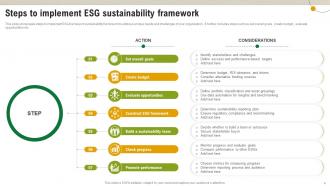
Steps to implement ESG sustainability framework
-

ESG sustainability framework in financial institutions
-

KPI s to measure ESG sustainability in organizations
-

ESG sustainability framework to enhance automation process
-

ESG sustainability for banking industry
-

Applications of ESG sustainability in real estate
-

Different elements for ESG sustainability framework
-

Best practices for corporate ESG sustainability
-

ESG sustainability governance for credit approval
-

ESG sustainability reporting and data challenges
-

ESG sustainability icon for corporate governance
-

ESG sustainability icon to enhance business productivity
-

ESG sustainability dashboard icon to measure business performance
-

Thanks for watching
-

-

-

-

-

-

-

-

FAQs for ESG Sustainability Powerpoint
So it's Environmental, Social, and Governance - whoever named it wasn't feeling creative that day lol. Environmental is your climate stuff, waste, resource use. Social covers how you treat people - employees, communities, diversity initiatives. Governance deals with leadership structure and being transparent about decisions. Here's the thing though - you don't need to tackle everything at once. Most companies do materiality assessments first to figure out what actually matters for their industry. I'd honestly start there and map out which issues your stakeholders care about most. Way less overwhelming that way.
Start with GRI, SASB, or TCFD frameworks - they're your best bet for structure that stakeholders actually care about. Track the obvious stuff like carbon emissions, energy use, diversity numbers, and board makeup. Then add qualitative things like governance policies and community programs. Pick what makes sense for your industry though. Manufacturing companies obsess over environmental metrics way more than tech firms do, obviously. Get your baseline numbers first, then track quarterly. Third-party verification helps if you can swing it. Honestly, don't go crazy trying to measure everything - start with 5-10 key metrics that matter most to your specific risks and build from there.
Look, transparency is what makes or breaks your ESG credibility. Nobody's gonna trust claims they can't actually verify, right? Share your data openly - the good AND the ugly stuff. That's how people know you're not just bullshitting them. Greenwashing scandals? Yeah, those happen when companies hide too much. Be detailed about your sustainability metrics and get third-party verification. Even admit your failures - honestly, that builds more trust than pretending everything's perfect. Oh, and audit what ESG info you're sharing now. Figure out what gaps might be making people suspicious of you.
First thing - map out your whole supply chain so you can spot the risky areas and ESG issues at each level. Getting suppliers to actually care is honestly the trickiest part, but build sustainability requirements right into your contracts and vendor selection process. Smaller suppliers might need some hand-holding with training. Use scorecards to track who's improving and who's dragging their feet. I'd focus on your biggest suppliers first since they have the most impact anyway. Don't try to fix everything at once - you'll burn out fast.
Honestly, ESG is tough for small businesses - you don't have those fancy sustainability teams that big companies throw money at. Your already swamped staff has to figure it out while juggling everything else. Budgets are tight, so investing in green tech or reporting systems? Yeah, good luck with that. The frameworks are confusing as hell too, and there's barely any guidance for smaller operations. Sometimes I think they design this stuff just for Fortune 500s. Here's what actually works: pick one area you care about that makes business sense, then slowly expand. Don't try to boil the ocean right away.
Look, ESG stuff does pay off financially, just not right away. Most companies see real returns after 2-3 years - patience is key here. Better operations, lower risks, and investors are literally throwing money at sustainable businesses right now. Plus you get perks like cheaper loans, people actually stick around longer, and customers trust your brand more. Honestly, the hardest part is proving it to skeptical executives. Track your financial numbers alongside ESG metrics so you can show the actual connection when presenting to stakeholders.
Look, most people think ESG is just feel-good marketing BS, but honestly? It's about avoiding actual business risks. Yeah, everyone focuses on the environmental part, but the social and governance stuff can make or break your reputation too. The cost thing drives me crazy - sure, there's upfront investment, but you usually save money down the road through better efficiency. Small businesses think it's only for big corporations. Not true. You don't need a whole department for this stuff. Just figure out what ESG factors actually matter for your specific industry and start there.
Dude, tech is completely changing how companies handle ESG stuff. AI tracks carbon footprints instantly now. Blockchain verifies if your supply chain is actually ethical - no more BS claims. Those awful manual compliance reports? Gone. Automated platforms do it all. Satellites can literally spot deforestation from space, which is pretty wild if you think about it. Your stakeholders get live dashboards showing real impact data instead of waiting for yearly reports. Honestly beats the hell out of Excel spreadsheets. You should check out some automated ESG platforms before your next reporting cycle.
Honestly, stakeholders run the whole ESG show. Investors are throwing crazy money at companies with solid environmental and social policies. Customers will drop brands instantly over sustainability drama - I've seen entire boycotts blow up over packaging choices. Your employees care too, especially younger ones who want meaningful work. Then you've got regulators breathing down everyone's necks with new rules constantly. Here's what I'd do: figure out which stakeholders matter most to your company first. Listen to what they're actually asking for, not what you think they want. Their pressure is what drives real change.
Honestly, people can spot fake green marketing instantly these days. Pick your best wins first - like actual data showing waste reduction or real community projects. Don't just slap "eco-friendly" everywhere without proof. Social media and your website are perfect for sharing these stories, but make them concrete. Certifications help too. I mean, I've watched companies get absolutely roasted online for vague sustainability claims! Tell stories that connect to stuff people genuinely care about. Maybe start by looking at what you're already doing right and build from there.
Honestly, the biggest thing hitting right now is mandatory disclosure. Companies can't just talk a good game anymore - EU's CSRD and SEC climate rules are forcing them to actually report real ESG data. Standardized frameworks are finally happening too, so no more cherry-picking whatever metrics look best. Double materiality is getting big (assessing both financial risks AND your impact on society/environment). Oh, and supply chain due diligence requirements keep expanding globally. My advice? Start collecting actual data now because the voluntary reporting era is basically over.
So investors use ESG scores to check out companies before they invest - it's like doing your homework on environmental stuff, how they treat people, and whether management's sketchy. Some folks avoid entire industries they hate (oil companies, whatever), others hunt for well-run businesses that might crush it long-term. Wall Street's totally jumped on this bandwagon now too. Honestly, I'd focus on companies improving their ESG game over time instead of chasing perfect scores. That shows they actually care rather than just checking boxes.
Look, NGOs have credibility you just can't fake - they know their stuff when it comes to social and environmental issues. They've already got the community connections and data you'd need. Way better than trying to DIY it and coming off like you're just ticking boxes (which honestly happens a lot). These partnerships help you dodge reputation landmines too. Oh, and their research capabilities are solid. Don't go after every NGO out there though - find ones that actually match your specific ESG goals. Makes the whole thing feel more genuine.
Skip the boring PowerPoint decks - nobody remembers those anyway. Map out how each team actually affects your ESG stuff, then build workshops around their real daily decisions. Hands-on simulations work way better than lectures. Try lunch-and-learns with actual case studies, or honestly? Gamify it with team challenges. People need to see how their specific job connects to environmental impact, not just hear generic sustainability talk. Give them clear metrics to track and celebrate the wins publicly. That's how you get momentum going instead of just checking a training box.
Get independent auditors who know sustainability stuff - they'll spot the BS that companies try to hide. Cross-check their data from multiple sources and make sure they're using the same methods year over year. Companies love cherry-picking the good numbers while burying the bad ones, which honestly drives me crazy. Check if their goals are actually specific with real deadlines, not just fluffy promises. Their latest sustainability report is your starting point - compare it against GRI or SASB frameworks. Also look for consistent patterns across reporting periods. Third-party verification is key here.
-
The slides are remarkable with creative designs and interesting information. I am pleased to see how functional and adaptive the design is. Would highly recommend this purchase!
-
SlideTeam is my one-stop destination for templates. Highly recommended!