


Essential phases of audit process powerpoint slide





Try Before you Buy Download Free Sample Product
 Impress Your
 Audience
 100%
100% Editable
 Save Hours
 of Time


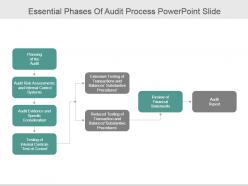
Our Essential Phases Of Audit Process Powerpoint Slide facilitate appropriate action. Be able to face emerging competition.
People who downloaded this PowerPoint presentation also viewed the following :
Essential phases of audit process powerpoint slide with all 5 slides:
Our Essential Phases Of Audit Process Powerpoint Slide include contemporary fashions. Advise folks on current haute couture.




FAQs for Essential phases of audit
The audit planning phase aims to assess risk and establish scope, the fieldwork phase focuses on evidence gathering and testing controls, while the reporting phase communicates findings and recommendations to stakeholders. These phases work together by ensuring systematic risk evaluation, thorough documentation, and clear communication of audit results, with many organizations finding that structured phase management ultimately delivers enhanced transparency, regulatory compliance, and improved operational controls.
Audit scope is determined by assessing risk levels, regulatory requirements, materiality thresholds, and organizational priorities during planning. Auditors analyze previous findings, stakeholder concerns, and business operations to define coverage areas, with many organizations finding that strategic scope definition streamlines the process, reduces costs, and delivers more targeted insights for operational improvements.
Risk assessment guides audit planning by identifying areas with higher likelihood of material misstatements, errors, or compliance issues, enabling auditors to allocate resources strategically and focus testing procedures effectively. Through systematic evaluation of internal controls, financial processes, and operational environments, organizations streamline audit efficiency while enhancing detection capabilities, ultimately delivering more targeted assurance and stronger financial reporting accuracy.
Materiality in auditing represents the threshold above which misstatements could influence economic decisions of financial statement users, typically calculated as a percentage of key benchmarks like net income or total assets. Auditors apply materiality by establishing planning materiality for overall audit scope, performance materiality for individual procedures, and specific materiality for particular account balances, ultimately enabling more efficient resource allocation while maintaining audit effectiveness and regulatory compliance.
Essential components of an effective audit plan include risk assessment, scope definition, resource allocation, timeline development, and compliance requirements evaluation. These elements work together by identifying potential issues early, establishing clear boundaries and expectations, and ensuring adequate staffing and expertise, ultimately delivering thorough coverage while minimizing disruptions to business operations.
Auditors gather evidence through substantive testing, analytical procedures, inspection of documents, physical observation, and third-party confirmations. These methods enable comprehensive risk assessment, transaction verification, and control evaluation across financial statements, with many accounting firms finding that combining multiple evidence-gathering techniques ultimately delivers more reliable audit conclusions and enhanced client assurance.
Fieldwork challenges include incomplete documentation, limited staff availability, system access restrictions, time constraints, and resistance to information requests. These obstacles can be mitigated through thorough pre-audit planning, establishing clear communication protocols with client teams, securing necessary system permissions in advance, and maintaining flexible scheduling approaches, ultimately ensuring comprehensive audit coverage while minimizing operational disruptions.
Common techniques for evaluating internal controls include inquiry and observation, walkthrough procedures, control testing, documentation review, and analytical procedures. These methods enable auditors to assess control design and operating effectiveness by examining segregation of duties, authorization processes, and monitoring activities, with many organizations finding that comprehensive control evaluation ultimately delivers enhanced risk management and regulatory compliance.
Auditors should document findings through standardized working papers, detailed evidence matrices, risk assessment summaries, and comprehensive audit trails that support conclusions. Best practices include maintaining contemporaneous documentation, cross-referencing evidence sources, using consistent formatting templates, and ensuring findings are clearly linked to audit objectives, with many firms finding that structured documentation protocols significantly enhance audit quality and regulatory compliance.
The reporting phase involves drafting findings, reviewing conclusions with management, incorporating client feedback, finalizing the audit report, and presenting recommendations to stakeholders. Through comprehensive documentation and clear communication, auditors deliver actionable insights, regulatory compliance assurance, and strategic recommendations, with many organizations finding that well-structured audit reports ultimately enhance operational transparency and decision-making processes.
Auditors ensure compliance by conducting comprehensive risk assessments, performing detailed testing procedures, reviewing internal controls, and maintaining thorough documentation throughout the audit process. Through systematic verification methods, organizations across industries like banking, healthcare, and manufacturing can identify gaps, streamline regulatory adherence, and ultimately deliver enhanced transparency while minimizing compliance risks.
Interim communications should include progress updates, preliminary findings, emerging risks, schedule changes, and requests for additional documentation or clarification from management. These strategic touchpoints enable auditors to address concerns early, maintain stakeholder engagement, and ensure transparency throughout the process, with many organizations finding that regular communication ultimately streamlines final reporting and enhances audit effectiveness.
Audit findings can be effectively communicated to non-technical stakeholders through visual presentations, executive summaries with clear risk ratings, simplified language that avoids technical jargon, and actionable recommendations with business impact assessments. These communication strategies enable management teams across finance, operations, and leadership to understand compliance gaps, resource requirements, and implementation timelines, ultimately delivering organizational transparency and informed decision-making capabilities.
Post-audit follow-up actions include developing corrective action plans, implementing recommended improvements, monitoring compliance with new procedures, scheduling follow-up reviews, and communicating results to stakeholders. These activities ensure audit findings translate into operational enhancements, with many organizations finding that systematic follow-up processes ultimately deliver sustained compliance improvements and stronger internal controls.
Technology has transformed the audit process through automated data collection, AI-powered risk assessment, cloud-based collaboration platforms, and real-time analytics tools. These innovations streamline audit workflows by reducing manual tasks, enhancing accuracy, and enabling continuous monitoring, with many financial institutions and corporations finding that digital audits deliver faster completion times and improved compliance transparency.
-
Visually stunning presentation, love the content.
-
Content of slide is easy to understand and edit.