


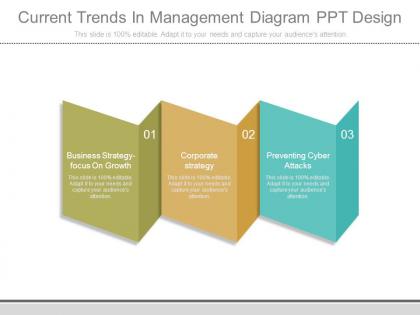
Current trends in management diagram ppt design




Try Before you Buy Download Free Sample Product
 Impress Your
 Audience
 100%
100% Editable
 Save Hours
 of Time


Familiarize yourself with any aspect you desire through our Current Trends In Management Diagram Ppt Design. You will find it highly informative.
People who downloaded this PowerPoint presentation also viewed the following :
Current trends in management diagram ppt design with all 7 slides:
Identify innermost desires with our Current Trends In Management Diagram Ppt Design. Find out their basic driving force.

FAQs for Current trends in management
So async communication is basically taking over everywhere now. Companies are finally getting decent virtual tools (thank god), and people work whenever they're actually productive instead of pretending to be busy from 9-5. AI tracking productivity too, which is kinda weird but whatever. Honestly? People are way more productive when they can skip pointless meetings and work during their good hours. You just gotta be super clear about when people need to respond to stuff. Maybe look at what you're doing now - like, does everything really need a Slack ping immediately? Probably not.
Look for actual problems AI can fix first - don't just jump on the hype train. Small pilots work best. Try data analysis or customer service stuff before going big. Getting your team comfortable is huge though. People freak out thinking they'll get replaced by robots, which honestly I get. Train managers to see AI as a teammate, not competition. Oh and definitely pick one process to test properly first. Measure what happens, then expand if it works. I've seen too many companies try to do everything at once and just create chaos.
Honestly, taking care of your employees isn't just being nice anymore - it's smart business. Burnout kills productivity and makes people quit. The data backs this up completely. Companies doing mental health support, flexible schedules, actual work-life balance? They're seeing way better retention and performance. I know it sounds soft, but the numbers don't lie. Higher engagement across the board when people aren't stressed out of their minds. Simple first step - just ask your team how they're actually doing and what would help. You'd be surprised what you learn.
Look, people won't innovate if they're terrified of getting canned for trying something different. Start by actually celebrating smart failures - not just the wins. I've watched so many companies talk a big game about wanting innovation, then lose their minds over every mistake. Give teams real time and budget to mess around with ideas that might flop. Quick prototyping helps too. But honestly? The biggest thing is leading by example - admit when your own stuff doesn't work out. Maybe start small with dedicated innovation hours or throw different departments together for brainstorming sessions.
Honestly, ditch the whole "culture fit" thing - it's usually just code for hiring people who remind you of yourself. Start by actually seeking out diverse candidates instead of posting jobs and hoping. When interviewing, remove the bias wherever you can. Make sure everyone gets heard in meetings by mixing up who speaks first. Call out microaggressions when they happen (awkward but necessary). Set up mentorship between diverse team members and leadership. Oh, and make your promotion criteria crystal clear so there's no guessing games. Track everything with real numbers because otherwise you're just pretending to care.
Agile turns those old-school hierarchies upside down. Cross-functional teams basically run themselves now and make decisions right where the action is. Managers? They're more like coaches removing roadblocks instead of barking orders - though honestly, some of them hate this change. Short feedback loops replaced those dreaded yearly reviews too. Oh, and forget controlling every little process. It's all about enabling your people now. When you're leading, ask yourself what's blocking your team instead of micromanaging their tasks. Way better results that way.
Look, data-driven decisions just mean you stop guessing and start using actual numbers to back up your choices. You'll spot problems way earlier this way. Plus when you need to explain why you did something to your boss, you've got real evidence instead of just "it felt right." I mean, gut instinct has its place but data is so much more convincing. Start small though - pick one thing you can easily track and see how those insights change your next few moves. Once you get the hang of it, you'll wonder how you ever managed without looking at the numbers first. It really does make resource allocation way smarter too.
Honestly, you've gotta run two timelines at once. Map out your quarterly goals that build toward your bigger 2-3 year vision. Then do monthly check-ins to catch yourself before short-term wins totally hijack your long-term plans - I've watched so many teams fall into this trap! The trick is actually protecting time for future stuff even when everything's on fire right now. Maybe try the 80/20 rule? Like, dedicate 20% of your team's time to strategic projects that won't pay off this quarter but will set you up way better for next year.
Honestly, start with the boring stuff - make sure everyone knows who's doing what and how you're all gonna talk to each other. I've watched so many teams implode because Bob thought Sarah was handling the deadline while Sarah was on vacation lol. Regular check-ins are clutch, but keep them short or people zone out. Pick tools everyone will actually use (sorry IT, nobody likes your ancient software). Map out who needs stuff from who first - sounds tedious but it saves your sanity later. Most important thing? People gotta feel safe calling out problems without getting their heads bitten off.
Honestly, this whole sustainability thing is making managers rethink everything - no more just hitting those quarterly targets. Now you're weighing environmental impact on literally every choice, from suppliers to HR policies. It's kinda overwhelming at first, not gonna lie. But here's the thing - customers and employees actually expect this stuff now. Your planning gets way more complicated since you're juggling profit with doing good. Oh, and everyone wants to see your numbers on both fronts. My advice? Find one green initiative that cuts costs. Makes it so much easier to get buy-in from the higher-ups.
Honestly, you've gotta nail digital literacy and adaptability first - like, there's no getting around it anymore. Emotional intelligence is massive too since you're basically shepherding people through chaos 24/7. Get solid with data analysis because "I have a feeling" doesn't cut it in meetings anymore lol. Communication skills are clutch, especially the virtual stuff - so many leaders still suck at this. Here's the thing though: you can't wait for things to make sense before making decisions. Ambiguity is just the reality now. Pick whichever area feels like your biggest weakness and actually work on it this quarter.
Look, people hate change when they don't get the reasoning behind it. So walk them through the big picture first, then get specific about how it impacts their actual work. Don't just blast out one announcement email - that never works. Mix it up with team meetings, quick one-on-ones, whatever. Give people space to ask questions and actually voice their concerns. The repetition thing is huge too. I swear, most leaders think they can explain something once and everyone magically gets it. Let people process and push back a bit - that's how you know they're actually engaged with what you're trying to do.
Honestly, flexible work makes a huge difference for keeping people around. Your team feels way more trusted when they can control their schedule and location. Job satisfaction goes through the roof. Plus retention gets so much better - nobody wants to leave once they've tasted that work-life balance freedom. Going back to commuting every day after remote work? Hard pass. Just make sure you're crystal clear about deadlines and how you'll stay in touch. That way people stay productive but aren't micromanaged. Trust me, it's worth the adjustment period.
Honestly, start with figuring out what's driving you crazy communication-wise first. Slack or Teams work great for quick back-and-forth stuff. For tracking projects, Asana's pretty solid - way better than endless email chains about who's doing what. Video calls are obviously everywhere now (remember when we all had no clue how to mute ourselves?). The trick is finding tools that don't make your team want to throw their laptops out the window. Cloud docs are a game-changer too - no more "final_version_ACTUAL_final.docx" nightmares. Don't overthink it though. Pick simple solutions that solve your actual problems.
Honestly, it's all about how different each generation communicates at work. Boomers want those formal meetings and structured processes. Meanwhile Gen Z expects instant feedback through Slack or whatever. Millennials are somewhere in the middle but they're really big on work-life balance - can't blame them there. Gen X just wants to do their job without unnecessary complications, which I totally get. You'll need to switch up your approach depending on who you're dealing with. Best thing? Just ask each person how they like getting feedback instead of guessing based on their age.
-
Graphics are very appealing to eyes.
-
Very unique and reliable designs.