


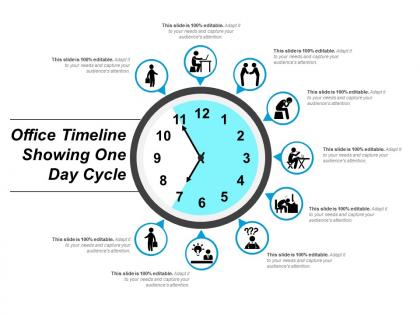
Office timeline showing one day cycle




Try Before you Buy Download Free Sample Product
 Impress Your
 Audience
 100%
100% Editable
 Save Hours
 of Time


Bait your audience with our Office Timeline Showing One Day Cycle. They will bite the hook of your ideas in large numbers.
People who downloaded this PowerPoint presentation also viewed the following :
Office timeline showing one day cycle with all 5 slides:
Our Office Timeline Showing One Day Cycle will depict you the best. They will be forced to hand pick you..
FAQs for Office timeline showing
Okay so for a one-day cycle, I'd start with morning standup, then do a mid-morning check-in. Obviously lunch break in there somewhere! After that, maybe an afternoon status thing and wrap up at the end with deliverables review. Space them out evenly so people don't feel like you're breathing down their necks - that's the worst. Build in some buffer time too because stuff always goes sideways. Each milestone should have a point, not just exist for the sake of it. Honestly, I'd map this to when your team actually has energy and tweak from there.
Honestly, visuals are game-changers for one-day timelines. People can instantly see how morning stuff connects to what happens later, instead of trudging through boring bullet points. I'm talking simple flowcharts, progress bars, even just a timeline with little icons - anything beats a wall of text. Your audience will actually spot problems like bottlenecks or weird gaps they'd totally miss otherwise. Oh, and here's what works for me: sketch it out first, then think about what someone would need to see to immediately go "ah, got it." Trust me, the visual approach saves everyone time.
Software dev, e-commerce, and content creation see the biggest payoff from daily releases. Makes sense since speed = money in those spaces. SaaS teams fix bugs instantly, online stores pivot with market shifts, news sites stay ahead of competitors. Manufacturing works too, but honestly only for expensive, small-batch stuff. Here's the thing - your industry has to prioritize speed over perfection. If you're building planes or drugs where screw-ups kill people, daily cycles will bite you. The real question? Does shipping faster actually matter to your customers, or are you just chasing the latest trend?
Pick your start time based on when your most important stuff actually happens - like when people show up, operations start, whatever matters most. End it 24 hours later at that same time. Midnight to midnight sounds nice and clean, but honestly it's not always practical depending on what you're measuring. The big thing is staying consistent though. If you start at 6am on day one, you gotta end at 6am the next day or your data's gonna be weird. Choose times that match how things actually work, not just what looks good on a spreadsheet.
Honestly, I'd just use Lucidchart or Miro - you can drag stuff around super easily when things inevitably change. Google Sheets works too if you're more of a spreadsheet person. PowerPoint has decent timeline templates that'll work in a pinch. Here's what I always do: block out your big stuff first, then squeeze the smaller tasks around them. Trust me, your day's gonna shift no matter how perfectly you plan it, so pick something where you can move things around quickly. Actually, I spent way too much time once making this gorgeous timeline that I never even followed lol.
Ugh, the worst thing you can do is pack everything in too tight - you'll be stressed and miss stuff. Always add buffer time because literally everything takes longer than you think it will. I learned this the hard way lol. Make your checkpoints flexible too since priorities change constantly throughout the day. Oh and define what "finished" actually means for each thing you're doing, otherwise you'll just confuse yourself later. My trick? Map out the must-do items first, then squeeze the other stuff around those.
Oh man, time zones are such a pain for daily cycles! What I'd do is map out when everyone's actually available first - like who's a morning person vs night owl. Then stagger your check-ins instead of forcing everyone into one slot. Maybe do morning standups for your US folks, afternoon updates for Europe, whatever works. The annoying part? You'll have to document way more than usual so people can catch up async. Shared boards help tons though - keeps progress visible even when half the team's asleep. Just focus on keeping that feedback loop tight somehow, even if it's not real-time.
Honestly, time management makes or breaks your whole day plan. Track how you actually spend time for a few days first - you'll be shocked where hours disappear. We all suck at estimating how long stuff takes, so build in buffer time for random interruptions. Match your hardest tasks to when your brain works best. Like, I'm useless after 3pm for anything requiring real focus. Map out your natural energy dips and peaks against what needs doing. Otherwise you're just setting yourself up to feel behind all day.
Honestly, I'd start with a quick morning call to align on priorities - nothing fancy, just 15 minutes max. Throughout the day, use shared docs or polls so people can drop feedback without scheduling another damn meeting. Around midday, do a fast checkpoint to see if you're still on track or need to pivot. The trick is setting specific windows for input and actually sticking to them. Otherwise you'll get random feedback at 4pm that derails everything. Wrap up with a brief session to show what got done and grab any final thoughts. Makes stakeholders feel heard without killing your momentum.
Honestly, I just check if I knocked out my three big things by EOD - that's what actually matters. Did your energy match up with what you planned? Most people totally bomb this part at first lol. Quick reality check: were your time guesses way off, or did you cram too much stuff in? Before bed I'll do like a 2-minute mental recap of what went sideways and why. Tomorrow you can tweak things based on how today actually went. Don't aim for perfect - just figure out what you can realistically handle.
So basically you want a transformation story that happens in just one day. Start with their normal morning routine, then throw in some disruption or big decision they have to make. The cool thing about the single-day format is it creates this natural pressure - like they can't just sleep on it, you know? Follow them through how they react and change throughout the day. It's kind of like a mini hero's journey but way more focused. Some really great short films do this exact thing. By nighttime, they should be in a completely different headspace than where they started. The tight timeline forces you to cut all the fluff and just hit the important moments.
Honestly, color choice makes a huge difference in how urgent your timeline feels. Bright reds scream "important deadline!" while blues feel way more chill and steady. I'd go with bold fonts for the big milestones, but don't go crazy - too many font changes just looks sloppy. You could try darker colors for morning tasks when energy's high, then maybe softer tones for those afternoon slumps (we all have them). Keep it simple though - pick 2 or 3 colors max and stick with them. Light fonts work fine for background stuff that doesn't need attention.
Tech companies are the obvious ones - they do daily sprints where devs push out features or fixes constantly. News orgs work perfectly since they're already on 24-hour cycles anyway. Digital marketing agencies crush it too because social content has to respond to trends instantly. Oh, and e-commerce companies use daily cycles for inventory stuff and promos. Honestly, it only works when you're dealing with digital-first work where you can actually finish something meaningful in a day. Maybe try sketching out what you could realistically complete daily with your current projects?
Don't save feedback for the end - weave it right into your daily cycle. Do quick 5-minute check-ins when you naturally transition between stuff: after morning planning, midday progress checks, end-of-day wrap-ups. Keep it stupid simple though - nobody wants another boring survey to fill out. Just ask "what's working, what sucks?" or throw up a quick poll. The whole point is grabbing those thoughts while they're still hot in people's minds. Then you can actually tweak tomorrow based on what you learned today instead of flying blind.
Honestly, go digital. You can update stuff instantly and share changes with everyone at once - no more playing phone tag about schedule shifts. I love that you can set automatic reminders and link to other tools too. Paper's okay if it's just you and it never changes, but let's be real - when does that ever happen? Digital templates are clutch for repeating projects. Plus you'll never lose important notes again or try to decode someone's terrible handwriting. The collaboration thing alone makes it worth it since everyone actually stays in the loop.
-
Use of icon with content is very relateable, informative and appealing.
-
Good research work and creative work done on every template.