


Office timings management ppt powerpoint presentation file show




Try Before you Buy Download Free Sample Product
 Impress Your
 Audience
 100%
100% Editable
 Save Hours
 of Time


Our Office Timings Management Ppt Powerpoint Presentation File Show will buck you up. Get that completely confident feeling.
People who downloaded this PowerPoint presentation also viewed the following :
Content of this Powerpoint Presentation
Descrption:
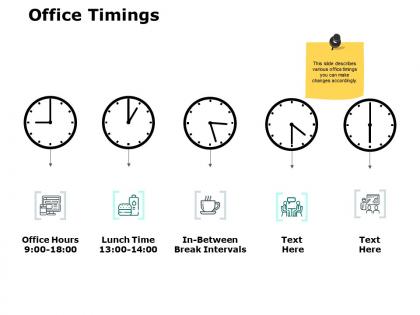
The image presents a slide titled "Office Timings" which outlines the structure of a typical workday through visual representation of clocks accompanied by text labels and specific time ranges. The slide is designed to inform individuals about different segments of the daily office schedule.
The first clock is labeled "Office Hours 9:00-18:00," indicating the overall duration of the workday, starting from 9 am and ending at 6 pm. The second clock has the label "Lunch Time 13:00-14:00," which sets apart one hour in the middle of the day for a lunch break, from 1 pm to 2 pm. The third clock is marked with "In-Between Break Intervals," suggesting that there are additional short breaks throughout the day, although specific times are not provided. There are two more clocks on the slide with text placeholders saying "Text Here," implying that the presenter can add more custom time slots or office activities as needed.
The note pinned in the upper right with a pushpin says, "This slide describes various office timings you can make changes accordingly," indicating the slide's customizable nature for different office schedules or organizational needs.
Use Cases:
This template can be invaluable for a range of industries seeking to communicate or establish clear daily routines for their employees:
1. Corporate Sector:
Use: To outline daily work schedules for staff
Presenter: Human Resources Manager
Audience: New Employees
2. Manufacturing:
Use: To present shift timings and breaks on the factory floor
Presenter: Shift Supervisor
Audience: Factory Workers
3. Healthcare:
Use: For discussing shift timings of medical professionals
Presenter: Hospital Administrator
Audience: Medical Staff
4. Education:
Use: To detail school administrative working hours and breaks
Presenter: School Principal
Audience: Teaching and Administrative Staff
5. Retail:
Use: To illustrate store operation hours and break periods for employees
Presenter: Store Manager
Audience: Retail Associates
6. Information Technology:
Use: To convey working hours and break times for IT professionals
Presenter: IT Department Head
Audience: IT Staff
7. Hospitality:
Use: To specify working shifts for hotel staff
Presenter: Hotel Operations Manager
Audience: Hotel Employees
Office timings management ppt powerpoint presentation file show with all 5 slides:
Get a booster dose with our Office Timings Management Ppt Powerpoint Presentation File Show. They deliver a fresh burst of energy.


FAQs for Office timings management ppt powerpoint
Honestly, flexible timing is a game changer - your people work when they're actually sharp instead of forcing 9-to-5. Less burnout because they can deal with life stuff without freaking out about schedules. Everyone expects flexibility now anyway, so it's basically required for hiring decent people. Work-life balance gets way better, turnover drops, and people actually give a damn when they feel trusted. Oh, and productivity usually goes up too which is wild. Just make sure you have core hours where everyone's around for meetings and stuff. I'd try a pilot first - see what actually works for your team instead of guessing.
Honestly, good time management is like a magic trick for teams. When everyone knows what's due when, you stop getting those awful situations where half the team is just sitting around waiting. Shared calendars are a game-changer - plus setting up clear response times so people aren't left hanging. Regular check-ins help too, otherwise someone's always out of the loop working on the wrong thing. Once your team can actually predict when people are free and swamped, everything clicks better. Oh, and time-blocking is seriously underrated. Try it and watch productivity go through the roof.
Honestly, just get a digital system - it'll save you so much headache. Badge scanners or mobile apps work great, especially if you've got remote people. Most of them sync with payroll automatically which is a lifesaver because manual timesheets are the worst. You can actually see who's showing up and catch problems before they get crazy. The scheduling insights are pretty useful too. Don't go overboard though - pick something simple that fixes your biggest issue first. You can always add more features later once everyone gets used to it.
Honestly, I'd set core hours where everyone has to be online - like 10am to 3pm or whatever works. Outside of that? Let people do their thing. Be upfront about when you actually need everyone collaborating vs when they can just heads-down work alone. If someone's crushing their deliverables but rolls in at 10:30 instead of 9, who cares? Focus on what they're producing, not micromanaging their schedule. The trick is laying out these expectations from day one so nobody's confused later. Oh, and definitely get team buy-in early - makes everything smoother.
Honestly, rigid schedules are the worst but you can make them work. Try crushing your most important stuff during your peak hours so you're not dragging work home. Those 15-minute breaks? Perfect for quick calls or errands - it adds up more than you'd think. The mental switch-off thing is huge when you clock out, even if the actual hours suck. Maybe chat with your manager about wiggle room for appointments. Oh, and track how you actually spend time this week - I bet you'll find random pockets you forgot about. Sometimes we're busier in our heads than reality.
Oh god, time zones are such a nightmare for global teams. Finding those overlap hours where everyone's actually awake? Good luck with that. I'd map out everyone's working hours first - visually, like on a chart or something. Rotating meeting times helps so one poor team isn't always doing 6am calls (been there, it sucks). World clock apps will save your sanity. For stuff that's not super urgent, just go async - way easier than trying to coordinate across like 8 time zones every single time.
Track the obvious stuff first - productivity metrics, attendance, overtime hours, sick days. Employee surveys are clutch though, people will literally tell you if it sucks. I'd also watch meeting participation and how long cross-team projects take since timing affects who can actually collaborate when. Customer satisfaction matters too if your hours need to match client expectations. Oh, and definitely get baseline numbers before you change anything - otherwise you're just guessing if it's working. Check back quarterly to see what's actually better vs what just feels different.
Dude, bad timing management is like a morale killer. Your team feels totally disrespected when you're switching schedules last minute or making them stay late without warning. Nobody wants to deal with that constant chaos - it's exhausting. Plus you end up in this awful cycle where your best people burn out and quit, then you're back to square one training newbies. Honestly, the solution isn't rocket science though. Just set clear policies around scheduling and actually stick to them. Oh, and give people a heads up about changes whenever you can. Makes all the difference.
Honestly, just write everything down from the start - put your timing rules in the employee handbook or shoot everyone an email they can save. Cover the basics like core hours, break times, flexibility stuff, and what happens if people are constantly late. I learned this the hard way after way too many weird conversations that totally could've been avoided! Don't just send it once though. Bring it up in meetings and check-ins so it actually sticks. Trust me, your team would rather know the rules upfront than spend time wondering if they're screwing up.
Start with a solid policy that spells out who qualifies and how approvals work. Document everything - seriously, informal deals will bite you later when people start comparing notes. I'd pilot it with just a few people first, honestly that's way less messy than rolling it out company-wide. Train your managers on fair assessment criteria so nobody's making random decisions. Regular check-ins are crucial to see if it's actually working for productivity. Oh, and be super transparent about your decision process - that prevents the whole "why did Sarah get approval but not me" drama. Trust me on this one.
Honestly, office hours make or break team chemistry. Different schedules kill those random conversations where problems actually get solved - you know, the good stuff that happens by the water cooler. Meeting coordination becomes absolutely brutal too. Your team bonds through casual moments way more than formal sit-downs, so flexible timing can backfire if you're not careful about it. Remote work? Sure, but you've got to fight harder for connection. I'd say nail down some core hours when everyone overlaps, then throw in regular check-ins. Otherwise people just... drift apart.
Just ask your clients when they actually want to talk to you! Most businesses just wing it and guess wrong. Send out a quick survey about their preferred hours and when they're busiest. Maybe try extended hours during crazy seasons or split your team to cover morning people vs night owls (though that's honestly a pain with small teams). I'd pilot new hours for like a month first. Track if clients are happier and whether your team can handle it. The whole point is being available when they need you, not just when it's convenient for you.
Honestly, the hardest part is figuring out how to measure productivity fairly - like how do you even quantify "relationship building" or creative stuff? Managing client expectations is brutal too. They'll panic if they can't reach someone during normal hours. Your managers will probably struggle with it since they're so used to the whole butts-in-seats mentality (seriously, some of them never change). Oh, and you've gotta set super clear deliverables from day one. Communication is everything - both with your team and clients before you pull the trigger on this.
Look, your employees literally have all the answers you need - you just have to ask them! Survey your team about their schedules, commute issues, when they're most productive. Most timing policies bomb because nobody bothered asking what people actually want. Take that feedback and test stuff out - maybe flexible hours or different meeting times. Oh, and here's the thing everyone messes up: you've got to actually follow through on what they tell you. Then circle back later to see if it's working. Otherwise you're just shooting in the dark and wondering why nothing sticks.
Dude, you NEED to take breaks. I know it sounds counterproductive but hear me out - your brain literally can't focus for hours straight without getting fried. Used to be one of those people who'd sit at my desk for 6 hours thinking I was being productive, but honestly? Just made more mistakes. Now I do like 10-15 minutes every few hours and come back way sharper. Lunch breaks are huge too - gives you that afternoon energy boost. Oh and actually put them in your calendar or you'll skip them. Trust me on this one.
No Reviews