


Cycle time reduction powerpoint template




Try Before you Buy Download Free Sample Product
 Impress Your
 Audience
 100%
100% Editable
 Save Hours
 of Time


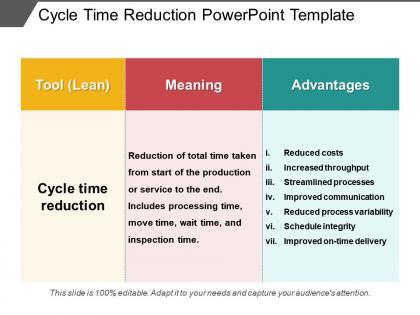
Use our cycle time reduction PowerPoint template and represent your data in the most effective possible manner. This time reduction PPT template will be very useful to you as it will reduce all your stress and workload. This cycle time PowerPoint presentation has been specially designed by business experts for business professionals like you who do not have time to sit and design the slides themselves. This tables and matrix slideshow presentation will help you lay emphasis on business processes like reduced cost, increased throughput, streamlined processes, improved communications, reduced process variability, schedule integrity, improved on-time delivery, etc. The use of this circle time reduction business template will assist you in the reduction of total time taken from the start of production or services to the end including processing time, movie time, wait time, inspection time, etc. The slideshow will also help you in raising the standard of your work as the circular time reduction PowerPoint template has been designed using high resolution and premium quality slides. Consistency is an inbuilt characteristic of our Cycle Time Reduction Powerpoint Template. You will invariably excel.
People who downloaded this PowerPoint presentation also viewed the following :
Cycle time reduction powerpoint template with all 5 slides:
Acquaint folks with all the constituent elements with our Cycle Time Reduction Powerpoint Template. Be able to divulge the ingredients.




FAQs for Cycle time
Key factors contributing to project cycle time include resource availability, task dependencies, approval processes, communication delays, and scope changes. These elements interconnect significantly, with many organizations finding that streamlining approval workflows, optimizing resource allocation, and establishing clear communication protocols reduces overall project duration by 20-30%, ultimately delivering faster time-to-market and enhanced competitive advantage.
Process mapping reveals bottlenecks, redundancies, and inefficiencies by providing visual clarity into each workflow step, handoff point, and decision gate throughout operations. Through detailed process visualization, organizations can pinpoint delays, eliminate non-value-added activities, and streamline task sequences, with many manufacturing and service companies finding significant time savings and enhanced operational efficiency.
Technology streamlines workflows to reduce cycle time through automation, real-time data analytics, process optimization software, digital collaboration tools, and AI-powered task management systems. These solutions eliminate manual bottlenecks, accelerate decision-making, and enhance coordination across teams, with manufacturing and financial services organizations finding that integrated platforms deliver significantly faster processing times and improved operational efficiency.
Lean principles reduce manufacturing cycle time by eliminating waste, streamlining workflows, and optimizing resource allocation through just-in-time production, continuous improvement, and value stream mapping. These methodologies enable manufacturers to minimize inventory costs, accelerate production schedules, and enhance operational efficiency, with automotive and electronics companies finding significantly faster turnaround times and improved competitive positioning.
Organizations should track lead time, processing time, wait time, queue length, throughput rate, and defect rates to evaluate cycle time effectively. These metrics enable comprehensive analysis by identifying bottlenecks, measuring workflow efficiency, and quantifying improvement opportunities, with many manufacturing and service organizations finding that combining these measurements delivers significant operational insights and competitive advantage.
Common pitfalls include rushing without proper analysis, cutting quality controls, overlooking employee training needs, focusing solely on speed over efficiency, and implementing changes without stakeholder buy-in. These missteps often result in increased errors, employee resistance, and customer dissatisfaction, with many organizations finding that sustainable cycle time reduction requires balanced approaches prioritizing both speed and quality maintenance.
Cross-functional teams reduce cycle times by eliminating handoff delays, enabling parallel workflows, and facilitating real-time problem-solving across departments. These collaborative structures streamline decision-making, minimize rework through early integration of diverse expertise, and accelerate project completion, with many organizations finding that strategic cross-functional collaboration delivers significantly faster time-to-market and enhanced operational efficiency.
Employee training significantly impacts cycle time reduction by improving skill proficiency, standardizing processes, reducing errors, and enhancing cross-functional collaboration across teams. Through comprehensive training programs, organizations streamline workflows, minimize rework, and accelerate decision-making, with many manufacturing and service companies finding that well-trained employees deliver faster turnaround times and operational efficiency.
Organizations balance cycle time reduction with quality maintenance through strategic automation, standardized processes, and continuous monitoring systems. By implementing quality gates at critical stages, leveraging real-time analytics, and adopting lean methodologies, companies streamline operations while preserving standards, with manufacturing and software development sectors finding that integrated quality assurance ultimately delivers faster, more reliable outcomes.
Best practices for implementing cycle time reduction initiatives include process mapping and analysis, stakeholder engagement and training, technology integration, continuous monitoring systems, and phased implementation approaches. These strategies streamline operations by identifying bottlenecks, standardizing workflows, and leveraging automation tools, with many manufacturing and service organizations finding that systematic implementation delivers faster delivery times, reduced costs, and enhanced competitive advantage.
Data analytics identifies cycle time improvement opportunities by analyzing workflow patterns, detecting bottlenecks, and measuring process variations across different stages. Through predictive modeling and real-time monitoring, organizations streamline operations, reduce delays, and optimize resource allocation, with many manufacturing and financial services companies finding significant efficiency gains and faster delivery times.
Toyota's lean manufacturing reduced automotive assembly time by 50% through just-in-time production and continuous improvement processes. Similarly, Amazon streamlined order fulfillment cycles from days to hours using automated warehousing and predictive logistics, while banks like JPMorgan accelerated loan approvals from weeks to minutes through digital workflows, ultimately delivering faster customer service and significant competitive advantages across industries.
Customer feedback and demand variability significantly impact cycle times by creating planning complexities, resource allocation challenges, and production scheduling disruptions that can extend delivery timelines. However, organizations leveraging real-time analytics and flexible manufacturing systems can transform this variability into competitive advantage, with many retail and automotive companies finding that responsive cycle management actually enhances customer satisfaction while maintaining operational efficiency.
Sustaining cycle time reductions requires fostering a continuous improvement mindset, encouraging cross-functional collaboration, and embracing data-driven decision making throughout all organizational levels. These cultural shifts enable teams to proactively identify bottlenecks, streamline processes, and maintain operational efficiency, with many organizations finding that employee empowerment and accountability ultimately deliver lasting competitive advantage.
Agile methodologies reduce cycle times by emphasizing iterative development, continuous feedback loops, and adaptive planning rather than rigid sequential processes. Through shorter sprints, daily standups, and regular retrospectives, teams in software development, manufacturing, and financial services accelerate delivery cycles, minimize bottlenecks, and respond faster to changes, ultimately delivering products to market weeks or months ahead of traditional approaches.
-
Designs have enough space to add content.
-
Top Quality presentations that are easily editable.