


Delivery timeline with schedule and resources




Try Before you Buy Download Free Sample Product
 Impress Your
 Audience
 100%
100% Editable
 Save Hours
 of Time


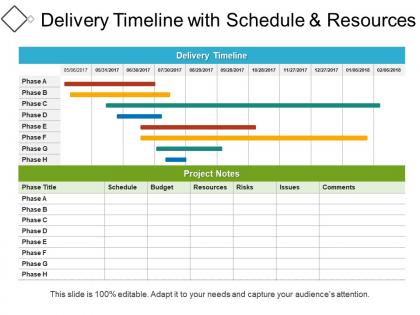
Introducing Delivery Timeline With Schedule And Resources slideshow. Take the advantage of this effective timeline PPT visual, to determine the project dependencies, and the total time needed for each task. Get this ready-to-use PowerPoint theme and make an awesome presentation for representing your yearly goals. This monthly timeline PowerPoint slide design can also be used for setting the objectives or goals on a monthly basis which will lead to the achievement of the organization's main goal. With this, it will be easier for you to show to the people, the sequence of tasks that have been done and that needs to be done. Highlight the steps for creating the timeline for a project. Showcase the project scope statement with the help of this content-ready PowerPoint theme. Project delivery methods can also be showcased with the help of our ready-to-use PPT slide. Discuss the key elements of the timeline such as tasks that are to be accomplished, date of the task, duration of tasks, dependencies between the task. Download this ready-to-use PowerPoint template and make an awesome presentation for representing your yearly goals.
People who downloaded this PowerPoint presentation also viewed the following :
Delivery timeline with schedule and resources with all 5 slides:
Beat the odds with our Delivery Timeline With Schedule And Resources. Come out on top in any gamble.


FAQs for Delivery timeline with
So there are five main phases: initiation, planning, execution, monitoring, and closure. First thing - nail down your scope and objectives during initiation, then map out timelines and resources. Execution is honestly make-or-break territory where you actually get stuff done while keeping everyone on track. Monitor constantly and pivot when needed (trust me on this one). Break everything into smaller chunks and over-communicate with stakeholders - like, way more than feels necessary. Oh, and don't blow off the closure phase even when you're exhausted. Document what worked and what didn't for next time.
Think of it like a seesaw - something's gotta give when one side changes. Scope creeps up? You'll need more time or cash. Budget gets slashed? Cut features or push the deadline. Honestly, stakeholders hate surprises way more than trade-offs, so be upfront about this stuff from the start. My first major project almost killed my team because I stupidly tried keeping everything locked down. Don't be me lol. Always get sign-off before making changes though - covers your butt later. Oh, and ask stakeholders to rank scope/time/budget by priority right away. Makes those tough conversations so much easier.
Honestly, start with Asana or Monday.com - they're pretty solid for most teams. Trello's awesome if you're into the whole visual board thing (moving those cards around is weirdly addictive lol). Got bigger projects with tons of resource planning? Microsoft Project or Smartsheet will handle that no problem. Whatever you pick though, make sure it plays nice with Slack so updates just flow into your team chats automatically. Oh, and here's what I'd do - grab the free versions of like 2 or 3 options, test them on something small first. Then just go with whatever doesn't make your brain hurt.
Dude, agile is a game changer for project management. You get way more flexibility since you're working in short sprints instead of planning everything upfront and crossing your fingers. The feedback comes fast, so you can pivot when stuff isn't working. My team actually stays engaged because we're collaborating constantly and seeing real progress every couple weeks - it's weirdly motivating once you find your groove. Stakeholders eat up the regular updates too, plus they can actually influence where things go. I'd say start with daily standups and two-week sprints, see how it feels.
Right off the bat, figure out how often each stakeholder group needs updates and how they want to hear from you. Some people are email-only, others need those face-to-face meetings. Send regular updates even when nothing's happening - trust me, radio silence freaks people out and then they'll blow up your phone. Match the detail level to what they actually care about. Oh, and make a simple matrix at kickoff showing who gets what info when. Honestly, being proactive saves you so much headache later. Stick to your schedule religiously.
Honestly, risk management can make or break your project. You've gotta spot potential problems early so you're not scrambling later when stuff hits the fan. Do a quick risk assessment first - figure out what could go sideways and tackle the worst ones. My old boss used to say "hope for the best, plan for the worst" which sounds cheesy but actually works. Set up backup plans and pad your timeline with buffer time. Don't forget to check your risk list weekly - like 30 minutes tops. Seriously saves you from major disasters down the road.
Honestly, good teamwork can totally save your project or completely tank it. People solve problems way faster when they're actually talking to each other instead of working in silos. Clear communication channels are huge - nobody wants to hunt down updates in five different apps. Weekly syncs work great for sharing blockers and progress. Oh, and define roles upfront so people aren't duplicating work or getting territorial about stuff. The whole thing falls apart if everyone's confused about who does what. Trust me, those awkward "wait, I thought you were handling this" moments are the worst.
Track the obvious stuff first - scope, budget, timeline. But honestly, stakeholder satisfaction matters way more than people think. I usually wait like 2-3 months after wrapping up, then send a quick survey to the team and main stakeholders. That's when you get the real tea, not the polite feedback from day one. Did it actually deliver the business outcomes you promised? Don't get caught up only measuring execution stuff. Oh, and definitely do a post-mortem with your core team while everything's still fresh. You'll forget the important details faster than you think.
Ugh, you're gonna deal with scope creep constantly - people always want "just one more thing." Unrealistic deadlines are brutal too. Communication between everyone involved? Usually a mess. Oh, and resource issues will definitely pop up. Here's what actually works: nail down exactly what you're doing upfront and make everyone sign off. I can't stress this enough - check in with people constantly so problems don't blindside you later. Push back when requests are crazy (trust me on this one). Also just talk to people way more than feels necessary. Better to over-explain than have everything fall apart because someone didn't know what was happening.
Get them working on real projects - even tiny ones help build those core skills like planning and scheduling. Pair newbies with your best PMs for mentoring, which honestly beats classroom training every time. Make sure everyone's actually comfortable with whatever PM software you're using (so many people just wing it and wonder why things go sideways). The trick is letting them mess up on low-stakes stuff first. They need that safe space to learn from mistakes before you throw them into anything major. Gradually ramp up complexity as they get more confident.
So basically, when you align PM with company strategy, your projects actually matter instead of being random busy work. Map your current stuff against the company's top 3-5 goals first - you'll probably find some weird gaps. The real win? Executives will actually care about what you're doing and give you resources. Plus everyone gets why their work matters, which honestly makes everything so much easier. Better priorities, clearer metrics, more engagement - the whole nine yards. I sound like a broken record but seriously, it changes everything when people see the bigger picture connection.
Oh man, cultural stuff will absolutely mess with your project if you're not careful. Different regions have totally different approaches to feedback - some want it straight up, others think that's super rude. Deadlines? Yeah, good luck with that one because everyone interprets those differently too. You've got varying comfort levels with hierarchy, risk, how meetings should run... it's a lot. Honestly though, if you do a cultural check with your team upfront and get everyone on the same page about communication rules, you'll save yourself so many headaches later.
Start with the basics - track your planned vs actual timelines and cost variance. Quality stuff like defect rates and customer satisfaction are critical too. Honestly, keeping stakeholders happy usually trumps perfect deadlines anyway. Team velocity and resource utilization give you good insight into performance. Oh, and don't forget risk mitigation - that one bites people all the time. Pick maybe 4-6 metrics that actually matter for your project instead of tracking everything under the sun. Set up a weekly dashboard review with the team and you're golden.
Honestly, good resource management is a game changer. You're basically putting the right people on the right stuff when they're actually available. I learned this the hard way - nothing's worse than watching half your team drowning while the other half has nothing to do. Super awkward. When you plan it out upfront, deadlines become way more realistic and you won't blow your budget. Your team stays sane too since nobody's getting crushed. Just map out who's got which skills and when you need them. Oh, and always pad your timeline because something will definitely go sideways.
Honestly, you've got to lock down those requirements before anything else starts. Get everyone to sign off in writing - I learned this the hard way on my last project. Build a solid project charter that spells out exactly what you're doing and what you're NOT doing. New requests will come up constantly (they always do), so put them through a formal change process instead of just agreeing to keep people happy. Your team needs to flag any scope changes immediately. Keep documenting everything and update stakeholders regularly. The key is setting those boundaries early and actually sticking to them, even when it gets uncomfortable.
-
Innovative and attractive designs.
-
Presentation Design is very nice, good work with the content as well.