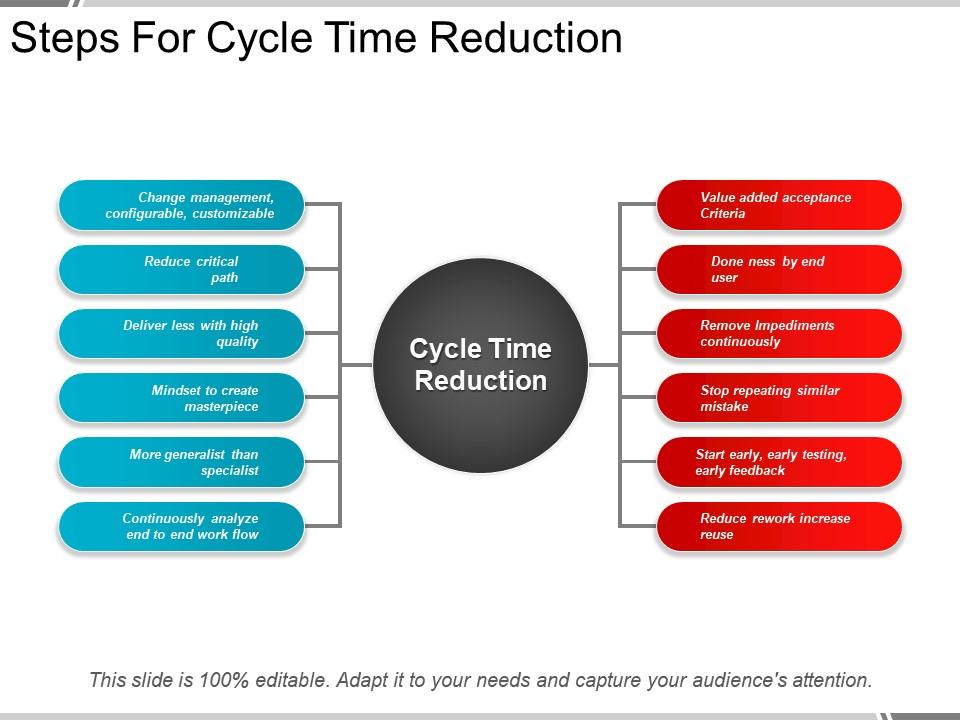
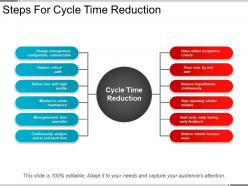
Steps for cycle time reduction powerpoint templates

Rating:
90%
Steps for cycle time reduction powerpoint templates
Slide 1 of 5
Favourites Favourites

Try Before you Buy Download Free Sample Product

Audience Impress Your
Audience
Editable 100%
Editable
Time Save Hours
of Time
The Biggest Sale is ending soon in
0
0
:
0
0
:
0
0
Rating:
90%
SlideTeam would like to present to all of you its most downloaded steps for cycle time reduction PowerPoint templates. This slideshow will let you customize the color, size, and orientation of the diagrams used in it. The business template after being downloaded can be viewed in standard size display ratio of 4:3 or widescreen display ratio of 16:9. The slides are totally user friendly as you can or delete a number of features from the predesigned set of slides. The business slides can also be saved in PDF or JPG format.

FAQs for Steps for cycle time

So cycle time is just how long it takes to get something done - like making a product or processing an order. Why care? Well, faster processes mean you can handle more customers and cut costs. Also, people are impatient these days lol. Here's what I'd do: map out your whole workflow first and time each step. You'll find bottlenecks in weird places, trust me. Then focus on cutting out the waste and unnecessary stuff. Sometimes the biggest time sucks are hiding in steps you barely think about.

So I'd definitely start with Value Stream Mapping - you gotta see what's actually happening before fixing anything. Lean Manufacturing is your bread and butter for cutting waste, and honestly? Kaizen events are where the magic happens. Those quick brainstorming sessions with your team catch the dumbest inefficiencies that somehow everyone just lived with. Six Sigma's solid if you're into heavy data analysis (some people love that stuff). But seriously, map your current process first. I've seen people jump straight into improvements and miss the obvious bottlenecks staring them in the face.

Honestly, start by mapping out your whole process first - you'll spot the bottlenecks right away. Cut down those batch sizes and get people cross-trained (seriously saves your butt when someone calls out). Pull systems work way better than push for reducing that pile-up of work-in-progress stuff. Standardize how things get done so there's less confusion. The trick is measuring where you're at now, then making small tweaks instead of blowing everything up at once. I've seen too many people try to fix everything overnight and it backfires.

Honestly, tech is like having a cheat code for cutting cycle times. Automation kills those annoying manual handoffs between steps. Real-time tracking catches bottlenecks before they become disasters. If you're in manufacturing, robots and IoT sensors are game-changers for monitoring equipment. Service companies should look at workflow tools and customer portals. But here's the thing - don't just buy shiny tech because it looks cool. Map out your process first, find where time gets wasted, then pick tools that actually fix those specific problems. Way more effective than the spray-and-pray approach.

Track lead time first - that's request to delivery. Then processing time (actual work) and wait time between steps. Throughput matters too - how much you're actually finishing per week or whatever. Work in progress limits are huge since they mess with your cycle times. Quality metrics though... don't skip those because faster isn't better if you're just creating more rework later. Been there, done that. Queue times and handoff delays can come later once you've got the basics. Honestly, stick to 3-4 metrics tops or you'll drive yourself crazy trying to fix everything.

Honestly, cross-functional teams are total lifesavers for cutting cycle time. All those handoff delays between departments? Gone. When your marketing, engineering, and ops people are actually talking to each other daily (instead of playing email tag for a week), problems get solved fast. Different viewpoints help you catch issues way earlier too. Oh, and this only works if you give the team real decision-making power - not just endless meetings where nothing gets decided. I've seen too many "cross-functional" teams that were basically just discussion groups.

Honestly, the biggest pain points are usually people hating change, terrible data visibility, and not enough resources. I mean, who doesn't get stuck in their routines, right? But here's what works - get your team to help spot the bottlenecks instead of just telling them what to fix. Map out your current process first to see where things get stuck. Resources are always tight, but focus on the obvious waste you can eliminate quickly. That stuff doesn't cost anything to fix. Try one small pilot first to show it actually works before going bigger.

Start by mapping out your current process and just timestamp each step - you'll be shocked at what shows up. Data will reveal patterns you'd never notice otherwise, like where work keeps piling up or when delays hit worst (usually around lunch, honestly). Track wait times and processing speeds at each stage. Compare your fastest cycles against the slowest ones to spot the differences. Look for stages that consistently take forever or bottlenecks that appear at specific times. Even basic tracking catches surprising inefficiencies you can fix right away.

Honestly, cutting cycle time is one of those things that just makes everything better. Your customers get stuff faster, which they love. Fewer delays means less headaches for everyone too. I've watched teams bump their satisfaction scores up 20-30% just by speeding things up - pretty crazy what a difference it makes. Start with your slowest processes first though, that's where you'll see the biggest wins. Those are usually the pain points anyway. Once you fix the worst bottlenecks, delivery speed basically takes care of itself.

Honestly, process mapping is a game changer - you basically draw out every step in your workflow and suddenly all the problems become super obvious. Like, you'll see where things get stuck or where someone's doing double work for no reason. Get your team to help map it out because they know where the real pain points are (plus they won't resist changes as much if they helped create the map). The whole point is figuring out which steps actually matter versus the stuff that's just... there because it's always been there, you know? Just start with a whiteboard and one simple process.

Start with Lucidchart or Visio for mapping out your process - you'll spot bottlenecks way easier when you can actually see them. Tableau and Power BI are solid for real-time dashboards that track cycle times automatically. Excel works too if you're not trying to get fancy (honestly, sometimes simple is better). Process mining stuff like Celonis is pretty cool but total overkill unless your workflows are super complex. Oh, and whatever you pick, make sure your team will actually use it. I've seen too many expensive tools just collecting digital dust because nobody wanted to learn them.

Honestly? Your team can totally make or break this whole thing. People hate change - they'll just go back to doing things the old way when stuff gets hectic, which is obviously when you need those improvements most. But here's the thing: once they actually get why you're switching things up and see how it works, they become your biggest cheerleaders. I'd start with whoever has the most influence on your team first. Those people will help sell it to everyone else and basically do half the coaching work for you. Skip the proper training though and you're screwed.

Dude, check out Toyota's lean manufacturing - they cut assembly time in half. Amazon went from hours to literally minutes for order fulfillment with warehouse automation. Southwest Airlines does 10-minute gate turnarounds, which honestly still blows my mind. Ford dropped their product development from 60 months to 24 using concurrent engineering. Oh, and Virginia Mason cut patient wait times by 85% just by mapping their processes better. The key thing? All of them timed their current setup first, found the bottlenecks, then got rid of the waste. You'll want to map your process end-to-end before changing anything.

Honestly, frameworks like Kaizen or Lean are game-changers because they stop you from just putting out fires constantly. Monthly review sessions help you actually measure what's working and spot new bottlenecks before they get nasty. The real magic happens when your team develops that improvement habit - otherwise people get comfortable once things are "decent enough" and forget to keep optimizing. I've seen this so many times. Make cycle time reduction feel ongoing, not like some one-off project you check off. Track 2-3 key metrics consistently and you'll start seeing patterns you missed before.

Honestly, cutting cycle time is one of the fastest ways to boost profits. You're spending less on labor and overhead since work gets done quicker. More customers served with the same team = more revenue, obviously. Cash flow gets better too because you're getting paid faster. Most places see results in 3-6 months, which is pretty solid. Oh, and your bottlenecks? That's where the magic happens. Map out your current process first - I know it sounds boring, but those problem areas are literally costing you money. Fix the worst ones and you'll see the biggest impact.

Ratings and Reviews

90% of 100
Review Form
Write a review
Most Relevant Reviews
  1. 80%

    by Michael Clark

    Informative presentations that are easily editable.
  2. 100%

    by Deon Warren

    Thanks for all your great templates they have saved me lots of time and accelerate my presentations. Great product, keep them up!

2 Item(s)

per page: