

Evolution Of Recommender Systems From Modern Era Recommendations Based On Machine Learning




Try Before you Buy Download Free Sample Product
 Impress Your
 Audience
 100%
100% Editable
 Save Hours
 of Time


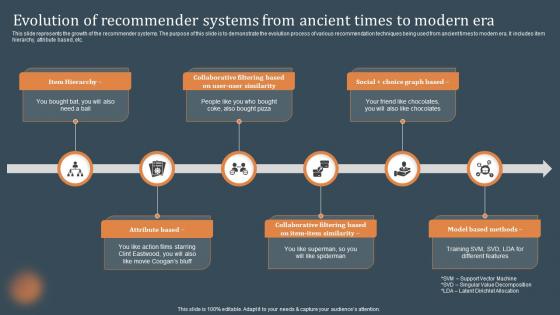
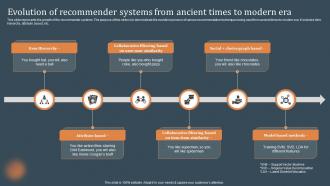
This slide represents the growth of the recommender systems. The purpose of this slide is to demonstrate the evolution process of various recommendation techniques being used from ancient times to modern era. It includes item hierarchy, attribute based, etc.
People who downloaded this PowerPoint presentation also viewed the following :
Evolution Of Recommender Systems From Modern Era Recommendations Based On Machine Learning with all 9 slides:
Use our Evolution Of Recommender Systems From Modern Era Recommendations Based On Machine Learning to effectively help you save your valuable time. They are readymade to fit into any presentation structure.








FAQs for Evolution Of Recommender Systems From Modern Era Recommendations Based
The primary types of recommender systems include collaborative filtering, content-based filtering, hybrid systems, knowledge-based systems, and demographic filtering. These approaches differ by streamlining personalization through user behavior analysis, product characteristics evaluation, and strategic combinations of multiple methods, with retail platforms, streaming services, and e-commerce sites finding that hybrid models ultimately deliver enhanced customer experiences and increased engagement rates.
Collaborative filtering analyzes user behavior patterns and preferences to recommend items by identifying users with similar tastes or items frequently chosen together. While this approach delivers highly personalized recommendations and works well with large user bases, it faces cold-start problems for new users, requires substantial data to function effectively, and can create filter bubbles that limit discovery of diverse content.
Content-based filtering enhances user experience by analyzing item attributes, user preferences, and historical interactions to deliver highly personalized recommendations. This approach enables platforms to suggest relevant products, content, or services based on specific user tastes and behaviors, with e-commerce sites and streaming services finding significantly improved engagement, reduced search time, and enhanced customer satisfaction through targeted, meaningful suggestions.
Hybrid recommender systems enhance accuracy by combining multiple filtering approaches like collaborative, content-based, and knowledge-based methods, reducing individual algorithm limitations while leveraging their collective strengths. Through strategic integration of diverse recommendation techniques, organizations across retail, streaming, and e-commerce sectors deliver more personalized user experiences, minimize cold-start problems, and ultimately achieve higher engagement rates and customer retention.
Common evaluation metrics for recommender systems include precision, recall, F1-score, mean absolute error (MAE), root mean square error (RMSE), and normalized discounted cumulative gain (NDCG). These metrics enable organizations to measure recommendation accuracy, relevance, and user satisfaction across diverse applications, with e-commerce platforms, streaming services, and content providers finding that comprehensive evaluation ultimately delivers enhanced user experiences and increased engagement rates.
Recommender systems address cold-start problems through hybrid approaches, demographic profiling, content-based filtering, knowledge-based recommendations, and popularity-based suggestions for new users or items. These strategies enable platforms to deliver meaningful recommendations immediately, with e-commerce sites and streaming services finding that strategic combination of multiple techniques significantly improves user engagement and retention rates.
Diversity in recommendations significantly enhances user engagement by preventing filter bubbles, introducing users to new products or content, and maintaining long-term interest through varied suggestions. While highly personalized recommendations drive immediate conversions, diverse recommendations increase exploration rates, session duration, and platform stickiness, with many streaming and e-commerce platforms finding that balanced diversity ultimately delivers higher lifetime user value.
Recommender systems leverage machine learning algorithms like collaborative filtering, content-based filtering, matrix factorization, deep learning neural networks, and ensemble methods to analyze user behavior patterns and preferences. These algorithms continuously learn from user interactions, purchase history, and feedback data, enabling platforms like Netflix, Amazon, and Spotify to deliver increasingly personalized recommendations, ultimately enhancing customer engagement and driving revenue growth.
Ethical considerations include algorithmic bias, privacy invasion, filter bubbles, manipulation concerns, and transparency issues. These systems can perpetuate discrimination through biased data, create echo chambers limiting exposure to diverse content, and raise questions about user autonomy, with many organizations finding that implementing fairness audits, diverse datasets, and user control features helps balance personalization benefits while maintaining ethical standards.
User privacy in recommender systems can be protected through differential privacy, federated learning, data anonymization, homomorphic encryption, and minimal data collection practices. These approaches enable organizations to deliver personalized recommendations while safeguarding sensitive information, with many e-commerce platforms and streaming services finding that privacy-preserving techniques ultimately enhance user trust and engagement without compromising recommendation quality.
Context-aware recommender systems enhance user personalization by incorporating situational factors like location, time, device, and social context alongside traditional user preferences and behavior patterns. Through real-time contextual analysis, streaming platforms, e-commerce sites, and mobile applications deliver significantly more relevant recommendations, ultimately increasing user engagement and conversion rates while reducing decision fatigue.
Biased data significantly undermines recommender system effectiveness by creating unfair recommendations, reinforcing stereotypes, limiting content diversity, and reducing user satisfaction across different demographic groups. This presents both challenges and opportunities for organizations, with many companies in retail, streaming, and e-commerce finding that addressing algorithmic bias through diverse datasets and fairness metrics ultimately delivers broader market reach and enhanced user experiences.
Recommender systems enhance non-e-commerce industries by personalizing content delivery, optimizing resource allocation, and improving user experiences across diverse sectors. Healthcare organizations utilize them for treatment recommendations, financial institutions for investment advice, and streaming platforms for content curation, while educational institutions leverage these systems for personalized learning paths, ultimately delivering enhanced engagement and operational efficiency.
Future trends influencing recommender systems include artificial intelligence integration, real-time personalization, cross-platform data synthesis, voice-activated recommendations, and privacy-preserving technologies. These advancements enable organizations to deliver increasingly sophisticated user experiences by combining behavioral analytics, contextual awareness, and predictive modeling, with many retailers and streaming platforms finding that enhanced recommendation accuracy significantly drives engagement and revenue growth.
A/B testing optimizes recommendation strategies by comparing different algorithms, personalization levels, and content presentation methods against control groups to measure engagement, conversion rates, and user satisfaction. Through systematic testing across segments, companies like Netflix and Amazon refine their recommendation engines, ultimately delivering more relevant suggestions and improved customer experiences while maximizing business outcomes.
-
Easy to edit slides with easy to understand instructions.
-
It's always a delight to see new templates from you! I am extremely pleased with the fact that they are easy to modify and fit any presentation layout in seconds!