

Content Based Recommendation Systems Flow Diagram Ppt Slide




Try Before you Buy Download Free Sample Product
 Impress Your
 Audience
 100%
100% Editable
 Save Hours
 of Time


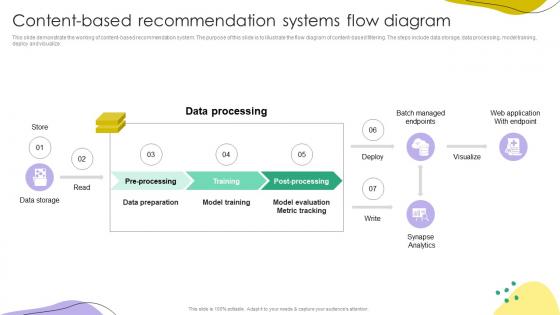
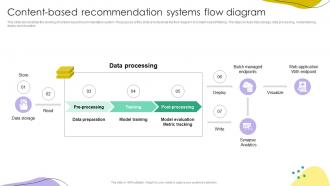
This slide demonstrate the working of content based recommendation system. The purpose of this slide is to illustrate the flow diagram of content based filtering. The steps include data storage, data processing, model training, deploy and visualize.
People who downloaded this PowerPoint presentation also viewed the following :
Content Based Recommendation Systems Flow Diagram Ppt Slide with all 6 slides:
Use our Content Based Recommendation Systems Flow Diagram Ppt Slide to effectively help you save your valuable time. They are readymade to fit into any presentation structure.





FAQs for Content Based Recommendation Systems Flow
So TF-IDF and cosine similarity are your go-to tools - they're like the foundation of content-based systems. TF-IDF figures out which words actually matter in your documents compared to everything else. Cosine similarity then helps you match stuff with similar features. K-means clustering is pretty useful too for grouping similar items together. Oh, and Naive Bayes shows up everywhere for classification, though the name makes it sound way more complicated than it is. I'd honestly just start with TF-IDF and cosine similarity first since you'll use them constantly.
User profiling is everything for content recommendations. The more you know about someone's preferences and behavior, the better matches you'll make. It's like having a friend who actually gets your taste versus someone just throwing random stuff at you. Collect whatever signals you can - ratings, how long people spend looking at things, clicks, what they tell you directly. All that data helps you figure out what each person actually wants. Oh, and definitely look at which user features predict good recommendations in your specific area first. That'll give you the biggest bang for your buck.
So NLP basically takes messy text and turns it into something your recommendation system can actually work with. It pulls out sentiment, topics, entities - all that good stuff. Instead of just matching "action movie" to "action movie," it understands the deeper meaning behind content. Like, it might connect two thriller reviews that never use the same keywords but have similar vibes. Movie reviews, product descriptions, whatever - it catches those subtle connections that keyword matching completely misses. The result? Way better recommendations that actually make sense to users. Pretty neat how that works.
So metadata is what stops your recommendations from being totally random garbage. You tag stuff with details like genre, mood, difficulty, topics - whatever matters for your content. Netflix does this perfectly - they know you're into "dark comedy TV shows" not just any comedy, which honestly makes all the difference. More detailed tags = way better "if you liked this, try that" suggestions. I'd pick like 5-10 key attributes that actually matter for your stuff first. Don't go crazy tagging everything at once. The deeper your metadata gets, the smarter your matches become.
Feature extraction is gonna be your biggest headache - especially with messy text or image data where you need decent NLP/computer vision chops. New items are basically ghosts in your system without enough data to work with. Plus users get trapped in these weird content bubbles seeing the same stuff repeatedly. Honestly, subjective content is the worst because personal taste trumps any objective features you can pull. The cold start problem will bite you too. Get your feature engineering solid first though - that's literally the foundation for everything else working properly.
So basically get users to tell you what they actually want! Simple ratings work great - thumbs up/down, that kind of thing. Track what they're doing too, like how long they spend on stuff or if they bail early. Here's the thing though - most systems totally ignore the "dislike" feedback, which is dumb because that's super useful data. Let people block genres they hate or tweak their preferences directly. Oh, and if someone keeps rating action movies poorly, obviously dial down action in their feed. Start simple with basic ratings, then you can get fancier later. The key is actually using all that feedback to adjust your algorithm weights.
Netflix and Spotify absolutely nail this approach - they're matching content features to suggest similar movies or music with comparable vibes. Fashion e-commerce does great with it too, recommending stuff based on style and color similarities. Oh, and news sites use it constantly to show related articles. The cool thing is you don't need massive user datasets since it analyzes the actual content attributes. Honestly, if your industry cares more about product characteristics than what the crowd's doing, this is probably where you should start. Way less creepy than tracking everything users do, right?
So content-based looks at stuff you already liked - genre, actors, whatever - then finds similar things. Collaborative filtering is way different though, it's like "hey, people with your taste also loved this random thing." Content-based doesn't need other people's data which is nice for privacy I guess. Problem is you get stuck seeing the same type of content over and over. Collaborative can surprise you more but needs tons of user data to work well. I'd probably start with content-based since it's easier and works right away, even for brand new users.
So basically you want to track what content features people actually click on - genres, topics, that kind of stuff. Then weight those preferences differently for each user based on their behavior. Here's what's pretty neat though: you can also look at timing patterns. Like maybe someone watches comedies on weekends but switches to documentaries during the week (honestly happens more than you'd think). Keep updating these profiles since people's tastes change. Use both the ratings they give you and their implicit behavior - what they actually watch vs what they say they like. That way you're matching content that'll actually keep them engaged.
So for tracking your recommendation system, precision and recall are your bread and butter - they show how many relevant items you actually caught versus what you missed. F1-score combines both if you want one number. Accuracy sounds good but honestly it's pretty useless with unbalanced data. Don't forget about coverage and diversity metrics either - you don't want to be that system constantly pushing the same Netflix originals to everyone, you know? I'd probably start with precision@k and recall@k though since they're way easier to explain when your boss asks what's going on.
So basically, semantic analysis gets your system to understand *meaning* instead of just word-matching. Someone reads about "machine learning" and boom - you're recommending neural networks or AI ethics articles, even without exact keywords. It connects ideas, not just buzzwords. Way more useful than the old keyword spam approach, honestly. Your users get content they actually want instead of random stuff that happens to use the same terms. Word embeddings are probably your best starting point - or maybe topic modeling if you're feeling ambitious.
Hey! So the big things to watch out for are bias amplification and filter bubbles. Your system might just reinforce whatever biases already exist in your data - which sucks because it can shut out certain groups. Also, you don't want users stuck in echo chambers where they only see stuff that matches what they already think. That gets boring fast, honestly. Be upfront about how your algorithm works and let people tweak their settings. Oh, and audit for bias regularly - maybe throw in some diverse content recommendations too, even if they're slightly off someone's usual taste.
Honestly, just be straight up with people about what you're collecting and why. Nobody wants to feel like they're being secretly tracked. Make it super easy for users to opt out or tweak their privacy settings - like, actually easy, not buried in some menu. You could look into differential privacy or federated learning too, though that stuff gets pretty technical. The whole thing is about making people feel like they're in control instead of being harvested for data (which, let's be real, is what most companies do). Start by figuring out what data you actually need versus what you're hoarding.
You've probably seen this with Netflix - they look at genres, directors, cast, all that stuff to suggest movies based on what you've watched. Spotify does the same thing with music features and tempo. Oh, and Pandora basically built their entire company around this with the Music Genome Project (which honestly is a pretty cool name). Amazon's "people who bought this also bought" works similarly by analyzing product details. The big thing is having good metadata - like actually tagging and categorizing your stuff properly. Makes a huge difference in how well it works.
So basically you're testing different algorithms against each other with real users to see what actually clicks. Try tweaking things like how much weight you put on genre vs director, or mess with similarity thresholds. Run tests on separate user groups at the same time - don't just look at clicks though, track if people actually stick around and finish watching stuff. The math behind statistical significance gets pretty wonky (I still don't totally get it tbh). But here's what matters: run tests for at least a week, pick metrics that actually mean something, and test your winner again before you roll it out everywhere.
-
Wonderful templates design to use in business meetings.
-
Mesmerized with the fantastic collection! Super sleek, relevant infographics.