


Recommender Systems IT Comparison Between Content Based And Collaborative Filtering




Try Before you Buy Download Free Sample Product
 Impress Your
 Audience
 100%
100% Editable
 Save Hours
 of Time


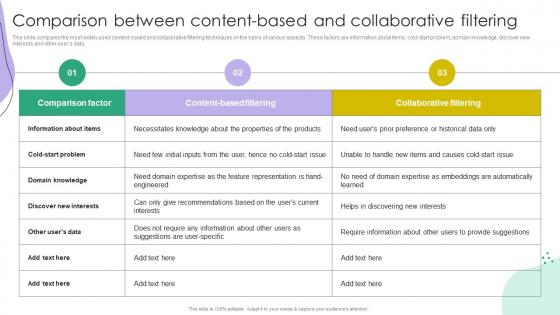
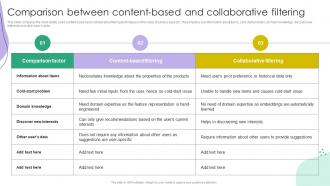
This slide compares the most widely used content based and collaborative filtering techniques on the basis of various aspects. These factors are information about items, cold start problem, domain knowledge, discover new interests and other users data.
People who downloaded this PowerPoint presentation also viewed the following :
Recommender Systems IT Comparison Between Content Based And Collaborative Filtering with all 6 slides:
Use our Recommender Systems IT Comparison Between Content Based And Collaborative Filtering to effectively help you save your valuable time. They are readymade to fit into any presentation structure.





FAQs for Recommender Systems IT Comparison Between Content Based
The main types of recommender systems include collaborative filtering, content-based filtering, hybrid systems, knowledge-based systems, and demographic filtering. These approaches differ by analyzing user behavior patterns, item characteristics, or combining multiple methods, with retail platforms, streaming services, and e-commerce sites leveraging different types to enhance customer experiences and drive engagement.
Collaborative filtering analyzes user behavior patterns and preferences to identify similarities between users or items, then recommends products based on what similar users liked or purchased. By examining purchase histories, ratings, and browsing data, retail platforms like Amazon and Netflix deliver personalized recommendations that significantly increase conversion rates, enhance customer satisfaction, and drive revenue growth through targeted product discovery.
Content-based filtering offers personalized recommendations by analyzing item attributes and user preferences, ensuring transparency in suggestions and avoiding cold start problems for new users. While this approach delivers consistent recommendations based on established user profiles, it can create filter bubbles limiting discovery, with many e-commerce and streaming platforms finding that combining content-based methods with collaborative approaches ultimately enhances recommendation diversity and user engagement.
Hybrid recommender systems combine collaborative filtering, content-based filtering, and knowledge-based approaches through weighted blending, switching mechanisms, and ensemble methods to deliver more accurate predictions. By integrating multiple recommendation strategies, organizations in e-commerce, streaming services, and retail can minimize individual algorithm weaknesses while maximizing personalization accuracy, ultimately delivering enhanced customer experiences and increased engagement rates.
User segmentation enhances recommender systems by grouping users with similar preferences, behaviors, and demographics, enabling more targeted and relevant recommendations. Through strategic segmentation, platforms like Netflix categorize viewers by genre preferences while retailers segment customers by purchase history, ultimately delivering personalized experiences that increase engagement and conversion rates.
Recommender systems enhance e-commerce by personalizing product suggestions through collaborative filtering, content-based algorithms, and hybrid approaches that analyze user behavior, purchase history, and preferences. These systems streamline shopping experiences by reducing search time, increasing relevant discoveries, and boosting conversion rates, with many retailers finding that personalized recommendations drive 20-35% higher sales and improved customer retention.
Ethical considerations include algorithmic bias, privacy protection, transparency in recommendations, user consent management, and data security protocols. These challenges present both obstacles and opportunities for organizations, with many companies finding that implementing ethical frameworks enhances customer trust, ensures regulatory compliance, and ultimately delivers sustainable competitive advantage while minimizing legal risks.
Recommender systems significantly influence user behavior by personalizing content discovery, reducing choice overload, and guiding purchasing decisions through algorithmic suggestions based on past interactions and preferences. These systems reshape decision-making processes by creating filter bubbles, increasing engagement through targeted recommendations, and accelerating purchase cycles, with many e-commerce platforms and streaming services finding that personalized suggestions drive up to 35% higher conversion rates and user retention.
Common metrics include precision, recall, F1-score, Mean Absolute Error (MAE), Root Mean Square Error (RMSE), and diversity measures. These evaluation frameworks enable organizations to optimize recommendation accuracy, user satisfaction, and business outcomes, with e-commerce platforms, streaming services, and financial institutions finding that balanced metric approaches ultimately deliver enhanced customer engagement and increased conversion rates.
Machine learning algorithms enhance traditional recommender systems by enabling real-time personalization, processing complex user behavior patterns, and automatically adapting to changing preferences without manual rule updates. Through deep learning and collaborative filtering, retailers like Amazon and streaming services like Netflix deliver significantly more accurate recommendations, reduce customer churn, and increase engagement rates, ultimately driving higher conversion rates and customer satisfaction.
User reviews and ratings significantly enhance recommendation accuracy by providing explicit feedback data, sentiment analysis insights, collaborative filtering signals, and quality indicators for content evaluation. Through natural language processing and rating aggregation algorithms, e-commerce platforms, streaming services, and hospitality businesses deliver more personalized suggestions, improved user trust, and enhanced customer experiences, ultimately driving higher engagement and conversion rates.
Recommender systems adapt to changing user preferences through real-time learning algorithms, collaborative filtering updates, and continuous feedback integration that monitors behavioral patterns and adjusts recommendations accordingly. These systems leverage machine learning models that evolve with user interactions, enabling e-commerce platforms, streaming services, and content providers to deliver increasingly personalized experiences while maintaining engagement and competitive advantage.
Real-time recommender system challenges include latency constraints, scalability demands, data freshness requirements, computational complexity, and memory limitations. These systems must process millions of user interactions within milliseconds while maintaining accuracy, with streaming platforms and e-commerce sites finding that balancing recommendation quality with response speed ultimately determines user engagement and competitive advantage.
Recommender systems personalize for diverse demographics through demographic filtering, cultural preference analysis, geographic customization, behavioral segmentation, and multilingual content adaptation. These approaches enable platforms like Netflix, Amazon, and Spotify to deliver region-specific recommendations, culturally relevant suggestions, and demographically-appropriate content, ultimately enhancing user engagement while expanding market reach across diverse global audiences.
User-friendly recommender system interfaces include clear recommendation explanations, intuitive feedback mechanisms, personalization controls, diverse content presentation, and transparent filtering options. These design elements enhance user engagement by providing context for suggestions, enabling preference refinement, and building trust through transparency, with many e-commerce and streaming platforms finding that intuitive interfaces significantly improve user satisfaction and recommendation acceptance rates.
-
Crisp and neat slides. Makes it fun and easier to curate presentations.
-
I joined SlideTeam last month and there’s no doubt that I tend to find our bond only strengthening over time. Best place to find world-class themes, templates, and icons.