


Content Based Filtering Comparison Between Content Based And Collaborative Filtering




Try Before you Buy Download Free Sample Product
 Impress Your
 Audience
 100%
100% Editable
 Save Hours
 of Time


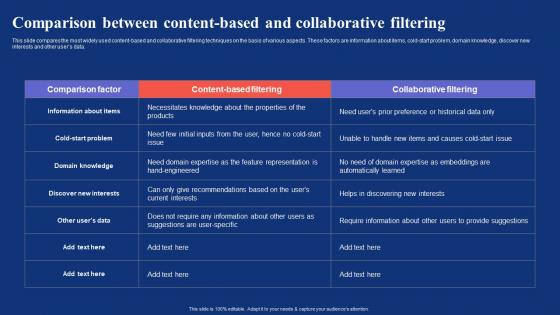
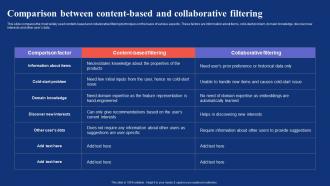
This slide compares the most widely used content-based and collaborative filtering techniques on the basis of various aspects. These factors are information about items, cold-start problem, domain knowledge, discover new interests and other users data.
People who downloaded this PowerPoint presentation also viewed the following :
Content Based Filtering Comparison Between Content Based And Collaborative Filtering with all 9 slides:
Use our Content Based Filtering Comparison Between Content Based And Collaborative Filtering to effectively help you save your valuable time. They are readymade to fit into any presentation structure.








FAQs for Content Based Filtering Comparison Between Content Based
Content-based filtering principles include analyzing item attributes, creating detailed user profiles, computing similarity between content features, personalizing recommendations based on historical preferences, and continuously updating user models. These systems enhance customer experiences by matching product characteristics with individual tastes, enabling retailers and streaming platforms to deliver targeted suggestions while reducing decision fatigue and ultimately increasing engagement rates.
Content-based filtering recommends items by analyzing product features and user preferences, while collaborative filtering relies on user behavior patterns and similar users' choices. Content-based systems work well for new users without historical data, particularly in media platforms and e-commerce, while collaborative filtering excels with established user bases, ultimately enabling personalized experiences.
Content-based filtering models commonly use textual features like keywords, topics, and descriptions, numerical attributes such as ratings and prices, categorical data including genres and brands, metadata like publication dates and authors, and user profile characteristics. These features enable systems to analyze item similarities and match user preferences across sectors like e-commerce, streaming services, and news platforms, ultimately delivering personalized recommendations.
Natural language processing enhances content-based filtering by analyzing text semantics, extracting contextual meaning, identifying sentiment patterns, and understanding user intent beyond simple keyword matching. Through advanced NLP techniques, organizations can deliver more personalized recommendations, improve content relevance accuracy, and create sophisticated user experiences, with many e-commerce and media platforms finding significantly higher engagement rates.
Content-based filtering faces challenges including data sparsity, limited feature extraction, over-specialization leading to narrow recommendations, and scalability issues with large datasets. While these systems excel at recommending similar items, they struggle with serendipitous discovery and cross-domain suggestions, with many e-commerce and streaming platforms finding that hybrid approaches ultimately deliver more diverse user experiences and higher engagement rates.
User profiles can be effectively constructed through explicit feedback collection, implicit behavioral tracking, demographic data integration, content interaction analysis, and preference weighting algorithms. These methods enable systems to capture comprehensive user preferences by analyzing viewing history, rating patterns, and engagement metrics, ultimately delivering more accurate content recommendations and personalized experiences across platforms.
**INPUT**: What metrics are used to evaluate the performance of content-based filtering systems? **OUTPUT**: Content-based filtering performance metrics include precision, recall, accuracy, F1-score, and Mean Absolute Error (MAE), along with coverage and diversity measures. These evaluation approaches enable organizations across e-commerce, streaming services, and news platforms to optimize recommendation accuracy, enhance user engagement, and deliver increasingly personalized experiences that drive customer retention and competitive advantage.
The "Cold Start" problem significantly impacts content-based filtering when new users have no interaction history, making personalized recommendations impossible until preferences are established through initial ratings or behavior patterns. While this creates initial recommendation challenges, many platforms address this by using demographic profiling, onboarding surveys, and popular content defaults, ultimately building robust user profiles that enhance long-term personalization accuracy.
Content-based filtering proves most effective in scenarios involving rich item metadata, personalized recommendations for niche interests, and cold-start situations with new users. Industries like streaming services, e-commerce platforms, and news aggregators find that this approach delivers highly relevant suggestions by analyzing product features, content attributes, and user preferences, ultimately enhancing customer engagement and satisfaction.
User feedback plays a crucial role in refining content-based filtering by enabling systems to learn user preferences, adjust recommendation weights, and identify content features that truly matter to individual users. Through ratings, clicks, and engagement data, organizations can continuously optimize their filtering algorithms, ultimately delivering more personalized experiences and higher user satisfaction across platforms.
Content diversity in content-based filtering can be maintained through diversification algorithms, similarity threshold adjustments, multi-criteria weighting, serendipity injection techniques, and hybrid recommendation approaches. These methods enhance user engagement by introducing varied content while preserving relevance, with streaming platforms and e-commerce sites finding that strategic diversity algorithms ultimately deliver improved user satisfaction and reduced recommendation fatigue.
Machine learning algorithms, natural language processing, computer vision, deep learning neural networks, and semantic analysis are revolutionizing content-based filtering systems. These AI advancements enable platforms to understand context, analyze multimedia content, and deliver personalized recommendations with unprecedented accuracy, with streaming services and e-commerce platforms finding significantly enhanced user engagement and retention rates.
Data representation significantly impacts content-based filtering effectiveness by determining feature extraction quality, similarity measurement accuracy, and recommendation precision. Different representations like TF-IDF, word embeddings, or categorical encodings capture varying aspects of content semantics, with streaming platforms and e-commerce sites finding that richer representations enhance user matching, reduce cold-start problems, and ultimately deliver more personalized experiences and higher engagement rates.
Content-based filtering integrates seamlessly with collaborative filtering, hybrid models, knowledge-based systems, and deep learning approaches to create more robust recommendation engines. This strategic combination enables organizations to overcome individual limitations while leveraging multiple data sources, with many e-commerce platforms and streaming services finding that hybrid approaches deliver significantly improved accuracy and user satisfaction.
Content-based filtering raises several ethical considerations including privacy protection, algorithmic bias prevention, transparency in recommendation logic, user consent for data usage, and content diversity preservation. While these systems enhance personalization by analyzing user preferences and item characteristics, organizations must balance targeted experiences with responsible data practices, ensuring recommendations don't create harmful echo chambers while maintaining user trust and regulatory compliance.
-
Spacious slides, just right to include text. SlideTeam has also helped us focus on the most important points that need to be highlighted for our clients.
-
Use of different colors is good. It's simple and attractive.