

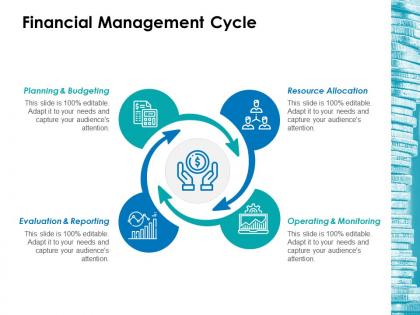
Financial management cycle ppt inspiration smartart





Try Before you Buy Download Free Sample Product
 Impress Your
 Audience
 100%
100% Editable
 Save Hours
 of Time


Whether you are looking to make an instructive, informative, problem solving, decision making or persuasive presentation we have a Financial Management Cycle Ppt Inspiration Smartart for each one of them.
People who downloaded this PowerPoint presentation also viewed the following :
Financial management cycle ppt inspiration smartart with all 5 slides:
Comprehend facts and figures with our Financial Management Cycle Ppt Inspiration Smartart. They are good for data analytics.




FAQs for Financial management cycle
So basically there are four stages to financial management: planning (budgets and forecasts), implementing (actually doing the plans), monitoring (checking how you're doing), and controlling (fixing stuff when it goes wrong). It's kinda like driving - plan your route, drive it, watch the GPS, then adjust if you mess up. Each step flows into the next one naturally. Your monitoring tells you what to control, which affects how you plan next time. Honestly, most people skip around too much. Focus on getting your planning solid first - everything else becomes way easier after that.
Think of budgeting as your game plan before you spend a dime. Set your limits upfront, then track how you're actually doing throughout the month. Without one, you're basically guessing with your money - which never ends well, trust me. Compare what you planned vs. what really happened at the end. Those variance reports (sounds fancy but they're just "where did I mess up" sheets) help you get better next time. Short sentences work. The whole thing feeds into a cycle where each month builds on the last one's lessons.
Look, forecasting is basically predicting your money situation before you're broke lol. Use your past numbers plus what's happening in your market to guess future income and expenses. Makes decisions about hiring or big purchases way less scary. I used to think it was boring paperwork until I got blindsided by a slow quarter - never again. It's honestly a lifesaver when seasonal stuff hits or random opportunities pop up. Just do a simple 12-month rolling forecast and update it monthly. Trust me, you'll feel so much more in control of everything.
Honestly, just pick 3-5 metrics that actually matter to your business - ROI, cash flow, budget variance, that kind of stuff. Monthly dashboards are clutch when your boss starts breathing down your neck with questions. Set up some regular check-ins too. Weekly cash flow reviews, monthly closes, quarterly bigger picture stuff. The key is automating the reporting so you're not stuck in Excel hell every month (been there, it sucks). Don't track everything just because you can - I made that mistake early on. Focus on what moves the needle for your specific situation.
Oh man, cash flow forecasting is where most people mess up badly. Also not checking your actual numbers against what you budgeted - like, ever. I've watched businesses tank because they were making decisions off month-old data, thinking everything was peachy. Don't mix personal stuff with business expenses either, that's a nightmare to untangle later. Seasonal ups and downs will blindside you if you don't plan ahead. Monthly money check-ins are clutch, and honestly? Automate whatever you can so problems don't sneak up on you.
Honestly, tech is a game-changer for managing money stuff. Your accounting software handles all the boring transaction sorting automatically, plus reports that used to take forever now pop up instantly. Cloud tools are clutch too - your whole team can see real-time numbers from anywhere, which saves so much back-and-forth when decisions need to happen fast. The AI prediction stuff is pretty wild - it'll actually spot cash flow problems before they hit. Oh, and you basically never have to do manual data entry anymore (thank god). Way more time for actually figuring out what those numbers are telling you about your business.
Honestly, weekly cash flow forecasting changed everything for me - way better than monthly. Chase down those overdue payments right away because that's where things usually fall apart. We almost couldn't make payroll once and it was terrifying! Map out your next 13 weeks of money coming in and going out. Try to time your supplier payments with when customers actually pay you. Oh, and get a line of credit set up now while you don't need it - banks are weird about that timing. Keep 2-3 months of expenses saved up if you can swing it.
So risk management is basically your safety net for the whole FP&A process. When you're forecasting, build in different risk scenarios. Stress-test those budgets against worst-case stuff. I always think of it like checking weather before planning a BBQ - you need backup plans, right? During strategic planning, create contingencies. Your variance analysis gets way more useful when you factor in risks that might've thrown off your projections. Oh, and don't just do this once during budget season. Make it part of your monthly close routine - that's where you'll actually catch problems early.
Regular review checkpoints are honestly a game-changer - don't just wait until the end to see where you stand. Get people from other departments involved because they'll spot stuff you totally missed. Monthly pulse checks are way more helpful than they sound, trust me. Set up those automated alerts for your key metrics so problems show up early instead of when you're screwed. Data visualization tools help you catch trends fast. Oh, and write down why you made each decision - you'll be grateful later when similar situations come up again.
So first thing - get multiple people involved in your money stuff, don't let one person handle everything alone. Set up approval levels for spending (like anything over $500 needs a manager's ok). Regular internal audits are huge too. Document literally everything - yeah it's boring but trust me, you'll thank yourself later when something comes up. Stay on top of whatever regulations hit your industry, they change more than you'd think. Oh and bring in outside auditors sometimes for a fresh pair of eyes. Basically build these checks into your daily routine instead of scrambling to be compliant later.
ROI and cash flow should be your main focus - those numbers don't lie about what's actually working. Also track debt-to-equity and current ratios for overall health, plus revenue growth to see if you're heading the right way. Honestly, I'm kind of obsessed with these metrics because they cut through all the BS. Profit margins and working capital turnover matter too since they show how efficient your operations really are. Pick maybe 3-4 that fit your goals though - trying to monitor everything will just drive you crazy.
Look, regular stakeholder communication is honestly what makes or breaks your financial planning. You'll catch budget problems way earlier when people actually talk to you. Plus you avoid those super awkward meetings where leadership's like "where did all our money go?" - been there, not great. Getting input from departments helps you adjust forecasts based on what's actually happening instead of just guessing. Oh and buy-in for spending decisions becomes so much easier. Don't wait for quarterly reviews though - set up regular check-ins instead. Your future self will thank you when everything's actually aligned with reality.
Honestly, just get QuickBooks or Xero first - don't overthink it. Track your income and expenses there. For budgeting, I'm weirdly obsessed with Excel but Mint or YNAB are solid if you hate spreadsheets. Cash flow stuff is usually built into whatever accounting software you pick, though some people love Float for that. Oh, and set up some basic charts or dashboards. Makes spotting trends so much easier when you can actually see the data visually. Start simple with one platform though - I made the mistake of trying everything at once and it was chaos.
Honestly, scenario planning saved my butt so many times. Pick your three worst nightmares - like losing a big client or revenue tanking 20%. Then work backwards to see how they'd crush your cash flow. I always run these during planning season because getting blindsided sucks. Build some buffer zones into your budgets based on what you find. The tricky part is remembering to update scenarios regularly since things change fast. Oh, and don't just do this once - make it part of your routine or you'll forget until it's too late.
Honestly, the whole financial cycle thing is just about staying connected to your big picture goals. You budget regularly, which forces you to think past next month's bills - suddenly you're linking today's coffee runs to that 5-year plan. Monthly reviews catch you when spending gets weird (happens to everyone). Think of it like GPS constantly checking if you're still heading the right direction. When stuff changes, you adjust. The key is using those check-ins to ask yourself: "Does this choice actually get me closer to where I want to be?" Sounds obvious but you'd be surprised how often we forget.
No Reviews