

Accounting cycle ppt slide




Try Before you Buy Download Free Sample Product
 Impress Your
 Audience
 100%
100% Editable
 Save Hours
 of Time


Frame your thoughts with our Accounting Cycle Ppt Slide. They will acquire a fantastic look.
People who downloaded this PowerPoint presentation also viewed the following :
Accounting cycle ppt slide with all 7 slides:
Our Accounting Cycle Ppt Slide are a bearer cheque. Feel free to fill it as you feel fit.





FAQs for Accounting
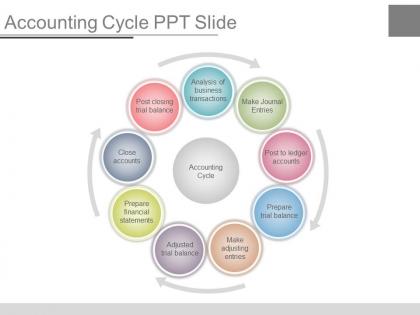
The key stages of the accounting cycle include transaction identification, journal entries, ledger posting, trial balance preparation, adjusting entries, financial statement creation, and closing entries. These interconnected stages streamline financial reporting by systematically recording transactions, ensuring accuracy through reconciliation, and producing comprehensive statements, with many organizations finding that proper cycle management enhances compliance and strategic decision-making.
The accounting cycle ensures accuracy through systematic verification steps including journal entry reviews, trial balance preparation, adjusting entries, and reconciliation processes that catch errors before finalization. These structured checkpoints enable organizations to identify discrepancies, correct misstatements, and maintain compliance standards, with many financial institutions finding that rigorous cycle adherence ultimately delivers reliable reporting and enhanced stakeholder confidence.
Adjusting entries ensure financial statements accurately reflect a company's financial position by recording accrued revenues, expenses, depreciation, and prepaid items at period-end. These entries bridge timing differences between cash transactions and economic events, enabling businesses to comply with accounting principles while providing stakeholders with precise financial data for strategic decision-making and regulatory reporting.
Technology streamlines the accounting cycle through automated data entry, real-time transaction processing, cloud-based accessibility, and integrated financial reporting systems. These digital solutions enhance accuracy by eliminating manual errors, accelerate month-end closings, and enable instant financial insights, with many organizations finding that automation reduces processing time by up to 75% while improving compliance.
Common accounting cycle pitfalls include data entry errors, missed transactions, inadequate documentation, poor reconciliation practices, and delayed closing procedures. These issues can be minimized through automated bookkeeping systems, regular internal audits, standardized documentation protocols, and monthly reconciliation schedules, with many organizations finding that systematic controls and staff training ultimately deliver improved accuracy and faster financial reporting.
The closing process varies primarily in complexity and account types, with sole proprietorships transferring net income directly to owner's equity, partnerships allocating profits among partner capital accounts, and corporations moving earnings to retained earnings while declaring dividends. Manufacturing businesses close additional cost accounts like work-in-progress and finished goods, while service companies focus mainly on revenue and expense accounts, ultimately ensuring accurate financial reporting across all business structures.
The accounting cycle supports regulatory compliance by establishing systematic documentation, ensuring accurate financial reporting, maintaining audit trails, and providing timely disclosure of financial information. Through standardized processes like journal entries, reconciliations, and closing procedures, organizations demonstrate adherence to GAAP, SOX requirements, and industry-specific regulations, ultimately delivering transparency and accountability that regulatory bodies require.
Most organizations complete the accounting cycle monthly for optimal cash flow monitoring and quarterly reporting compliance, while some high-volume businesses benefit from weekly cycles for enhanced oversight. This frequency enables timely financial decision-making, regulatory adherence, and strategic planning, with many companies finding that monthly cycles deliver the ideal balance between operational efficiency and comprehensive financial transparency.
Businesses can assess accounting cycle efficiency through metrics like days sales outstanding, accounts payable turnover, time-to-close periods, error rates, and cost per transaction processed. Financial services firms and retail organizations increasingly track these indicators to streamline operations, reduce processing costs, and enhance reporting accuracy, ultimately delivering faster financial insights and improved cash flow management.
Understanding the accounting cycle enhances managerial decision-making by providing systematic financial insights, ensuring data accuracy, and enabling timely performance analysis throughout reporting periods. This comprehensive framework allows managers to identify trends, allocate resources strategically, and make informed choices about budgeting, investments, and operational adjustments, ultimately delivering improved financial control and competitive advantage.
The accounting cycle enhances cash flow management by providing systematic tracking of receivables, payables, and cash transactions, enabling precise forecasting and timing predictions. Through regular reconciliations and accrual adjustments, organizations can identify cash flow patterns, optimize collection processes, and strategically time payments, with many businesses finding that consistent cycle adherence significantly improves liquidity planning and working capital optimization.
The accounting cycle for non-profit organizations emphasizes fund accounting, donor restrictions tracking, and compliance reporting, while for-profit entities focus on revenue recognition, shareholder equity, and tax optimization. Non-profits must demonstrate stewardship through detailed fund segregation and mission-focused financial statements, whereas businesses prioritize profitability metrics and investor returns, ultimately delivering different stakeholder accountability frameworks.
Not following the accounting cycle properly leads to inaccurate financial statements, compliance violations, poor decision-making, cash flow problems, and potential legal issues. These oversights significantly impact business operations, with many organizations finding that inconsistent accounting practices result in missed opportunities, regulatory penalties, and ultimately compromised investor confidence and competitive disadvantage.
Small businesses can implement effective accounting cycles through cloud-based software, automated transaction recording, monthly reconciliation schedules, and standardized chart of accounts. By leveraging affordable platforms like QuickBooks or FreshBooks, many small retailers and service providers streamline bookkeeping tasks, reduce manual errors, and maintain regulatory compliance, ultimately delivering better financial visibility without requiring dedicated accounting staff.
Accounting software integration revolutionizes the traditional accounting cycle by automating data entry, reducing manual calculations, and enabling real-time financial reporting throughout each phase. This technological enhancement streamlines journal entries, ledger updates, and trial balance preparation, while minimizing human error and accelerating month-end closing processes, ultimately delivering faster financial insights and improved accuracy for strategic decision-making.
-
Unique and attractive product design.
-
Unique and attractive product design.