

Fitness coach powerpoint presentation slides




Try Before you Buy Download Free Sample Product
 Impress Your
 Audience
 100%
100% Editable
 Save Hours
 of Time


Motivate and help your clients to achieve their fitness goals with the help of Fitness Coach PowerPoint Presentation Slides. The presentation gives detailed information about the company overview with the leadership team, leadership fitness consultant, a training program offered by our company, etc. The slides contain a fitness industry overview, challenges, and solutions, fitness consulting services offered by the company, cost analysis for fitness consulting, fitness consulting monthly planning, fitness consulting impact, etc. Utilize this ready-to-use fitness coaching PPT slide deck and give an overview of the fitness industry by showcasing the market size, the number of health, and fitness clubs worldwide. Discuss the need for fitness culture in the company and barriers and solutions to fitness. This fitness trainer PPT visuals allow you to organize fitness challenges in your company. Discuss the number of activities that are offered to employees to keep them healthy and fit. You can perform a cost analysis for fitness consulting by using health trainer PowerPoint themes. Discuss the impact of fitness consulting on insurance cost and the impact of introducing fitness consulting in the business by easily downloading our professionally designed gym trainer PPT presentation.
People who downloaded this PowerPoint presentation also viewed the following :
Content of this Powerpoint Presentation
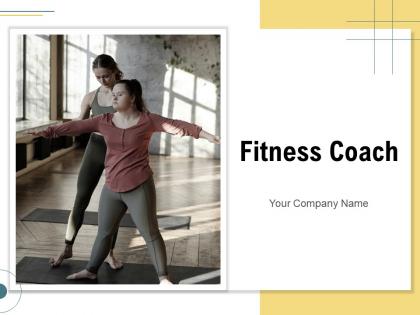
Slide 1: This slide introduces Fitness Coach. State your Company name and begin.
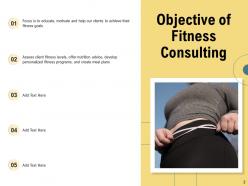
Slide 2: This slide displays Objective of Fitness Consulting
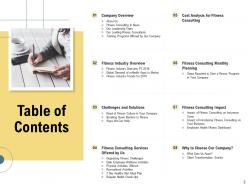
Slide 3: This slide displays Table of Contents
Slide 4: This slide displays Table of Content
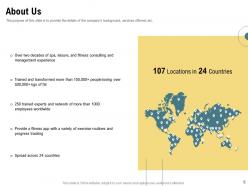
Slide 5: The purpose of this slide is to provide the details of the company’s background, services offered, etc.
Slide 6: This slide provides the details of the news where our company is covered as newspaper headlines showing the growth of the company.
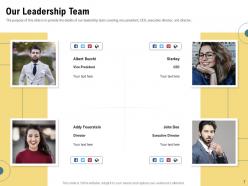
Slide 7: The purpose of this slide is to provide the details of our leadership team covering vice president, CEO, executive director, and director.
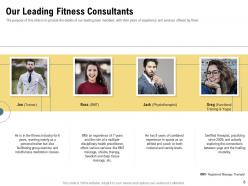
Slide 8: The purpose of this slide is to provide the details of our leading team members with their years of experience and services offered by them.
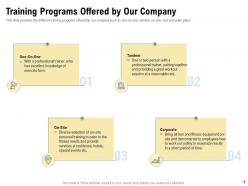
Slide 9: This slide provides the different training programs offered by our company such as one-on-one, tandem, on-site, and corporate plans.
Slide 10: This slide displays Table of Content
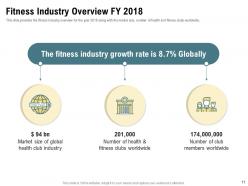
Slide 11: This slide provides the fitness industry overview for the year 2018 along with the market size, number of health and fitness clubs worldwide.
Slide 12: This slide provides the demand of mHealth apps during the year 2015 to 2026, to track the wellbeing using smartphones.
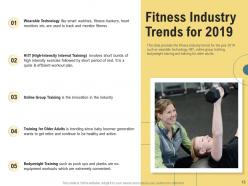
Slide 13: This slide provides the fitness industry trends for the year 2019 such as wearable technology, HIIT, online group training, bodyweight training and training for older adults.
Slide 14: This slide displays Table of Content of the presentation.
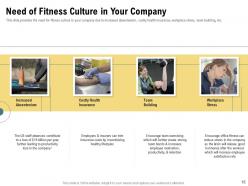
Slide 15: This slide provides the need for fitness culture in your company due to increased absenteeism, costly health insurance, workplace stress, team building, etc.
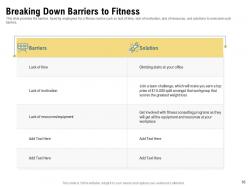
Slide 16: This slide provides the barriers faced by employees for a fitness routine such as lack of time, lack of motivation, lack of resources, and solutions to overcome such barriers.
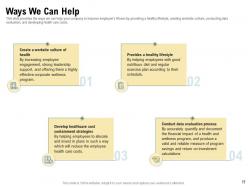
Slide 17: This slide provides the ways we can help your company to improve employee's fitness by providing a healthy lifestyle, creating worksite culture, conducting data evaluation, and developing health care costs.
Slide 18: This slide displays Table of Content
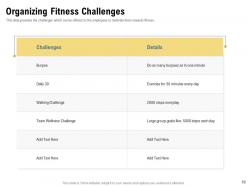
Slide 19: This slide provides the challenges which can be offered to the employees to motivate them towards fitness.
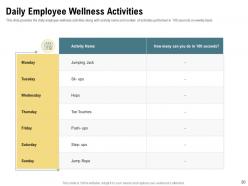
Slide 20: This slide provides the daily employee wellness activities along with activity name and number of activities performed in 100 seconds on weekly basis
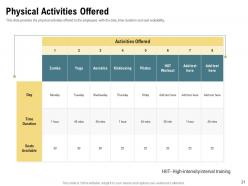
Slide 21: This slide provides the physical activities offered to the employees with the date, time duration and seat availability.
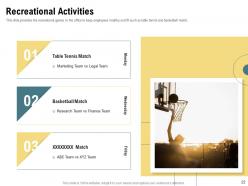
Slide 22: This slide provides the recreational games in the office to keep employees healthy and fit such as table tennis and basketball match.
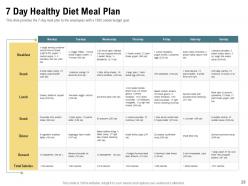
Slide 23: This slide provides the 7-day meal plan to the employees with a 1500 calorie budget goal.
Slide 24: This slide covers the health check-ups offered by us to the employees along with its costs such as medical & physical examination, laboratory investigations, and various other tests.
Slide 25: This slide displays Table of Content
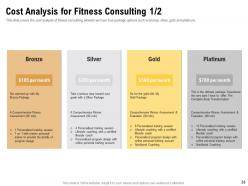
Slide 26: This slide covers the cost analysis of fitness consulting, wherein we have four package options such as bronze, silver, gold and platinum.
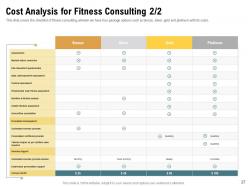
Slide 27: This slide covers the checklist of fitness consulting, wherein we have four package options such as bronze, silver, gold and platinum with its costs.
Slide 28: This slide shows Table of Content
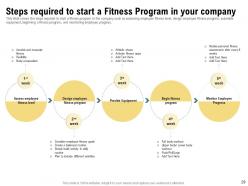
Slide 29: This slide covers the steps required to start a fitness program in the company such as assessing employee fitness level, design employee fitness program, assemble equipment, beginning a fitness program, and monitoring employee progress.
Slide 30: This slide highlights Table of Content
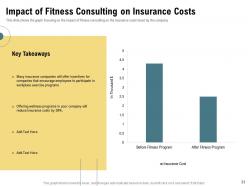
Slide 31: This slide shows the graph focusing on the impact of fitness consulting on the insurance costs faced by the company
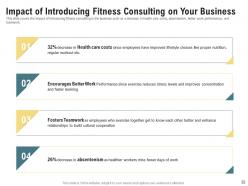
Slide 32: This slide covers the impact of introducing fitness consulting in the business such as a decrease in health care costs, absenteeism, better work performance, and teamwork.
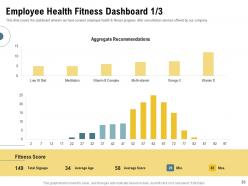
Slide 33: This slide covers the dashboard wherein we have covered employee health & fitness progress after consultation services offered by our company
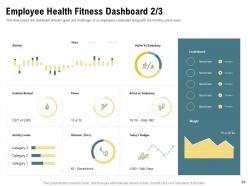
Slide 34: This slide covers the dashboard wherein goals and challenges of an employee is evaluated along with the monthly active users.
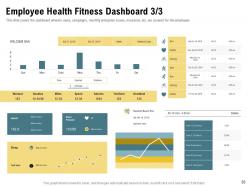
Slide 35: This slide covers the dashboard wherein users, campaigns, monthly enterprise scores, insurance, etc. are covered for the employees.
Slide 36: This slide displays Table of Content
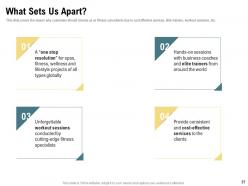
Slide 37: This slide covers the reason why customers should choose us as fitness consultants due to cost effective services, elite trainers, workout sessions, etc.
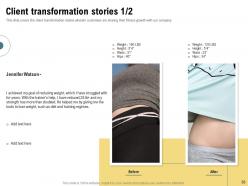
Slide 38: This slide covers the client transformation stories wherein customers are sharing their fitness growth with our company
Slide 39: This slide covers the client transformation stories wherein customers are sharing their fitness growth with our company
Slide 40: This is Icons Slide for Fitness Coach.
Slide 41: This slide is titled as Additional Slides for moving forward.
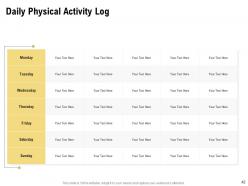
Slide 42: This slide represents Daily Physical Activity Log
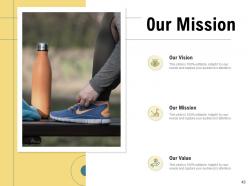
Slide 43: This slide displays Mission, Vision and Goals.
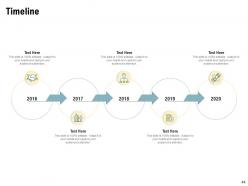
Slide 44: This slide shows Timeline process.
Slide 45: This is Idea Generation slide to highlight important message and beliefs.
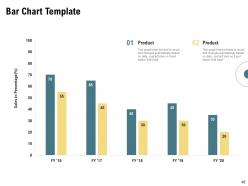
Slide 46: This is Bar Chart Template
Slide 47: This slide is titled as Post It Notes. Post your important stuff.
Slide 48: This slide displays Venn Diagram
Slide 49: This is Thank You slide with Contact details.
Fitness coach powerpoint presentation slides with all 49 slides:
Use our Fitness Coach Powerpoint Presentation Slides to effectively help you save your valuable time. They are readymade to fit into any presentation structure.




FAQs for Fitness coach
Definitely check their certifications first - NASM, ACSM, or ACE are solid. You want someone who actually studied anatomy, not just someone who posts gym selfies all day. Match them to what you're doing though. Like if you want to deadlift heavy, don't get the Pilates person (learned that one the hard way lol). Good trainers will assess you properly and make you a real program instead of handing everyone the same cookie-cutter workout. Oh and do a consultation call first - you'll know pretty quick if they're actually listening or just trying to sell you packages.
So first thing they'll do is basically interrogate you about everything - your fitness level, injuries, schedule, goals, the works. Sounds intense but it's actually super helpful! They need to know if you're dealing with a bad knee or can only work out at 6am before kids wake up. Past workout disasters? Yeah, they want to hear about those too. The whole point is creating something that actually works for YOUR messy real life instead of some generic program. Good coaches will tweak things as you go - maybe you hate burpees (who doesn't?) or need to switch up timing. Find someone who actually listens instead of just pushing their favorite routine on everyone.
Dude, you can't coach properly if you're running on fumes. I crashed mid-session once and felt like an idiot. Your body needs fuel to handle back-to-back clients and stay mentally sharp during consultations. Consistent meal timing is huge - I usually eat around my coaching blocks now. Protein's your best friend for recovery between your own workouts. Plus clients notice everything. They're watching how you look and move, so your eating habits become part of the package whether you like it or not. Get your nutrition right and everything else follows.
Honestly, it's like 50% therapist work lol. I'm always mixing things up so clients don't get bored - new exercises, different goals each week. Celebrating tiny wins matters way more than people think. Some clients need me to be their hype person, others respond better when I'm more direct about their BS excuses. I track everything beyond just weight - strength, how they're sleeping, energy levels. When someone's struggling, I remind them why they started this whole journey. Regular check-ins are huge. Oh, and making it feel like a lifestyle instead of some horrible punishment? Game changer.
Dude, get a coach if you can swing it. They'll actually fix your form before you hurt yourself - I was doing squats completely wrong for like two years lol. Plus they design stuff specifically for what you want, not some random program online. The accountability thing is huge too. You won't bail on workouts when someone's expecting you there. And honestly? They push you way harder than you'd ever push yourself. If you're stuck in a plateau or keep making excuses, try a few sessions. Game changer.
You gotta track the obvious stuff - weight, strength gains, measurements, all that. But here's the thing: ask your clients how they actually *feel*. Better sleep? Less stressed? Moving easier day-to-day? That subjective stuff matters just as much, maybe more. Don't ignore adherence rates either. People not showing up? Your program's probably too intense or boring, doesn't matter what the scale says. I'd do check-ins every month or so to see what's working and what isn't. Oh, and confidence changes are huge - sometimes that's the best indicator you're on the right track, even when the numbers are being stubborn.
Most coaches I know track progress with body measurements, progress photos, and performance stuff like how many push-ups you can do or your mile time. Weight and body fat percentage too, obviously. The scale's super misleading though when you're putting on muscle - I learned that the hard way! Apps and fitness trackers are huge now. Energy levels matter just as much as the numbers honestly. Don't go crazy with tracking everything - pick maybe 3 or 4 methods you'll actually stick with consistently. That's where people mess up.
Experience helps for sure, but it's not the only thing that matters. When a coach has struggled with their own fitness stuff, they get the mental game - like when you hit those annoying plateaus or your body just decides to be stubborn. You can't really learn that from books, you know? But honestly, I've met some super fit trainers who were terrible at actually teaching people. The sweet spot is finding someone who's been there but can also break down the science behind what they're doing. They should tell you stories you relate to AND explain why you're doing certain exercises.
Good coaches start with form before anything else - gotta build that foundation right. They'll teach you proper movement patterns and make sure you're warming up enough. Rest days are huge too, even though we all wanna train every single day (guilty as charged). If your mobility's terrible or you've got old injuries, they'll switch up exercises. Watch for coaches who actually pay attention to what you're doing instead of just counting reps. Honestly, find someone who cares more about technique than how much weight you're throwing around.
Definitely get doctor clearance first - that's non-negotiable. Then figure out what modifications work for their specific issues. Seated exercises for mobility problems, low-impact stuff for bad joints, you know? I've honestly gotten way more creative working with clients who have limitations than I ever was with regular cases. Progress super slowly and watch how they react to everything. What they CAN do matters way more than focusing on restrictions. Keep backup exercises in your back pocket because you'll probably need to switch things up mid-workout sometimes. It's actually pretty rewarding once you get the hang of it.
Listen, active listening is everything - like actually hearing what they're struggling with instead of just waiting to jump in. Most people get lost with all the fitness jargon, so explain stuff super simply. I've literally watched great trainers lose clients because they couldn't describe a basic squat without sounding like a textbook! Empathy matters too since everyone wants to quit at some point. Oh, and motivational skills obviously. Just pretend you're explaining workouts to your friend who's never stepped foot in a gym - that mindset will make you so much better at this.
Honestly, the best coaches I know are obsessed with learning new stuff. They're constantly taking courses, getting new certifications, hitting up conferences. I'd start with something like NASM or ACSM if you want the legit organizations. PubMed's great for actual research, though it can be pretty dense. Social media works too but man, there's so much garbage mixed in with the good science. Oh and definitely connect with other trainers - workshops and networking events are clutch. Maybe start simple with a monthly fitness journal subscription first?
Dude, people think fitness coaches just yell motivational stuff and count to ten. That's so wrong. You actually need to know anatomy, nutrition, psychology - plus how to work around injuries. Oh, and everyone assumes you have to look like a magazine cover 24/7. Some of the smartest coaches I know look totally normal, which honestly makes sense. Another thing - it's not easy money at all. Clients cancel constantly, and you're always studying new research. If you're thinking about it, get real certifications first. It's way more complicated than people realize.
Honestly, the best trainers are basically part therapist anyway! They'll start sessions with breathing exercises or quick mindfulness stuff to help you decompress. During workouts, they actually pay attention to your energy and mood - like if you're stressed, they might switch up the plan. Good ones teach you that exercise is self-care, not some punishment you deserve. They focus on building confidence through goal-setting instead of just obsessing over numbers on the scale or whatever. Find someone who checks in on your headspace, not just whether your squat form is perfect.
Honestly, start simple with one solid tracking app - the whole tech thing can get crazy overwhelming fast. I use Trainerize mostly, plus MyFitnessPal for the food stuff. Heart rate monitors are clutch, and those body composition scales are pretty neat if you can swing it. Resistance bands and measuring tape are basics you'll definitely need. Oh, and video apps for checking form are getting really popular now. I got carried away buying gadgets when I started lol. Build up your setup slowly once you figure out what your clients actually respond to. Some people love all the data, others just want to show up and work out.
-
Best way of representation of the topic.
-
The content is very helpful from business point of view.
-
Attractive design and informative presentation.
-
Visually stunning presentation, love the content.
-
Very unique, user-friendly presentation interface.
-
Much better than the original! Thanks for the quick turnaround.
-
Informative design.