


Sports center management powerpoint presentation slides




Try Before you Buy Download Free Sample Product
 Impress Your
 Audience
 100%
100% Editable
 Save Hours
 of Time


Ensure your facilities are in the best possible condition by maintaining, upgrading, repairing and improving them using our Sports Center Management PowerPoint Presentation Slides. The facility management PPT layout helps you to discuss the business and structural model of your club with the potential clients. Use our sports club PowerPoint slideshow to showcase the focus areas of the management team like a proposed action plan, responsible committee, and communication on mode, estimated budget and completion date. To build strong brand names elucidate the facilities and offerings, evolutionary phases, and stakeholders expectations from the club as embraced in the event management PPT template. This leisure centre PowerPoint presentation also describes the fee structure and sponsorship benefits. Develop a solid marketing plan and campaign to attract customers, also explain the loyalty program and benefits and a communication plan as simplified in the academy administration PPT graphic. Besides this, the club performance PowerPoint slides also explicate clear expression of strategies, challenges & solutions along with equipment and gym safety checklists.
People who downloaded this PowerPoint presentation also viewed the following :
Content of this Powerpoint Presentation
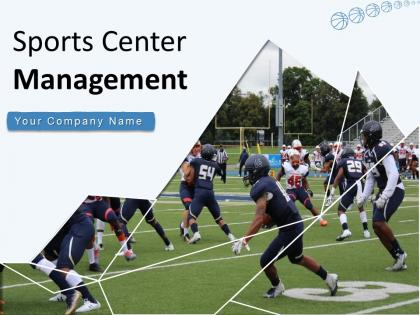
Slide 1: This title slide introduces the Sports Center Management. Add the name of your company here.
Slide 2: This slide presents the Agenda of Sports Centre Management. It includes: A reputed sports club wants to open its branch at ABC location, and Club administration will attract new customers by running a marketing campaign and will use the various checklist to maintain club’s health.
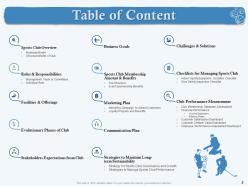
Slide 3: This slide contains the Table of Content. It includes: Sports Club Overview, Roles & Responsibilities, Facilities & Offerings, Evolutionary Phases of Club, Stakeholders Expectations from Club, Business Goals, Sports Club Membership Amount & Benefits, Marketing Plan, Communication Plan, Strategies to Maintain Long-term Sustainability, Challenges & Solutions, Checklists for Managing Sports Club, and Club Performance Measurement.
Slide 4: This is a table of content slide showing the Sports Club Overview. This includes the Business Model and the Structural Model of Club,
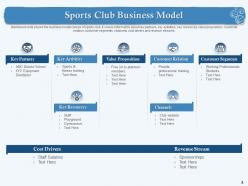
Slide 5: This slide presents the Sports Club Business Model. It shows the business model canvas of sports clubs. It covers information about key partners, key activities, key resources, value proposition. Customer relation, customer segments, channels, cost drivers, and revenue streams.
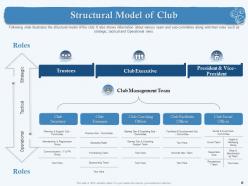
Slide 6: This slide presents the Structural Model of the Club. The following slide illustrates the structural model of the club. It also shows information about various teams and sub-committee along with their roles such as strategic, tactical, and operational roles.
Slide 7: This is a table of content slide showing the Roles & Responsibilities. This includes: The Management Team or Committees and Individual roles.
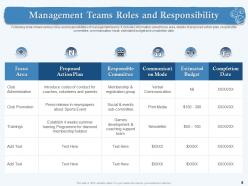
Slide 8: This slide presents the Management Teams Roles and Responsibilities. It shows various roles and responsibilities of management teams. It includes information about the focus area, details of the proposed action plan, responsible committee, communication mode, estimated budget, and completion date.
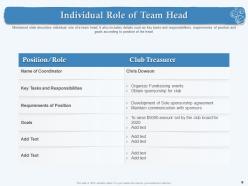
Slide 9: This slide presents the Individual Role of the Team Head. It describes the individual role of a team head. It also includes details such as key tasks and responsibilities, requirements of the position, and goals according to the position of the head.
Slide 10: Thi8s slide introduces the Expectations from Club. This includes: Facilities & Offerings, Evolutionary Phases of the Club, and Stakeholders.
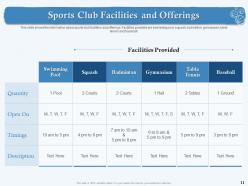
Slide 11: This slide presents the Sports Club Facilities and Offerings. It shows the information about sports club facilities and offerings. Facilities provided are a swimming pool, squash, badminton, gymnasium, table tennis, and baseball.
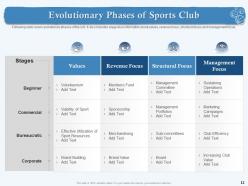
Slide 12: This slide presents the Evolutionary Phases of the Sports Club. It covers the evolutionary phases of the cub. It also includes stage-wise information about values, revenue focus, structural focus, and management focus.
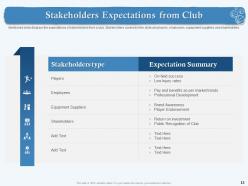
Slide 13: This slide presents the Stakeholders Expectations from Club. Mentioned slide displays the expectations of stakeholders from a club. Stakeholders covered in the slide are players, employees, equipment suppliers, and shareholders.
Slide 14: This is a table of content slide showing the Business Goals and Sports Club Membership Amount & Benefits. The latter includes: Fee Structure and Event Sponsorship Benefits.
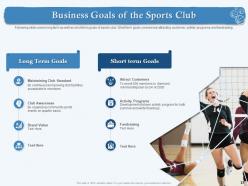
Slide 15: This slide presents the Business Goals of the Sports Club. It covers the long term as well as short-term goals of a sports club. Short-term goals covered are attracting customers, activity programs, and fundraising.
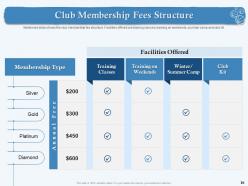
Slide 16: This slide presents the Club Membership Fees Structure. It shows the club membership fee structure. Facilities offered are training classes, training on weekends, summer camp, and club kit.
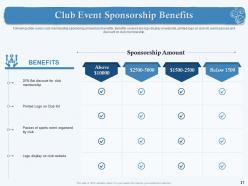
Slide 17: This slide presents the Club Event Sponsorship Benefits. It covers club membership sponsoring amount and benefits. Benefits covered are logo display on the website, printed logo on club kit, event passes, and discount on club membership.
Slide 18: This is a table of content slide showing the Marketing Plan which includes Marketing Campaign to Attract Customers and Loyalty Program and Benefits. It also introduces the Communication Plan.
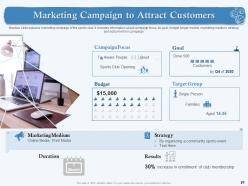
Slide 19: This slide presents the Marketing Campaign to Attract Customers. It explains the marketing campaign of the sports club. It includes information about campaign focus, its goal, budget, target market, marketing medium, strategy, and outcome from the campaign.
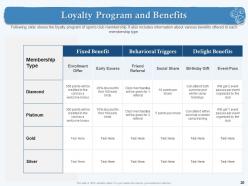
Slide 20: This slide presents the Loyalty Program and Benefits. It shows the loyalty program of sports club membership. It also includes information about various benefits offered to each membership type.
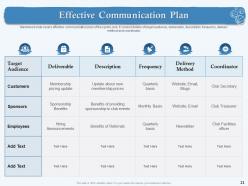
Slide 21: This slide presents the Effective Communication Plan. It covers the effective communication plan of the sports club. It consists of details of the target audience, deliverable, description, frequency, delivery method, and coordinator.
Slide 22: This is a table of content slide showing the Strategies to Maintain Long-term Sustainability. This includes the Strategy for Sports Club Governance and Growth and Strategies to Manage Sports Club Performance.
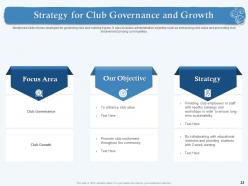
Slide 23: This slide presents the Strategy for Club Governance and Growth. It shows strategies for governing the club and making it grow. It also includes administration objectives such as enhancing club value and promoting club involvement among communities.
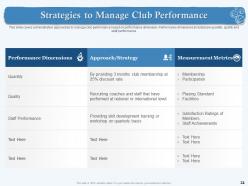
Slide 24: This slide presents the Strategies to Manage Club Performance. It covers administration approaches to manage club performance based on performance dimensions. Performance dimensions included are quantity, quality, and staff performance.
Slide 25: This is a table of content slide showing the Challenges & Solutions.
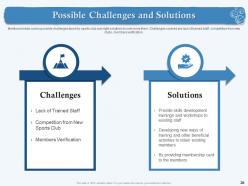
Slide 26: This slide presents the Possible Challenges and Solutions. It covers possible challenges faced by the sports clubs and the right solutions to overcome them. Challenges covered are lack of trained staff, competition from new clubs, members verification.
Slide 27: This is a table of content slide showing the Checklists for Managing Sports Club. This includes Indoor Sports Equipment Condition Checklist and Gym Safety Inspection Checklist.
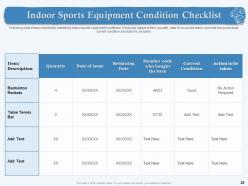
Slide 28: This slide presents the Indoor Sports Equipment Condition Checklist. It shows a checklist for identifying indoor sports equipment conditions. It includes details of the item, quantity, date of issue and return, member who purchased, current condition, and action to be taken.
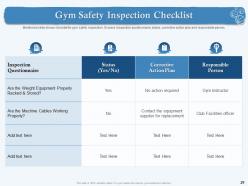
Slide 29: This slide presents the Gym Safety Inspection Checklist. It shows the checklist for a gym safety inspection. It covers inspection questionnaire, status, corrective action plan, and responsible person.
Slide 30: This is a table of content slide showing the Club Performance Measurement. This includes the Club Membership Database Assessment and Financial Performance. The latter includes Income Statement and Balance Sheet.
Slide 31: This slide presents the Club Membership Database Assessment. It shows the assessment of the club membership database. It covers information about how many members applied for enrollment and how much has been left along with their reason for leaving.
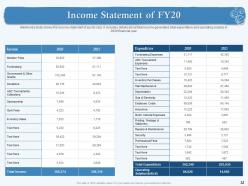
Slide 32: This slide presents the Income Statement of FY20. It shows the income statement of a sports club. It includes details about the total income generated, total expenditure, and an operating surplus in the 2020 financial year.
Slide 33: This slide presents the Balance Sheet of FY20. It shows the balance sheet of a sports club. It includes total assets, total liabilities, net assets, and total members fund in the 2020 financial year.
Slide 34: This slide presents the Customer Satisfaction Dashboard, Customer Lifetime Value Dashboard, and Employee Performance Assessment Dashboard.
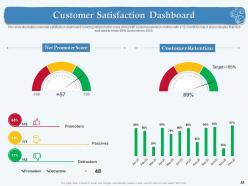
Slide 35: This slide presents the Customer Satisfaction Dashboard. It illustrates a customer satisfaction dashboard covering net promoter score along with customer retention metrics with a 12-month format. It also indicates that the club was able to retain 89% of its customers in 2020.
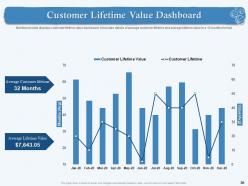
Slide 36: This slide presents the Customer Lifetime Value Dashboard. It displays a customer lifetime value dashboard. It includes details of average customer lifetime and average lifetime value in a 12 months format.
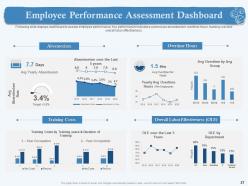
Slide 37: This slide presents the Employee Performance Assessment Dashboard. It displays a dashboard to assess employee performance. Key performance indicators covered are absenteeism, overtime hours, training cost, and overall labor effectiveness.
Slide 38: This is the Icons Slides for Sports Center Management
Slide 39: This slide presents the Additional Slides.
Slide 40: This slide contains the information about the company aka the ‘About Us’ section. This includes the Value of Clients, Premium Services, and Our Company.
Slide 41: This slide provides the Mission for the entire company. This includes the vision, the mission, and the goal.
Slide 42: This slide is a Roadmap template to showcase the stages of a project, for example.
Slide 43: This slide is a Timeline template to showcase the progress of the steps of a project with time.
Slide 44: This slide contains Post It Notes that can be used to express any brief thoughts or ideas.
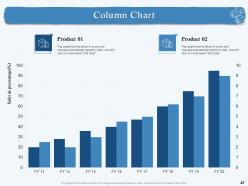
Slide 45: This slide shows a Column Chart that compares 2 products’ sales over a timeline of financial years.
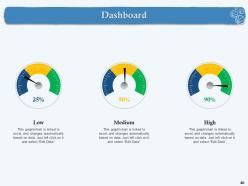
Slide 46: This slide presents the Dashboard with the data’s numbers at Low, Medium, and High.
Slide 47: This is a slide with a 30 60 90 Days Timeline to set goals for these important intervals.
Slide 48: This is a Thank You slide where details such as the address, contact number, email address are added.
Sports center management powerpoint presentation slides with all 48 slides:
Use our Sports Center Management Powerpoint Presentation Slides to effectively help you save your valuable time. They are readymade to fit into any presentation structure.








FAQs for Sports center management
Honestly, there's a lot to juggle but start with the basics. Your equipment needs to stay maintained and the place has to be clean - gross gyms lose members fast. Staff training matters since they're dealing with people all day. Budget oversight is huge too, along with scheduling classes and managing memberships. Don't forget safety stuff either, that's non-negotiable. Member experience should drive most decisions tbh. I'd say audit what you're doing now in each area first. Oh and revenue streams - gotta know where your money's coming from. Once you see the gaps, prioritize from there.
First thing - track when your facilities are actually busy vs empty. You'll probably be surprised by how much downtime there really is! Charge more during peak hours to naturally spread people out. Block booking works great for teams who need regular slots, just make sure you can shift them around when necessary. Honestly, most places wing it with scheduling and it shows. Get a centralized system where staff can see everything and move bookings easily. Track your weekly utilization rates so you can catch patterns early and make quick adjustments.
Dude, you can't run a sports center without solid tech anymore. Booking systems handle all your court reservations and classes. Access control manages who gets in. Payment processing covers memberships, classes, whatever. The analytics stuff is actually pretty cool - shows you when people show up most so you can staff properly. Oh and there's facility tech that monitors your equipment and keeps the lights/AC running smoothly. I mean, my gym still uses a paper sign-up sheet for some classes and it's chaos. Start by figuring out what systems you already have, then see where the biggest headaches are in your daily routine.
Honestly, it's all about making people feel like the gym actually cares about them. Track what classes they like and send personalized suggestions - the data's right there, might as well use it. Remember their names when they walk in (sounds basic but most places don't). Keep everything clean because gross equipment is an instant turnoff. Make booking super easy through apps so they can grab spots without calling. Oh, and create actual community vibes - challenges, events, spaces where people can chill. I'd start by just asking your current members what they want more of.
Dude, don't put all your eggs in the membership basket - that's where most places mess up. Personal training, classes, equipment rentals, even corporate stuff can bring in solid cash. Track your numbers like crazy and actually look at your budget every month. I learned this the hard way, but keep 3-6 months of expenses saved up because something always breaks at the worst time. Also diversify your income streams beyond just monthly fees. Cash flow control is huge - way too many centers get caught off guard during slow periods.
Dude, go super local with this stuff. Partner with schools for kids' programs and sponsor whatever community events are happening. Farmers markets are gold for trial classes - people are already in a good mood there. Social media's your friend too, but skip the corporate vibe. Post real member wins and show what actually goes on behind the scenes. Word-of-mouth still crushes everything else in small towns, so just focus on making people's experiences awesome. They'll do the talking for you. Oh, and pick three local groups you could work with this month and just call them up.
Honestly, you need to hit three big things: equipment checks, training your people, and having solid emergency plans. I'd do monthly safety walkthroughs - trust me, don't blow these off even when you're crazy busy. Get everyone trained on first aid and how to actually use your equipment properly. Emergency exits need to be obvious, keep those first aid kits stocked, and post safety rules everywhere. Document everything too because liability stuff is no joke. Oh, and make sure your insurance is decent. Start with a simple monthly checklist - it keeps you from forgetting stuff and catches problems early.
Hire for attitude over skills every time. You can teach anyone to scan membership cards, but you can't fix someone who just doesn't give a damn about helping people. I learned this the hard way with one particularly grumpy hire - members literally started avoiding the front desk when she worked! Look for natural problem-solvers who actually smile when they talk. Pair new people with your rockstar employees during training, not whoever's scheduled. Cross-train everyone so you're not screwed when someone calls out sick. And honestly? Keep doing customer service refreshers even after they're trained. Happy staff equals happy members.
Dude, community partnerships can totally make or break a sports center. Local schools, youth leagues, businesses - they give you steady revenue and people actually care about your place. The word-of-mouth alone is incredible. I've watched centers bomb because they tried going it alone, while others kill it by being part of the neighborhood fabric. Honestly, healthcare partnerships are underrated too - think physical therapy or wellness programs. Start with maybe 3-5 organizations that actually fit what you're doing and pitch them real collaboration ideas, not just "hey let's partner."
Track your member check-ins and class attendance first - you'll spot patterns fast. Data shows you peak hours, which equipment gets hammered, and honestly? Whether that pricey yoga instructor actually brings in money. I'd start simple before getting fancy with predictive stuff. You can catch maintenance issues early, see who's about to cancel their membership, and figure out if anyone actually uses childcare at 6am (spoiler: probably not). Revenue analysis helps too - some programs look popular but tank your profits. Game-changer for staffing decisions once you get the hang of it.
Start with LED lights and a smart thermostat - seriously, your electric bill will thank you. Pool and shower water usage adds up fast, so look into low-flow fixtures. I'd honestly get an energy audit first though, shows you exactly where you're wasting money. Recycling programs are easier to set up than you think, plus composting café scraps if you have space. When you renovate anything, go for sustainable materials. Oh and those eco-friendly cleaners? They actually work better for indoor air quality. The waste management stuff might seem boring but it makes a bigger difference than most people realize.
Dude, there's so much you can do! Personal training and group classes are obvious ones. Equipment rentals bring in easy cash too. I'd definitely add food/drinks - people are always starving after workouts. Corporate events and birthday parties can be huge money makers if you rent out space. Some gyms do massage therapy or nutrition stuff, but honestly that might be getting too fancy at first. Supplements and gear sales work well since people are already there buying into the fitness thing. Just pick one or two things that make sense with what you've already got going.
Honestly, scheduling's gonna be your biggest headache - volleyball and badminton both wanting the gym at the same time, wrestling mats vs basketball courts, equipment everywhere. Different age groups make it even messier. Get some solid scheduling software first, that'll save your sanity. Modular equipment helps too so you can flip spaces quickly. Cross-train your staff on multiple sports if possible. Map out when everyone actually wants to use stuff and see which sports can share. Oh, and always build in buffer time between bookings - trust me on that one. People never clean up as fast as they promise.
Look, start with the obvious stuff - ramps, accessible bathrooms, equipment that works for everyone. But the social barriers are honestly harder to tackle and way more important. Your staff needs training on being genuinely welcoming, not just polite. Create programs for groups who don't usually show up, keep pricing reasonable with sliding scales. Oh, and do an audit first - you'll be shocked at what you've been missing. The language in your marketing matters too, so ditch anything that sounds exclusive or intimidating.
Dude, feedback is literally how you figure out what's broken at your gym. Members will tell you about stuff you'd never even think about - like that one treadmill that makes weird noises or how the 6pm yoga class is always packed but 7pm is dead. I swear, sometimes the "small" complaints end up being the most important fixes. Set up different ways for people to reach you - surveys work, but so does just chatting with regulars. Oh, and actually follow through! If multiple people say the locker room smells funky, that's your sign to do something about it.
-
Commendable slides with attractive designs. Extremely pleased with the fact that they are easy to modify. Great work!
-
Thanks for all your great templates they have saved me lots of time and accelerate my presentations. Great product, keep them up!
-
Editable templates with innovative design and color combination.
-
Helpful product design for delivering presentation.