

Corporate wellness powerpoint presentation slides




Try Before you Buy Download Free Sample Product
 Impress Your
 Audience
 100%
100% Editable
 Save Hours
 of Time


Educate and motivate your employees to reach their fitness goals by using Corporate Wellness PowerPoint Presentation Slides. The presentation contains various high-quality templates that discuss company overview, leadership team, leading fitness consultants, a training program offered by the company, etc. It covers an overview of the fitness industry, global demand for health apps in the market, fitness industry trends for the year 2019. Utilize these attention-grabbing corporate health and fitness PPT layouts and discuss the need for fitness culture in the company. This health and wellness PowerPoint slide deck, allows you to overcome barriers faced by employees for fitness by providing solutions. Take the assistance of ready-to-use business health and fitness to depict the fitness consulting services offered by the company. Showcase the challenges which can be offered to employees to motivate them towards fitness. The presentation also covers the healthcare check-ups offered to employees along with costs and duration. Thus, download our professionally designed employee healthcare PPT presentation and help to achieve the fitness goals of the clients.
People who downloaded this PowerPoint presentation also viewed the following :
Content of this Powerpoint Presentation
Slide 1: This slide introduces Corporate Wellness. State your Company name and begin.
Slide 2: This slide explains Objective of Fitness Consulting
Slide 3: This slide displays Table of Contents.
Slide 4: This slide displays Table of Content.
Slide 5: This is About Us slide to showcase Company specifictions.
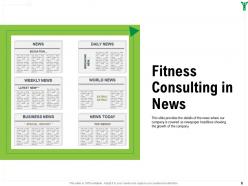
Slide 6: This slide provides the details of the news where our company is covered as newspaper headlines showing the growth of the company.
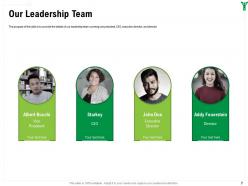
Slide 7: The purpose of this slide is to provide the details of our leadership team covering vice president, CEO, executive director, and director.
Slide 8: The purpose of this slide is to provide the details of our leading team members with their years of experience and services offered by them.
Slide 9: This slide provides the different training programs offered by our company such as one-on-one, tandem, on-site, and corporate plans.
Slide 10: This slide displays Table of Content
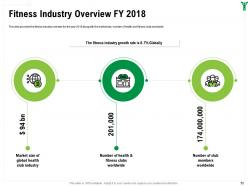
Slide 11: This slide provides the fitness industry overview for the year 2018 along with the market size, number of health and fitness clubs worldwide.
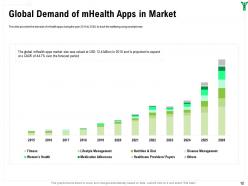
Slide 12: This slide provides the demand of mHealth apps during the year 2015 to 2026, to track the wellbeing using smartphones.
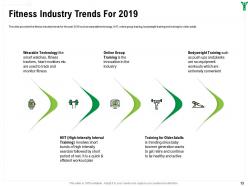
Slide 13: This slide provides the fitness industry trends for the year 2019 such as wearable technology, HIIT, online group training, bodyweight training and training for older adults.
Slide 14: This slide displays Table of Content
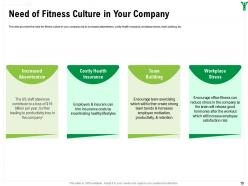
Slide 15: This slide provides the need for fitness culture in your company due to increased absenteeism, costly health insurance, workplace stress, team building, etc.
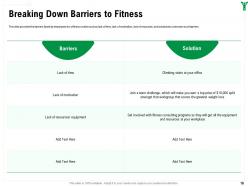
Slide 16: This slide provides the barriers faced by employees for a fitness routine such as lack of time, lack of motivation, lack of resources, and solutions to overcome such barriers.
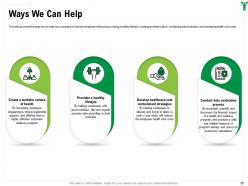
Slide 17: This slide provides the ways we can help your company to improve employee's fitness by providing a healthy lifestyle, creating worksite culture, conducting data evaluation, and developing health care costs.
Slide 18: This slide displays Table of Content.
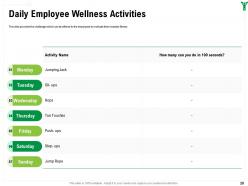
Slide 19: This slide provides the challenges which can be offered to the employees to motivate them towards fitness.
Slide 20: This slide provides the challenges which can be offered to the employees to motivate them towards fitness.
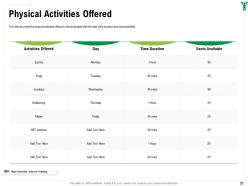
Slide 21: This slide provides the physical activities offered to the employees with the date, time duration and seat availability.
Slide 22: This slide provides the recreational games in the office to keep employees healthy and fit such as table tennis and basketball match.
Slide 23: This slide provides the 7-day meal plan to the employees with a 1500 calorie budget goal.
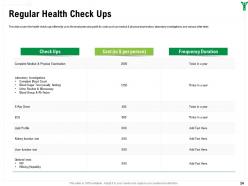
Slide 24: This slide covers the health check-ups offered by us to the employees along with its costs such as medical & physical examination, laboratory investigations, and various other tests.
Slide 25: This slide displays Table of Content
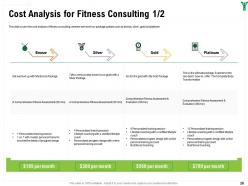
Slide 26: This slide covers the cost analysis of fitness consulting, wherein we have four package options such as bronze, silver, gold and platinum.
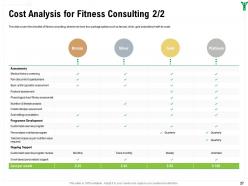
Slide 27: This slide covers the checklist of fitness consulting, wherein we have four package options such as bronze, silver, gold and platinum with its costs.
Slide 28: This slide displays Table of Content
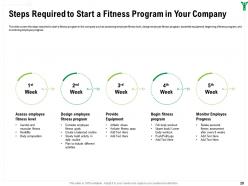
Slide 29: This slide covers the steps required to start a fitness program in the company such as assessing employee fitness level, design employee fitness program, assemble equipment, beginning a fitness program, and monitoring employee progress.
Slide 30: This slide displays Table of Content
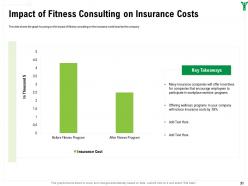
Slide 31: This slide shows the graph focusing on the impact of fitness consulting on the insurance costs faced by the company.
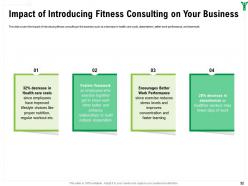
Slide 32: This slide covers the impact of introducing fitness consulting in the business such as a decrease in health care costs, absenteeism, better work performance, and teamwork.
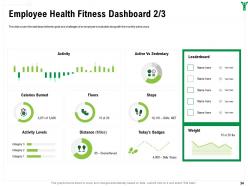
Slide 33: This slide covers the dashboard wherein we have covered employee health and fitness progress after consultation services offered by our company.
Slide 34: This slide covers the dashboard wherein goals and challenges of an employee is evaluated along with the monthly active users.
Slide 35: This slide covers the dashboard wherein users, campaigns, monthly enterprise scores, insurance, etc. are covered for the employees.
Slide 36: This slide displays Table of Content
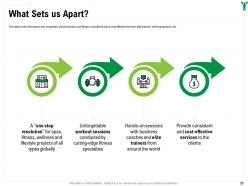
Slide 37: This slide provides the different training programs offered by our company such as one-on-one, tandem, on-site, and corporate plans.
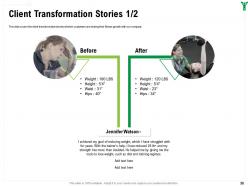
Slide 38: This slide covers the client transformation stories wherein customers are sharing their fitness growth with our company
Slide 39: This slide covers the client transformation stories wherein customers are sharing their fitness growth with our company
Slide 40: This is Icons Slide for Corporate Wellness.
Slide 41: This slide is titled as Additional Slides for moving forward.
Slide 42: This slide displays Daily Physical Activity Log
Slide 43: This slide displays Mission, Vision and Goals.
Slide 44: This is Our team slide with Names and Designations.
Slide 45: This is About Us slide to showcase Company specifications.
Slide 46: This is Idea Generation slide to highlight important facts and message.
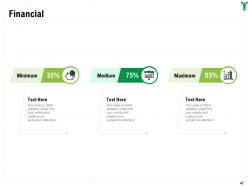
Slide 47: This slide shows Finance related stuff.
Slide 48: This is Thank you slide with Contact details.
Corporate wellness powerpoint presentation slides with all 48 slides:
Use our Corporate Wellness Powerpoint Presentation Slides to effectively help you save your valuable time. They are readymade to fit into any presentation structure.















FAQs for Corporate wellness
Health screenings, fitness programs, mental health support, and nutrition education - those are your core four. Most places just throw gym memberships at people and call it a day, which is honestly pretty lazy. Mental health resources are huge right now. Leadership has to actually care though, otherwise it's dead in the water. Communication about what's available matters too. Oh, and definitely track how people are engaging - you need some way to measure if it's working. Incentives help a lot. People love rewards for participating. Just start with one thing that's really solid instead of going crazy trying to launch everything.
Track your hard numbers like healthcare costs, sick days, and how many people actually show up to programs. But don't stop there - survey employees about stress and job satisfaction too. Participation rates are honestly kind of a no-brainer indicator of whether your stuff is working. Productivity metrics matter a lot since that's where you'll probably see the biggest payoff. Oh, and definitely get baseline measurements before you start anything, otherwise you're just guessing at results. The soft feedback is just as crucial as the financial data.
Honestly, if your employees are burned out and stressed, nothing else in your wellness program will work. I've seen companies throw money at gym memberships while people are having panic attacks at their desks - it's backwards. Absenteeism goes through the roof when mental health tanks. Plus stress literally makes people sick more often, which is kind of obvious but companies ignore it anyway. You don't need anything fancy to start. Just normalize talking about mental health and maybe add some EAP resources or those quick mindfulness things.
Honestly, just make it easy and worth their time. Gift cards work great, or maybe extra PTO - who doesn't want that? Don't design everything for fitness fanatics though. Survey people first to see what they actually want instead of assuming. Your executives need to participate too or it'll flop immediately. Communication is everything - tell them what's available and how it benefits THEM specifically. Mix up options for different schedules and fitness levels. I've seen so many companies mess this up by overthinking it. Start simple with something most people can do.
Okay so there's actually a bunch of good options out there! Fitbit for Teams and Virgin Pulse are solid for step challenges and that gamification stuff. For mental health, Headspace for Work is pretty decent, or Lyra if you need actual counseling resources. Honestly though, the all-in-one platforms might be your best bet - Wellhub and Thrive Global bundle fitness classes, nutrition tracking, sleep coaching, basically everything. The selection is kind of overwhelming now. But here's the thing - definitely survey your team first to see what they'd actually use before you commit to anything.
Honestly, wellness programs are kind of a no-brainer when you think about it. Healthier employees just show up better - less sick days, way more energy, actually engaged instead of zombie-walking through meetings. People feel like you give a damn about them as humans, not just productivity machines. Some companies go all out with meditation rooms and whatever, but you don't need to get fancy. My friend's company started with just "hey, work from home Fridays" and stress workshops. Even healthy snacks work. Just pick something your team would actually use - not some random HR thing nobody wants. Build from there once you see what sticks.
Honestly, just start tiny! Walking meetings are clutch, or throw some decent snacks in the break room instead of vending machine garbage. Step challenges work great too - hit up local businesses for prizes. Mental health stuff is where it's at though. Maybe grab someone to do a lunch thing on stress management? Flexible hours help tons when you can swing it. Here's the thing - just ask people what they'd actually want first. I learned that the hard way at my last job. Pick one thing that won't break the bank, see what happens, then add more later.
Honestly, just ask your people what they actually want first - don't guess. Boomers usually love the face-to-face stuff like seminars and anything they can print out. Gen X wants quick, practical things that don't waste their time - lunch sessions work great. Millennials and Gen Z? They're living on their phones anyway, so apps and virtual options are your best bet. I'd start small though - maybe try 2-3 different approaches and see what sticks. Mix it up with some old-school fitness classes plus digital tools like meditation apps. Track participation rates and you'll figure out what's working pretty fast.
Oh totally, there's a huge link there. People stick around way longer when they feel like their company actually gives a shit about them as people. Wellness programs, flexible schedules, mental health days - that stuff shows you're not just another cog in the machine. Why would anyone leave a job that makes their life easier? Companies doing this right see retention jump like 20-30%, which honestly makes sense. Plus all those turnover costs add up fast, so it basically pays for itself. If you're bleeding good employees, wellness programs are probably your best bet.
Honestly, it starts with leadership walking the walk. You can't tell people to prioritize wellness while you're firing off emails at 2am - that's just hypocritical. Actually check in with your team (like, genuinely ask how they're doing). Put real money behind it too - mental health days, flexible hours, maybe a gym membership thing. Here's what really bugs me though: people shouldn't feel bad for using their vacation days! Celebrate it instead. I'd start small - try walking meetings or block out lunch in your calendar. Trust me, your team watches everything you do and they'll copy it. Sometimes the simple stuff makes the biggest difference.
HIPAA's the big one - any health data needs protection, including from your vendors. ADA compliance is trickier though, tons of companies mess this up by accidentally discriminating against people with disabilities or conditions. Keep everything voluntary, obviously. Never tie health results to job decisions either. Honestly? Legal should review everything before you launch, especially with incentives or biometric stuff involved. Those areas get messy fast if you're not careful upfront.
Honestly, you can't just bolt wellness onto your existing setup and expect it to work. Update your actual company values first - mention employee wellbeing right next to those performance metrics. Then your managers need real training on supporting work-life balance, not just some generic seminar. I've watched too many places just add a wellness page to their website and think they're done. Your physical workspace should reflect this stuff too. The trick is weaving it into daily operations and decision-making. Make it feel authentic to who you already are as a company, not like some trendy afterthought.
Honestly, the AI wellness stuff is everywhere now - companies are using your data to customize fitness plans and stress management programs. Virtual therapy sessions are becoming pretty normal, which is great because mental health support was way overdue for an upgrade. A lot of places are also doing financial wellness programs since being broke obviously makes you stressed. Sleep optimization is getting weird though - I heard some companies actually change meeting times based on when people's bodies naturally wake up? That seems intense but kind of cool. Just focus on what'll actually help your team instead of chasing every shiny new trend.
Honestly, the numbers are pretty solid - you're looking at cutting healthcare costs by 15-30% after a couple years. Early screenings catch the expensive stuff before it gets out of hand, and people who stay active just don't call in sick as much. The trick is avoiding those cringe wellness seminars nobody shows up to. On-site flu shots work great, mental health support is huge right now, and fitness perks that don't feel forced. Oh, and the ROI takes a bit to kick in, so don't expect magic overnight. But once it does? Totally worth it.
Start by actually asking your employees what's driving them crazy - is it childcare issues, brutal commutes, or never being able to disconnect? Then build around those real problems. Flexible schedules are obvious, but think bigger: on-site childcare, mental health resources, meal delivery services. Meeting-free Fridays sound goofy but they genuinely work (my friend's company does this and people love it). Don't just throw random perks at the wall hoping something sticks. Try a small pilot program first and track what actually improves satisfaction scores.
-
Excellent products for quick understanding.
-
Enough space for editing and adding your own content.
-
The content is very helpful from business point of view.
-
Wonderful templates design to use in business meetings.
-
Unique design & color.
-
Best way of representation of the topic.
-
Easily Editable.
-
Professional and unique presentations.
-
Good research work and creative work done on every template.