


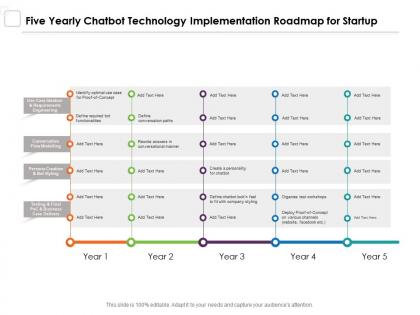
Five yearly chatbot technology implementation roadmap for startup




Try Before you Buy Download Free Sample Product
 Impress Your
 Audience
 100%
100% Editable
 Save Hours
 of Time


Visualize your work plan and communicate your ideas impactfully with our pre designed Five Yearly Chatbot Technology Implementation Roadmap For Startup. Showcase the detailed overview of the project, the key deliverables, and the milestones to be achieved with the help of our fully customizable PowerPoint layout. You can easily emphasize on the project goals and discuss all the activities involved in an easy to comprehend manner by utilizing our professionally designed PPT theme. This roadmap PowerPoint layout is a perfect strategic planning tool that can help in keeping the project on track. With our attractive PowerPoint theme, you can articulate the workflow, track the work progress, and have a clear vision of the goal to be achieved. Download this versatile Five Yearly Chatbot Technology Implementation Roadmap For Startup and save your hours of work.
People who downloaded this PowerPoint presentation also viewed the following :
Five yearly chatbot technology implementation roadmap for startup with all 2 slides:
Use our Five Yearly Chatbot Technology Implementation Roadmap For Startup to effectively help you save your valuable time. They are readymade to fit into any presentation structure.
FAQs for Five yearly chatbot technology implementation
Start with discovery and planning - figure out your use cases and user flows first. Then move into design and development, building out the conversation logic and connecting it to your existing systems. Testing is honestly where things get interesting because you'll discover so many weird edge cases you never thought of. After deployment, monitoring performance becomes your new best friend - you'll be constantly training the bot based on real conversations. Oh, and here's the thing that saved me tons of headaches: don't go crazy trying to build everything upfront. Focus on the most common customer questions first, then expand gradually.
Figure out the exact problem you're trying to fix first - support tickets, lead qualification, whatever. Then nail down your success metrics. Like, do you want 80% resolution rates or just fewer emails hitting your inbox? Here's the thing everyone screws up: they want their bot to do literally everything. Don't. Pick 2-3 things max for your first version. You can always add more later but starting simple actually works. Write this stuff down and make sure your team's on the same page about what winning looks like. Otherwise you'll be arguing about it later.
You'll need conversational flow design, NLP capabilities, and a good knowledge base to start. Definitely build in fallback responses - users will absolutely find ways to confuse your bot that you never saw coming. Analytics are crucial for tracking how it's performing, plus you need integration with your current systems. Oh, and make sure there's a way to hand off to real humans when things get messy. Honestly, I'd map out your most common user questions first and nail those basic flows. Save the fancy AI stuff for later once you've got the foundation solid.
Oh dude, personas are a game changer for chatbots! Interview your best customers first - figure out how they actually talk and what drives them crazy. Then you can train your bot to match their vibe. Like, B2B folks want formal responses, but millennials? Totally different energy. Honestly, people will try the weirdest stuff with bots just to mess with them. Map out those communication styles before writing responses though. Makes conversations way less robotic and more like... actual conversations your customers would have.
So for the AI side, check out Microsoft Bot Framework, Dialogflow, or AWS Lex - they do all the language processing stuff so you don't have to build from scratch. Where to put it though? Go where your people actually are. Slack and Teams are solid for business users. Your website's obvious. Mobile apps work great too. Facebook Messenger used to be the hot thing but feels kinda dated now tbh. Don't spread yourself thin - pick maybe 2 channels to start. Get it talking to your CRM first, then add more later.
First thing - map out all your touchpoints: CRM, databases, APIs, auth systems, everything. Build a solid middleware layer for data translation between the chatbot and existing systems. Trust me, our first integration literally crashed the customer portal (still cringe thinking about it). Use standardized APIs when you can, and definitely build in fallbacks for when stuff inevitably breaks. Test everything in a sandbox that mirrors production. Oh, and loop in your IT team early! They'll catch integration nightmares you'd never see coming. Saves so much headache later.
You'll want to watch your resolution rate - that's how often the bot fixes stuff without passing it to a human. User satisfaction scores matter too, obviously. Response time is huge since nobody wants to wait forever for answers. I'd also track how many conversations actually finish vs. how often people bail halfway through. The containment rate is super boring but crucial - it shows how many chats your bot handles start to finish. Oh, and don't ignore the qualitative stuff! Look at where users get confused or stuck in conversations. That's where you'll find your biggest problems. Set up weekly dashboards so you're not flying blind.
Set up different ways for users to give feedback - chat ratings, surveys, direct comments. I'd definitely track conversation logs to see where people bail out or get annoyed. The data usually shows stuff you wouldn't expect, honestly. Look for patterns instead of getting hung up on random complaints. A/B testing different responses helps too - sometimes small wording changes make a huge difference. Most important thing? Actually fix problems when you spot them and tell users you heard them. I do weekly feedback reviews now. Boring but it works.
Make sure it's actually helpful on day one - seriously, there's nothing worse than launching something that just pisses people off. Start with your most basic, common questions where it can genuinely help. Send a casual announcement about what it does (and doesn't do), then have your team mention it naturally when it makes sense. Track what confuses it most and fix those gaps. Oh, and set up easy feedback so people can tell you when it sucks - then actually listen to that feedback. Don't overhype it either.
Start by picking which languages you want to tackle first. Google Translate API is probably your easiest bet - way faster to set up than building custom models from scratch. Translation quality has actually gotten scary good recently, though it can still miss conversational nuances sometimes. If you get serious usage, then think about training separate models for each language with their own conversation flows. Oh and don't forget cultural context matters just as much as literal translations - learned that the hard way on a project last year. I'd test with one extra language first, see if people actually use it before going all in.
Honestly, the worst part is always messy data - your bot will say the weirdest stuff if your training data sucks. Users also expect way too much right off the bat. Start super focused on one specific thing instead of trying to solve everything. Clean your data first (I know, boring but trust me). Set realistic expectations early or people will get annoyed when it can't book their vacation AND do their taxes lol. Plan to keep tweaking it because v1 will definitely be rough. Oh and set up tracking so you can see where people rage quit - that's gold for improvements.
Honestly, I'd start with monthly check-ins - maybe quarterly if you're not getting tons of traffic yet. Go through your conversation logs and look for patterns where people are hitting dead ends or asking stuff your bot has no clue about. I keep a running notes app for this stuff throughout the week because you'll forget otherwise. Track your fallback rates too - that's when the bot basically gives up and says "I don't understand." Pretty telling metric. Oh, and user satisfaction scores if you have them. Don't try to monitor everything at once though. Pick one thing to review weekly first, then add more as you get into the rhythm of it.
So basically AI/ML transforms your chatbot from just spitting out canned responses to actually getting what people mean. Natural language processing handles when users phrase things weirdly, and sentiment analysis catches when someone's getting pissed off. The machine learning aspect is honestly the coolest part - it picks up on conversation patterns and can predict what users want mid-sentence. You can also set it up to route complex stuff to real humans. Oh, and it keeps getting smarter from each interaction. I'd start simple with NLP then build up the ML features once you've got enough data to work with.
Build your ethical guidelines into the development process from the start - don't try adding them afterward. Define what your bot should and shouldn't do with user data, focusing on privacy, bias prevention, and transparency. This feels pretty abstract initially, but trust me, it becomes very real once you're handling actual user information. Audit your training data regularly for biases. Be upfront about your bot's limitations. Set up consent mechanisms too. Oh, and do ethics reviews with your team consistently - catching problems early saves you major headaches later.
Honestly, start with the official stuff first - Microsoft Bot Framework, Dialogflow, AWS Lex all have free courses and labs that are pretty solid. Your team should definitely knock out those certifications. But here's the thing - the real gold is in places like GitHub and Stack Overflow where people actually talk about what goes wrong in production. I mean, vendor docs are nice and polished, but they won't tell you why your bot crashes at 3am on a Tuesday. Hit the forums and chatbot communities after you've got the basics down. That's where you'll learn what actually matters.
No Reviews