


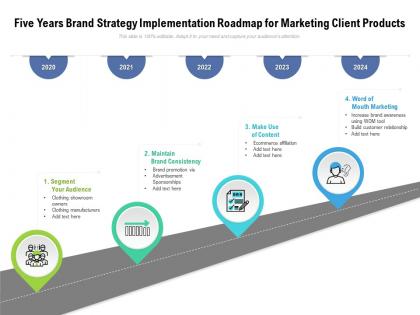
Five years brand strategy implementation roadmap for marketing client products




Try Before you Buy Download Free Sample Product
 Impress Your
 Audience
 100%
100% Editable
 Save Hours
 of Time


Visualize your work plan and communicate your ideas impactfully with our pre designed Five Years Brand Strategy Implementation Roadmap For Marketing Client Products. Showcase the detailed overview of the project, the key deliverables, and the milestones to be achieved with the help of our fully customizable PowerPoint layout. You can easily emphasize on the project goals and discuss all the activities involved in an easy to comprehend manner by utilizing our professionally designed PPT theme. This roadmap PowerPoint layout is a perfect strategic planning tool that can help in keeping the project on track. With our attractive PowerPoint theme, you can articulate the workflow, track the work progress, and have a clear vision of the goal to be achieved. Download this versatile Five Years Brand Strategy Implementation Roadmap For Marketing Client Products and save your hours of work.
People who downloaded this PowerPoint presentation also viewed the following :
Five years brand strategy implementation roadmap for marketing client products with all 2 slides:
Give your audience a fulfilling experience. They will find our Five Years Brand Strategy Implementation Roadmap For Marketing Client Products elevating.
FAQs for Five years brand strategy implementation roadmap for
Key components of an effective brand strategy roadmap include brand positioning, target audience definition, competitive analysis, messaging framework, visual identity guidelines, and implementation timeline. These elements work together by establishing clear market differentiation, aligning internal teams around consistent brand experiences, and providing measurable milestones, with many organizations finding that structured roadmaps accelerate brand recognition and customer loyalty.
Brands can effectively identify their target audience through comprehensive market research, demographic analysis, psychographic profiling, competitor audience assessment, and customer journey mapping. These strategic approaches enable organizations to understand consumer behaviors, preferences, and pain points across different segments, with many companies finding that detailed audience insights significantly enhance campaign effectiveness, improve resource allocation, and deliver stronger competitive positioning in increasingly crowded markets.
Brand positioning serves as the foundational cornerstone of any brand strategy roadmap, defining how the brand differentiates itself in the marketplace, communicates its unique value proposition, and connects with target audiences. This strategic positioning guides every subsequent roadmap element, from messaging frameworks and visual identity development to customer experience design and competitive differentiation strategies, ultimately ensuring cohesive brand execution across all touchpoints.
Brands measure strategy success through key performance indicators including brand awareness metrics, customer acquisition costs, market share growth, customer lifetime value, and net promoter scores. Through comprehensive analytics platforms, companies track engagement rates, conversion improvements, and revenue attribution while monitoring brand sentiment across channels, ultimately delivering measurable ROI and competitive positioning insights.
Common pitfalls include insufficient market research, unclear target audience definition, misaligned messaging across channels, unrealistic timelines, and lack of measurable objectives. These strategic missteps can derail brand positioning efforts, with many organizations finding that inadequate stakeholder buy-in and inconsistent brand voice implementation ultimately compromise competitive advantage and market differentiation initiatives.
Competitor analysis is crucial for brand strategy roadmaps, helping identify market gaps, positioning opportunities, pricing strategies, and differentiation points that inform strategic direction. Through comprehensive competitive research, organizations can benchmark their offerings against industry leaders, anticipate market shifts, and develop unique value propositions, ultimately enabling them to capture market share and establish sustainable competitive advantage.
**INPUT**: What tools or frameworks can assist in conceptualizing a brand strategy roadmap? **OUTPUT**: Brand strategy roadmap frameworks include brand positioning canvases, customer journey mapping, competitive analysis matrices, brand architecture models, and stakeholder engagement frameworks. These strategic tools streamline brand development by clarifying target audiences, defining value propositions, and establishing consistent messaging hierarchies, with many organizations finding that integrated approaches ultimately deliver stronger market differentiation and enhanced customer loyalty. [Word count: 58 words]
**INPUT**: How can a brand ensure consistency across all touchpoints in its strategy? **OUTPUT**: Brands achieve consistency through comprehensive brand guidelines, centralized asset management systems, regular cross-departmental training, and standardized messaging frameworks that align visual identity, tone, and customer experience protocols. Many organizations streamline this process by implementing digital brand management platforms and conducting quarterly audits across channels, ultimately delivering cohesive customer interactions and stronger brand recognition. [Word count: 54 words]
Storytelling serves as the emotional foundation that connects brand values, mission, and customer experiences throughout the strategic journey, creating narrative consistency across all touchpoints, marketing campaigns, and product developments. Through compelling brand narratives, companies like Nike and Apple differentiate themselves in competitive markets, build deeper customer loyalty, and guide strategic decisions, ultimately delivering memorable experiences that drive long-term growth.
Brands should adapt their roadmaps through continuous market monitoring, flexible milestone adjustments, and strategic pivoting based on consumer behavior shifts, competitive dynamics, and emerging trends. Through agile planning methodologies, companies in sectors like retail and technology streamline their brand positioning, messaging updates, and channel strategies, while maintaining core brand values, ultimately delivering sustained market relevance and competitive advantage.
Stakeholder involvement ensures brand strategy aligns with diverse perspectives, organizational capabilities, and market realities while building internal buy-in and commitment. Through collaborative workshops and strategic input sessions, companies like retail chains and financial institutions create more comprehensive brand positioning, streamline implementation processes, and ultimately deliver stronger market differentiation with greater organizational unity.
Brands can leverage social media by establishing consistent messaging across platforms, engaging directly with target audiences, building community relationships, and utilizing data analytics for strategic insights. Through targeted content strategies and influencer partnerships, companies in retail, hospitality, and consumer goods enhance brand awareness, drive customer loyalty, and ultimately achieve measurable engagement growth while gaining competitive advantage in digital markets.
Brands should track brand awareness, customer loyalty scores, net promoter scores, brand perception metrics, and market share to evaluate brand equity and effectiveness. These measurements enable organizations to assess recognition levels, customer retention rates, and competitive positioning, with many companies finding that combining quantitative data with qualitative insights delivers comprehensive understanding of brand performance and strategic advantage.
Brands should revisit their strategy roadmap quarterly for tactical adjustments and conduct comprehensive annual reviews, while remaining flexible for major market shifts, competitive disruptions, or significant business changes. This balanced approach enables organizations to maintain strategic consistency while adapting to evolving consumer behaviors, emerging technologies, and industry dynamics, ultimately delivering sustained competitive advantage and market relevance.
Best practices for communicating brand strategy to internal teams include creating comprehensive documentation, conducting interactive workshops, establishing clear messaging frameworks, implementing regular training sessions, and developing accessible visual guides. These approaches enhance alignment by ensuring consistent understanding across departments, facilitating seamless implementation through hands-on engagement, and ultimately delivering stronger brand coherence, with many organizations finding that structured communication significantly improves employee brand advocacy.
No Reviews