


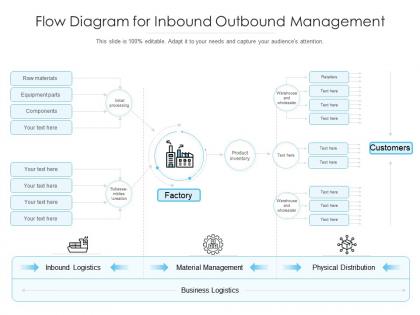
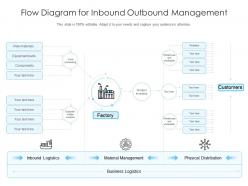
Flow diagram for inbound outbound management




Try Before you Buy Download Free Sample Product
 Impress Your
 Audience
 100%
100% Editable
 Save Hours
 of Time


Our Flow Diagram For Inbound Outbound Management are topically designed to provide an attractive backdrop to any subject. Use them to look like a presentation pro.
People who downloaded this PowerPoint presentation also viewed the following :
Flow diagram for inbound outbound management with all 2 slides:
Use our Flow Diagram For Inbound Outbound Management to effectively help you save your valuable time. They are readymade to fit into any presentation structure.
FAQs for Flow diagram for
So basically inbound is all the stuff coming in - receiving inventory, checking quality, getting things stored properly. Outbound handles everything going out to customers. Inbound's honestly kind of the boring side, but you get more wiggle room with timing. Outbound though? That's where the pressure is. Customers are waiting, so you're racing against the clock with picking and packing. The big thing is inbound focuses on verification while outbound is all speed and accuracy. I'd start by figuring out which team currently owns what - that's where you'll spot the gaps.
Honestly, flow diagrams are game-changers because they show you exactly where your stuff and info actually move through your whole system. You'll catch bottlenecks and weird gaps that are impossible to see when everything's just written out in boring documents. Think of it like getting above your operation and seeing all the connections between receiving, processing, shipping - suddenly everyone gets how their piece fits. I always tell people to map what you're doing now first, then figure out what you actually want it to look like. Way easier to spot where things can improve when it's all visual.
So you'll need supplier info, receiving steps, quality checks, and where stuff gets stored - that's your foundation. Map out vendor details and POs coming in first. Then show your dock operations, inspection process, and storage/distribution flow. Honestly, the people part is huge - document who does what at each stage. Include decision points too, like when quality fails or something's damaged. Oh, and make it detailed enough for a newbie to follow without wandering around confused. Nobody wants to be that person asking where the loading dock is on day three.
Dude, automation totally changes the game for warehouse flows. Manual bottlenecks just disappear when you get real-time tracking and AI routing working for you. Your team stops doing boring data entry and can actually focus on fixing problems before they blow up. The predictive analytics stuff is pretty crazy - it basically tells you what inventory you'll need before you run out. Oh and the routing optimization runs itself, which is honestly kind of scary how good it gets. Start by looking at where people are still doing things manually - that's where you'll see the biggest wins right away.
Honestly, just pick different metrics for each side. Inbound stuff - track your receiving accuracy, how long put-away takes, and that dock-to-stock time. For outbound, focus on pick rates, order accuracy, and whether you're actually shipping on time. Labor productivity matters way more than people think, that's usually where things fall apart. Oh and definitely watch your cost per unit and space usage. Don't try tracking like 20 different things though - pick maybe 4 or 5 that actually matter for your goals. What's your biggest pain point right now? Start there.
Honestly, most companies screw this up by keeping everything in separate silos - total headache. You'll want to get your data formats consistent first, then set up real-time connections between systems. APIs or middleware work great for translating info as it moves from receiving to shipping. Here's the thing though - your inventory system needs to be the central hub where both sides can update stuff simultaneously. I'd start by mapping where your data currently touches different points and finding where information goes missing or gets duplicated. That'll show you exactly where to build those bridges between systems.
So basically supply chain management is like the control center that keeps all your stuff flowing in and out. Inbound stuff - that's procurement, vendor relationships, making sure you get materials on time. Outbound covers your distribution and delivery networks. Honestly, it's probably more important than most people realize. Without good visibility across both sides, you'll miss bottlenecks until they bite you. Think of it as keeping your whole pipeline optimized so nothing gets stuck. Short version: it prevents chaos and keeps customers happy.
Honestly, customer feedback is like having a cheat sheet for both your inbound and outbound stuff. Your sales team hears the same objections over and over? Perfect - turn those into blog posts or FAQs. Meanwhile, if certain inbound leads are converting like crazy, your outbound team should hunt for more people who look just like them. It creates this weird cycle where your content gets better from sales insights, and your prospecting gets smarter from content data. I'd start by just writing down the top questions and pushback you're getting from both sides. You'll probably notice some obvious patterns pretty quickly that'll help you fine-tune everything.
Honestly, the worst part is when your inbound and outbound teams aren't talking to each other at all. Shipments show up out of nowhere or disappear without anyone knowing what's happening. Your receiving guys don't tell shipping about delays, so everything backs up. Then you've got these ancient systems that can't communicate - which is just frustrating for everyone involved. Labor's tight everywhere too, making it even messier. I'd start by actually walking through your whole process and figuring out where the communication totally falls apart. That's usually where the real problems are hiding.
Honestly, flow diagrams are lifesavers for training new people. Instead of handing them a massive manual, you just show them the whole process visually. People actually understand where they fit - like if they're doing shipments or whatever. I've watched new hires pick things up so much faster this way than when managers just talk at them for hours. Plus you can spot problem areas easily, like where tasks get passed between people and stuff goes wrong. Oh, and make different versions for each role so they're not overwhelmed with info they don't need right away.
Dude, just go with draw.io (they renamed it to diagrams.net but whatever). It's free and works great for flow diagrams - plus it connects to Google Drive if you're already living there. Lucidchart is another good option, especially if your whole team needs to jump in and edit together. The templates are actually useful too. I mean, you could use Visio but honestly? Way too much for basic flow mapping. My advice: start with draw.io since it costs nothing, see how it feels. If you end up needing more collaboration stuff later, then maybe switch to Lucidchart.
So basically you want your receiving and shipping to work together instead of being totally separate things. Right now you're probably dealing with chaos - can't find stuff, warehouse is packed, orders are slow. Fix the handoffs first. Map out where your inbound and outbound teams aren't talking to each other (there's always like 3-4 spots). Once they're synced up, everything flows better. Orders go out faster, customers are happier, your team isn't stressed. Oh and make sure the data connects too - you'll actually know what's happening instead of guessing.
Three things to nail down: accuracy when stuff comes in, where you put it, and how fast you move. Barcode scanning everywhere - seriously cuts down on mistakes. Cross-docking's clutch if you can pull it off, skips storage completely for items that fly out the door. Get your suppliers on consistent schedules so your crew isn't running around crazy. High-turnover stuff should live right by shipping - seems obvious but you'd be surprised how many places mess this up. Track your dock-to-stock times and set daily goals. Oh, and keep training your receiving team on new processes. Measure everything you can and automate whatever makes sense.
Track different stuff for each since they're totally different beasts. Inbound? Look at cost per lead, conversion rates, lifetime value - how much you're spending on content/SEO vs what's actually coming back. Outbound's easier to measure: ad spend, cold outreach costs, events against immediate revenue. Here's the thing though - inbound ROI will look like garbage for months, so don't freak out early on. I'd set up separate tracking for both and compare quarterly. Monthly comparisons are pretty useless for this stuff.
Amazon's fulfillment centers are probably your best bet - they're insane at handling tons of incoming inventory while shipping out millions of orders at the same time. Check out Zara too. They've got their supply chain mapped so well they can go from design to store shelves in weeks instead of months, which is pretty wild. Toyota's just-in-time system is solid for seeing how suppliers and production work together smoothly. Honestly, I'd start with Amazon since there's tons of documentation and flow diagrams you can actually find online without much digging.
-
Great quality slides in rapid time.
-
The content is very helpful from business point of view.
-
Excellent products for quick understanding.
-
Great quality product.
-
Very unique, user-friendly presentation interface.