

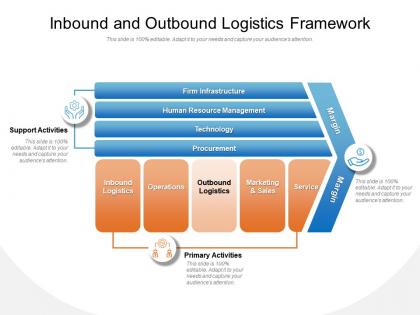
Inbound and outbound logistics framework




Try Before you Buy Download Free Sample Product
 Impress Your
 Audience
 100%
100% Editable
 Save Hours
 of Time


Highlight instances of heroism with our Inbound And Outbound Logistics Framework. Elaborate on inspiring deeds.
People who downloaded this PowerPoint presentation also viewed the following :
Inbound and outbound logistics framework with all 2 slides:
Elaborate on inspiring deeds with our Inbound And Outbound Logistics Framework. Highlight instances of heroism.
FAQs for Inbound and
Okay so you'll need five main things: transportation management, inventory control, warehousing, demand forecasting, and supplier relationships. Transportation gets your stuff moved around efficiently. Inventory control stops you from either hoarding too much or running out of important items. Warehousing is where everything lives and how fast you can grab it when needed. Honestly, demand forecasting tries to predict what you'll need but it's never spot-on. Good supplier relationships keep everything flowing smoothly - trust me on that one. I'd start by mapping your current setup to find the weak spots.
Route optimization software can cut your delivery times way down, and warehouse systems make picking/packing so much smoother. IoT sensors give you live tracking - honestly the accuracy blows my mind now. AI predicts demand patterns too. Don't try to overhaul everything at once though, that's a nightmare. Pick one thing like tracking or routing first. Automated inventory prevents stockouts while cutting carrying costs. Just make sure whatever you choose plays nice with your current setup - nobody wants another data silo headache. The tech's gotten crazy good lately.
Ok so think of supply chain management as the brain behind all your logistics stuff. It connects everything - from finding suppliers to actually getting products to customers. Logistics is more like the muscle doing the work (moving stuff, storing it, etc.) while SCM decides WHO you work with and WHEN things happen. I learned this the hard way at my last job - without good supply chain strategy, logistics just burns through money with no direction. My advice? Map out your supplier relationships first, then figure out how your transportation and warehousing will support those connections. Way easier than doing it backwards.
So first thing - figure out where your customers actually are, then work backwards from there. You'll want your warehouses close to highways, airports, ports, that whole deal. Mountains and rivers? Total pain for routing and they'll jack up your costs. Climate's a big one too since some transportation just doesn't work year-round in certain areas (learned that the hard way with a client in Minnesota). Storage requirements change based on weather too. Honestly, it's all about finding that sweet spot between keeping costs down and not pissing off customers with slow deliveries.
So for logistics metrics, I'd start with the obvious ones - on-time delivery and order accuracy since angry customers = bad news. Cost per shipment and inventory turnover matter too for keeping costs down. Lead times are honestly underrated for planning ahead. Then there's warehouse stuff like how fast your team picks and packs orders, plus space utilization (though that one can get weirdly complicated). Set up dashboards for these core ones first. Once you've got those running smoothly, you can dig into carrier performance and damage rates. Oh and inventory turnover - some people obsess over it but it's actually pretty telling about demand forecasting.
Honestly, start by measuring your current carbon footprint - you can't improve what you don't track. Route optimization is huge for cutting fuel costs. Switch to eco-friendly packaging when possible, and find carriers who actually care about green practices. Electric vehicles are amazing if you can swing the upfront cost. Consolidating shipments seems like a no-brainer but so many companies still don't do it! Regional distribution centers help cut down those long hauls too. Pick one thing first, see how it goes, then expand. Don't try to overhaul everything at once - that's how projects die.
Ugh, integration is honestly the worst part - nothing wants to talk to each other properly. Your teams will probably pushback hard because change sucks. Data quality issues? Yeah, those always pop up once you start digging around. Budget's gonna balloon too because projects never stay small. Training drags on forever, and you'll discover broken processes you didn't even know existed. Oh, and scope creep is basically guaranteed. Definitely try a small pilot first though - like just one department. Learned that the hard way on my last project. Way better than going all-in and having everything explode.
Look, inventory management is like the nerve center of your whole logistics setup. Everything connects through it. Without real-time visibility into what you've got and where it's sitting, you're making blind decisions about shipping, warehousing, all of it. I've seen companies completely fall apart when their inventory numbers are wrong - it's honestly insane how fast things spiral. You'll want to tie together demand forecasting, supplier stuff, and distribution planning around solid inventory tracking. But first? Audit what you can actually see right now. If those numbers are garbage, nothing else matters.
So I'd hit three main things: demand forecasting, inventory optimization, and route planning. Data analytics for predicting demand is huge - honestly saves like 15-20% right off the bat. Automate your inventory stuff to dodge overstocking disasters and those awkward stockout moments. Route optimization software will slash transportation costs too. Oh, and don't sleep on supplier relationships - good partnerships mean better terms and they'll actually respond when you need them. The real magic happens when all these systems actually talk to each other instead of being completely disconnected.
Here's what worked for me - map out where things usually go wrong first. Supplier issues, transport breaking down, sudden demand jumps, you know the drill. Then make backup plans for each weak spot. Keep extra stock of your must-have items and line up alternative suppliers before you need them. Honestly, monitoring systems are a game changer for catching problems before they explode. I wish I'd done this stuff sooner - would've saved me so much stress during last year's chaos. Just don't wait until you're already on fire to think about it.
Dude, regulations aren't optional - they basically control your whole logistics setup. You've gotta bake compliance in from the start, not slap it on later like some afterthought. This stuff affects everything: where you put warehouses, how you move goods, what tech you can even use. Cross-border paperwork alone will make your head spin. Smart move is mapping out all the rules early in planning. Otherwise you'll be scrambling to fix everything later, which honestly sounds like my personal nightmare. The routing, storage, data handling - it all has to play by their rules.
Dude, three big things are totally changing how logistics works right now. AI automation is letting companies predict problems before they even happen - like automatically rerouting stuff when there's gonna be delays. Real-time tracking is honestly a game changer because you can see everything from start to finish on one screen. Companies are also being forced to care about carbon footprint now, not just how fast and cheap they can move things. My cousin works in supply chain and says it's wild how different it is from even two years ago. If you're revamping anything, get the tracking system sorted first - everything else builds off that foundation.
Honestly, customer expectations run the whole show when it comes to logistics design. Want faster delivery? You're moving warehouses closer, switching shipping methods, repositioning inventory - the works. But if they care more about saving money than speed, flip your focus to efficiency instead. Real-time tracking expectations mean you need visibility tools baked in. The tricky part is expectations won't stop changing (Amazon really screwed us all on that front). Your framework has to bend with them. I'd start by comparing what customers actually expect versus what you can deliver right now. That'll show you where the biggest problems are hiding.
So B2B is way simpler - you're shipping bigger stuff in bulk to warehouses and businesses. Scheduled deliveries, longer timeframes, less headache overall. B2C though? Total chaos honestly. Thousands of tiny packages flying to random houses, everyone wants next-day delivery, and customers lose their minds if tracking isn't perfect. The last-mile delivery part gets expensive fast too. Oh and figure out your main customer type first - that choice basically determines your whole setup. B2B you can plan ahead, B2C you're constantly putting out fires.
Dude, you've gotta get your departments actually talking to each other. Sales, warehouse, procurement - when they're all in their own bubbles, everything falls apart. Weekly check-ins are seriously a lifesaver for catching problems early. Once teams start sharing what's coming down the pipeline, forecasting gets way more accurate. No more playing telephone between departments either, which honestly saves so much time. You'll spot inventory issues before they become disasters. I know it sounds basic, but most companies still suck at this. Start small with those weekly meetings and watch how much smoother things get.
No Reviews