

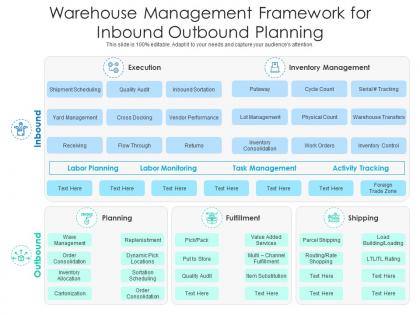
Warehouse management framework for inbound outbound planning




Try Before you Buy Download Free Sample Product
 Impress Your
 Audience
 100%
100% Editable
 Save Hours
 of Time


Our Warehouse Management Framework For Inbound Outbound Planning are topically designed to provide an attractive backdrop to any subject. Use them to look like a presentation pro.
People who downloaded this PowerPoint presentation also viewed the following :
Warehouse management framework for inbound outbound planning with all 2 slides:
Use our Warehouse Management Framework For Inbound Outbound Planning to effectively help you save your valuable time. They are readymade to fit into any presentation structure.

FAQs for Warehouse management framework for
So you're gonna need four main things: inventory tracking, order processing, labor management, and space optimization. Those are like the backbone of any decent WMS. Then add solid reporting so you can actually see what's working (trust me, you'll want those numbers). Integration is huge too - your systems need to talk to each other or you'll go crazy. Don't sleep on receiving and shipping workflows either, those can make or break you. Honestly though? Before you pick anything, figure out what's most broken in your current setup first. No point fixing what already works.
Dude, automation is where it's at - kills all that tedious manual crap your team's drowning in. Real-time inventory tracking, automated picking routes, systems that actually communicate instead of needing constant data entry. Yeah, setup's a pain initially but totally worth it. Your WMS updates stock automatically, creates pick lists, even forecasts reorders. Honestly the accuracy improvement alone pays for itself since human error rates drop big time. Oh and start with whatever's driving you most crazy right now - that's where you'll see money back fastest. Trust me on this one.
Dude, inventory management is literally what makes or breaks warehouse efficiency. Your team can pick orders way faster when they actually know what's in stock and where to find it. No more wandering around like lost sheep, you know? Good tracking also prevents those brutal stockouts that piss off customers. I worked with one place that improved their fulfillment time by 30% just from proper cycle counting - honestly blew my mind how much difference it made. Storage layout gets better too, plus you'll cut carrying costs. First thing though? Check your current inventory accuracy. If it's under 95%, fix that before anything else.
Dude, start tracking stuff like pick times and order accuracy - you'll spot patterns you never noticed before. Most warehouses are sitting on tons of data but aren't doing anything with it, which is honestly such a waste. Look at your peak hours, which inventory moves slow, how your team's performing. Short bursts work better than long sentences sometimes. Try predictive stuff too so you can actually forecast demand instead of just reacting to it. Don't go crazy though - pick one metric first and see what happens.
Okay so first thing - map out which products move fastest and put those closest to your shipping area. Keep receiving and shipping separate or you'll hate your life when trucks show up. Wide aisles are clutch for forklifts and stuff. Group similar products together, use your vertical space with good racking. Clear signage and numbering saves everyone's sanity when it's busy. Honestly the biggest mistake I see is not planning for growth - you don't want to redo this whole thing in a couple years when you're twice as big.
Honestly, good training makes a huge difference in warehouse performance. Your picking errors drop way down when people actually know what they're doing. Safety improves too - nobody's getting hurt because they don't understand the equipment. Operations just flow better overall. I've seen warehouses where undertrained staff constantly mess up workflows, and it's painful to watch. Confident employees work faster and adapt quicker when you roll out new systems. Yeah, training costs money upfront, but you'll save way more by avoiding all those preventable screwups down the road. Trust me on this one.
Honestly, just track the basics first - picks per hour, order fulfillment time, and your accuracy rates for picking/shipping. Space utilization matters too if you're tight on square footage. Cost per order is huge but can be tricky to calculate at first. Don't go crazy with metrics though, like 6-8 max or you'll drown in data. I learned that the hard way lol. Set up some simple dashboards so you can catch problems early instead of scrambling later. Start with whatever's actually measurable in your current setup and add more as you go. No point tracking stuff you can't act on anyway.
Dude, automation completely changes how warehouses work. Instead of putting out fires all day, you're actually preventing them. Real-time inventory tracking, optimized picking routes, better demand forecasting - the whole nine yards. Your people stop doing mind-numbing repetitive stuff and start managing systems instead, which is honestly way more interesting work. You'll get faster processing, fewer screwups, and actually know what's happening on your floor for once. The AI integration is getting pretty insane too. My advice? Don't go crazy right away. Pick something simple like order picking first, then expand from there.
Honestly, data migration is gonna be your worst enemy - that stuff never goes smoothly. Your team will hate the new workflows at first, which is super frustrating but happens every time. Integration with whatever systems you're already running? Total mess. Budget's gonna balloon too because these things always do. Oh, and expect downtime that'll screw with daily operations. My advice? Plan for double the timeline you think makes sense. Get people involved from day one so they don't feel like you're just dumping change on them. Makes a huge difference in buy-in.
Dude, seasonal stuff is brutal if you don't prep for it. You gotta build flexibility into your staffing - temp workers are seriously a lifesaver during crazy busy times. Warehouse zones need adjusting for different product mixes too. Maybe grab extra space during peak season if your budget allows it. The forecasting part is honestly the hardest - you don't want to be scrambling when things get nuts. Your WMS will track patterns from previous years, which helps. Oh, and start planning like 3-4 months out minimum. I learned that one the hard way when I waited too long once.
So there's basically three main types to consider - WMS systems like Manhattan Associates, ERP platforms with warehouse features (think SAP or NetSuite), and simpler inventory tools like Fishbowl. The market's honestly overwhelming right now. Most handle the basics: tracking inventory, order fulfillment, labor stuff, reporting. Some get super niche with yard management or whatever. My advice? Figure out what's actually broken in your warehouse first. Then demo maybe 2-3 options that fit your size. Don't go crazy trying to evaluate everything - you'll lose your mind.
Honestly, the easiest way is building those safety checks right into your workflows. Set up prompts that won't let people operate equipment until they confirm they've got their safety gear on. Some warehouses I know use RFID badges - pretty cool actually - so workers can't access risky areas without proving they finished training. You can also automate safety inspections before dangerous tasks start. The system tracks incidents too, which helps you spot patterns. Oh, and definitely map out what you're already doing first, then figure out what parts you can digitize. Way less overwhelming that way.
Dude, automation is everywhere now - robotic pickers, AI analytics that don't suck anymore. Real-time visibility is huge too, you can track everything from warehouse to doorstep. Cloud systems are finally killing off those nightmare on-premise setups (thank god). Labor optimization tools are getting popular since hiring warehouse staff is absolutely insane right now. Sustainability tracking is becoming a thing too, which honestly wasn't on my radar until recently. I'd check out cloud WMS platforms with automation built in. That's definitely where it's all going.
When supply chains go sideways, your inventory gets wrecked - you're either stuck with too much stuff or waiting forever for delayed shipments. Keep buffer stock for your must-have items, that's non-negotiable. Don't put all your eggs in one supplier basket either. Your warehouse setup needs to be flexible enough to handle whatever chaos comes next. Real-time tracking systems are worth their weight in gold because they give you a heads up when things start going wrong. Oh, and plan for disasters instead of crossing your fingers they won't happen. Companies that expect chaos do way better than the optimistic ones.
So real-time tracking basically means you can see where all your stuff is without having that mini heart attack when something goes missing. You'll know exactly what's moving between areas and catch problems early. The whole traceability thing is huge too - you can follow any product from when it arrives until it ships out, which saves your butt with quality issues and compliance stuff. Honestly, it's pretty satisfying being able to pinpoint bottlenecks like that. Just start with barcode scanners at your main checkpoints and you'll wonder how you lived without it.
-
Understandable and informative presentation.
-
Great quality slides in rapid time.
-
Easily Understandable slides.