

Follow Up Stage In Sales Process Training Ppt




Try Before you Buy Download Free Sample Product
 Impress Your
 Audience
 100%
100% Editable
 Save Hours
 of Time


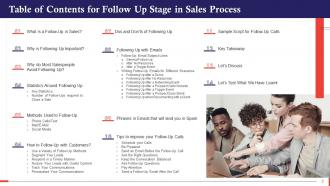
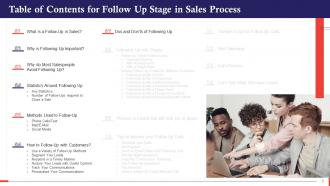
This training module on Follow Up Stage in Sales Process covers the concept of Follow-Up in Sales, its importance, and Why Most Salespeople Avoid Following Up. Then it discusses the Methods Used to Follow-Up Phone Calls or Text, Mail or E-Mail, Social Media, How to Follow-Up with Customers. Use a Variety of Follow-Up Methods, Segment Your Leads, Respond on Time, Nurture Your Leads with Useful Content, Track Your Communications, Personalize Your Communications, and Dos and Donts of Following Up. Further, comprehensively it covers Following Up with Emails, Phrases in Emails that will Land you in Spam, and Tips to Improve your Follow-Up Calls Schedule your Calls, Be Prepared, Send an Email Before the Follow-Up Call, Ask the Right Questions, Keep the Conversation Balanced, Ask Follow-Up Questions, Pay Attention, Send a Follow-Up Email After the Call. It also includes Key Takeaways and Discussion Questions related to the topic to make the coaching session more interactive. The deck has PPT slides on About Us, Vision, Mission, Goal, 30-60-90 Days Plan, Timeline, Roadmap, Training Completion Certificate, and Energizer Activities. It also includes a Client Proposal and Assessment Form for training evaluation.
People who downloaded this PowerPoint presentation also viewed the following :
Content of this Powerpoint Presentation
Slide 4
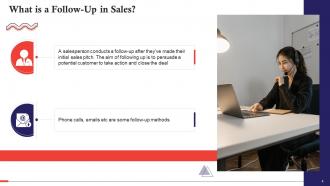
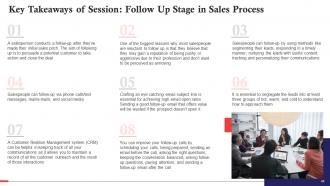
This slide introduces the concept of following up in sales. A salesperson conducts a follow-up after they’ve made their initial sales pitch. The aim of following up is to persuade a potential customer to take action and close the deal.
Slide 5
This slide highlights the importance of following up in sales. Following up is essential to generate positive results and get the most out of your sales process. A salesperson better understand their customers’ needs while following up, which is essential for a successful deal.
Slide 6
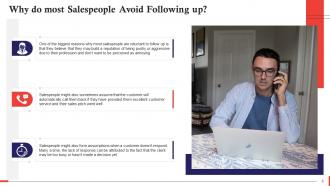
This slide lists reasons why salespeople are reluctant to follow up. One of the biggest reasons is that they believe that they may build a reputation of being pushy or aggressive due to their profession and don’t want to be perceived as annoying.
Slide 7
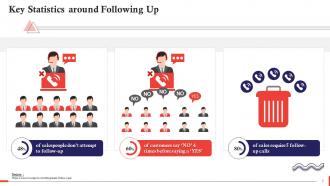
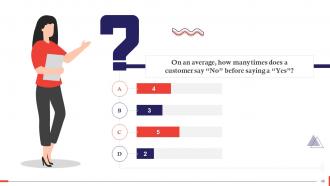
This slide highlights some key statistics around following up in sales. About 48 percent of salespeople don’t attempt to follow-up, 60 percent of customers say ‘no’ four times before saying a ‘yes’, and 80 percent of sales require five follow-up calls.
Slide 8
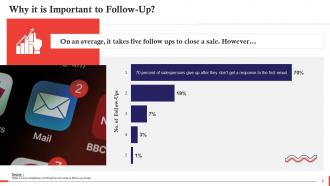
This slide depicts the importance of following up in sales. It takes five follow up calls to close a sale. However, 70 percent of salespeople give up after they don’t receive a response to their first email and only 1 percent of salespeople go through with five follow-ups.
Slide 9
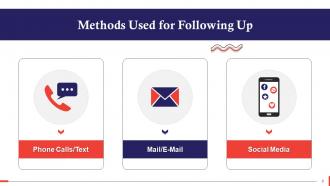
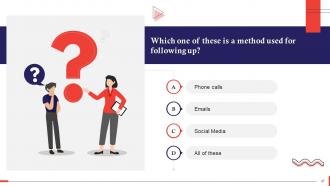
This slide showcases methods that can be used for sales follow-up. Salespeople can follow-up via phone calls/text messages, mail/e-mails, and social media.
Instructor’s Notes:
- Phone Calls/ Texts: Phone calls are considered to be the easiest and most effective way of following up as they are personal and a great way to obtain feedback from customers
- Mail/E-Mail: Following up via mail or e-mails can be personalized according to the customer. However, hearing back from them is difficult since most of the people choose no to respond to them
- Social Media: You can ask customers to engage with you over social media. You can also encourage them to write reviews or complete surveys on social media sites
Slide 10
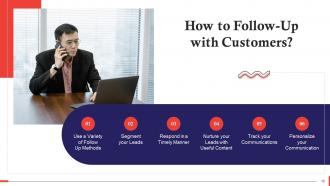
This slide highlights some techniques for following up with customers. Salespeople can follow-up by using methods like segmenting their leads, responding in a timely manner, nurturing the leads with useful content, tracking and personalizing their communication
Slide 11
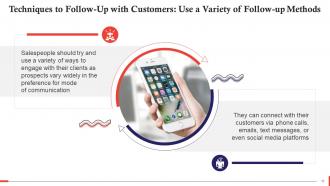
This slide talks about the importance of using various methods for following up with customers. Salespeople should try and use a variety of ways to engage with their clients as prospects vary widely in the preference for mode of communication.
Slide 12
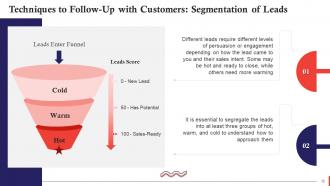
This slide talks about the importance of segmentation of leads for following up with them. Different leads require different levels of persuasion or engagement depending on how the lead came to you and their sales intent. Some may be hot and ready to close, while others need more warming.
Slide 13
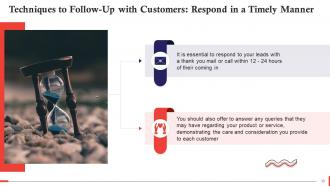
This slide discusses responding to leads in a timely manner while following up with customers. It is essential to respond to your leads with a thank you mail or call within 12 - 24 hours of their coming in.
Slide 14
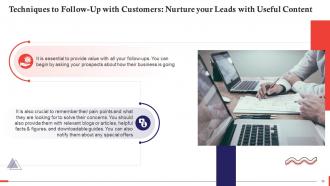
This slide talks about the importance of nurturing your leads while following up with them. It is essential to provide value with all your follow-ups. You should also provide them with relevant blogs or articles, helpful facts & figures, and downloadable guides. You can also notify them about any special offers.
Slide 15
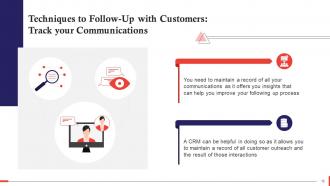
This slide talks about the importance of tracking your communications while following up with customers. You need to maintain a record of all your communications as it offers you insights that can help you improve your following up process.
Slide 16
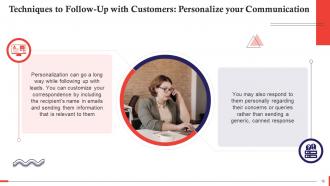
This slide talks about the importance of using personalization as a way of following up with customers. Personalization can go a long way while following up with leads. You can customize your correspondence by including the recipient’s name in emails and sending them information that is relevant to them.
Slide 17
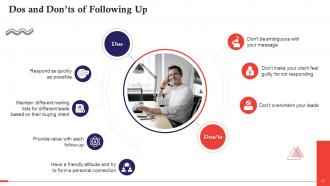
This slide highlights dos and don’ts of following up. A salesperson should respond quickly, maintain different mailing lists for different leads based on their buying intent, provide value, and have a friendly attitude while following up. They should not overwhelm their leads, make them feel guilty for not responding, and be ambiguous with their message.
Slide 19
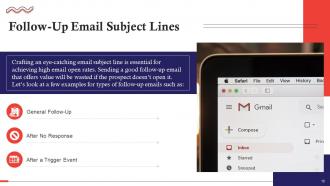
This slide discusses the importance of crafting a good email subject line while sending a follow-up email. This is essential for achieving high email open rates. Sending a good follow-up email that offers value will be wasted if the prospect doesn’t open it.
Slide 20
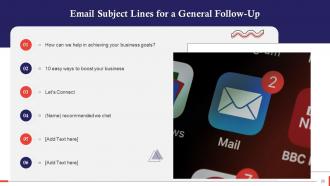
This slide gives examples of email subject lines for a general follow-up.
Slide 21
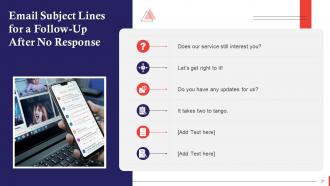
This slide gives examples of email subject lines for a follow-up after no response from a client.
Slide 22
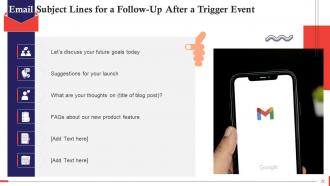
This slide gives examples of email subject lines for a follow-up after a trigger event such as a link click etc.
Slide 23
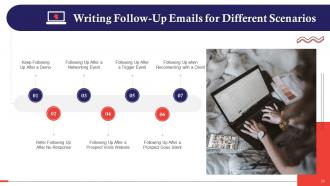
This slide highlights scenarios for writing follow-up emails. These are following up after a demo, no response, a networking event, a prospect visiting your website, a trigger event, a prospect going silent, and reconnecting with a client.
Slide 24
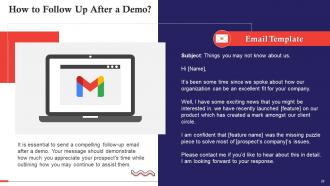
This slide depicts how to write a follow-up email after a demo. It is essential to send a compelling follow-up email after a demo. Your message should demonstrate how much you appreciate your prospect's time while outlining how you may continue to assist them.
Slide 25
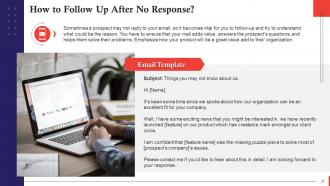
This slide depicts how to write a follow-up email after no response. Sometimes a prospect may not reply to your email, so it becomes vital for you to follow-up and try to understand what could be the reason. You have to ensure that your mail adds value, answers the prospect’s questions, and helps them solve their business problems.
Slide 26
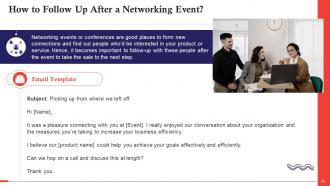
This slide depicts how to write a follow-up email after a networking event. Networking events or conferences are good places to form new connections and find out people who’d be interested in your product or service. Hence, it becomes important to follow-up with these people after the event to take the sale to the next step.
Slide 27
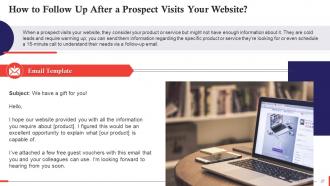
This slide depicts how to write a follow-up email after a prospect visits your website. When a prospect visits your website, they consider your product or service but might not have enough information about it. You can send them information regarding the specific product or service they’re looking for or even schedule a 15-minute call to understand their needs via a follow-up email.
Slide 28
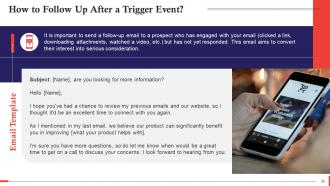
This slide depicts how to write a follow-up email after a trigger event. It is important to send a follow-up email to a prospect who has engaged with your email (clicked a link, downloading attachments, watched a video, etc.) but has not yet responded. This email aims to convert their interest into serious consideration.
Slide 29
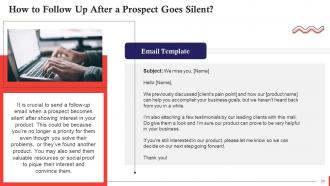
This slide depicts how to write a follow-up email after a prospect goes silent. It is crucial to send a follow-up email when a prospect becomes silent after showing interest in your product. You may also send them valuable resources or social proof to pique their interest and convince them.
Slide 30
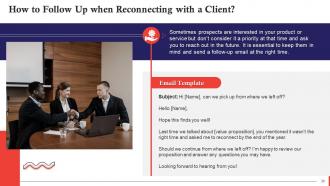
This slide depicts how to write a follow-up email when reconnecting with a client. Sometimes prospects are interested in your product or service but don’t consider it a priority at that time and ask you to reach out in the future. It is essential to keep them in mind and send a follow-up email at the right time.
Slide 31
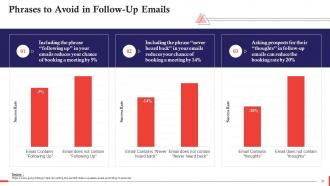
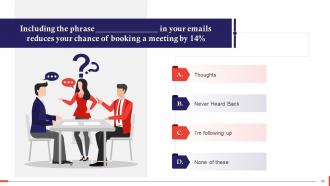
This slide depicts some phrases that should be avoided while crafting a follow-up email. Some of these phrases are, “following up”, “never heard back”, and “thoughts”.
Slide 33
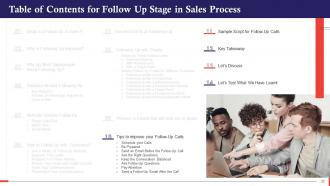
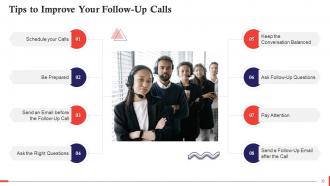
This slide lists some tips to improve your follow-up calls with prospects. These are scheduling your calls, being prepared, sending an email before the call, asking the right questions, keeping the conversation balanced, asking follow-up questions, paying attention, and sending a follow-up email after the call.
Slide 34
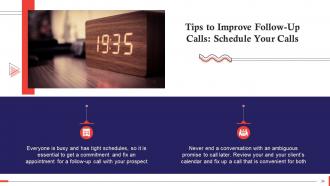
This slide talks about the importance of scheduling your follow-up calls. Everyone is busy and has tight schedules, so it is essential to get a commitment and fix an appointment for a follow-up call with your prospect.
Slide 35
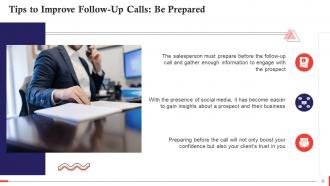
This slide discusses the importance of being prepared for your follow-up calls. It is essential for the salesperson to prepare before the follow-up call and gather enough information to engage with the prospect.
Slide 36
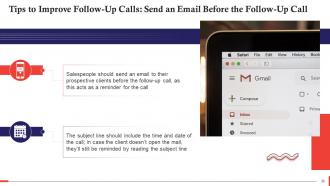
This slide talks about the importance of sending an email before the follow-up call. Salespeople should send an email to their prospective clients before the follow-up call, as this acts as a reminder for the call.
Slide 37
This slide discusses the importance of asking the right questions while following up on call. A salesperson needs to be prepared before the follow-up call and make a list of some questions that they'd like to ask their clients during the conversation.
Slide 38
This slide talks about the importance of keeping the conversation balanced while following up. An effective and productive phone call requires both parties to participate equally. As a salesperson, it is your job to keep the conversation balanced.
Slide 39
This slide discusses the importance of asking follow-up questions while following up on call. It is essential to listen to the answers carefully while asking questions to your clients. You may even need to ask follow-up questions to gather more information about a particular point.
Slide 40
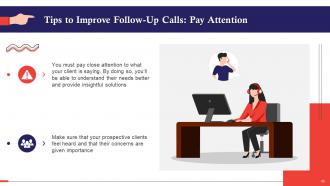
This slide talks about the importance of paying attention while following up. You must pay close attention to what your client is saying. By doing so, you’ll be able to understand their needs better and provide insightful solutions.
Slide 41
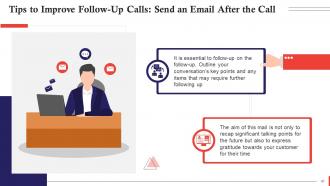
This slide discusses the importance of sending an email after following up with a customer on call. It is essential to follow-up on the follow-up. Outline your conversation’s key points and any items that may require following up.
Slide 42 and 43
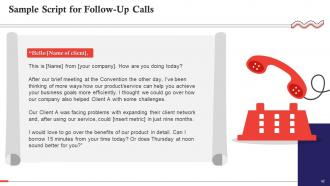
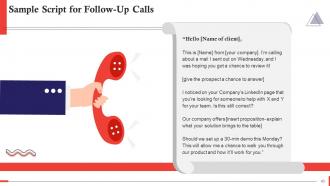
These slides depict a sample script for a follow-up call.
Slide 61 to 76
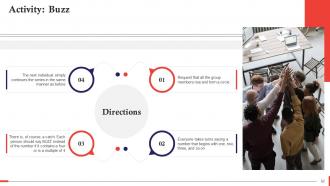
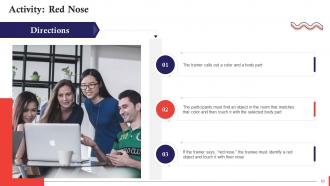
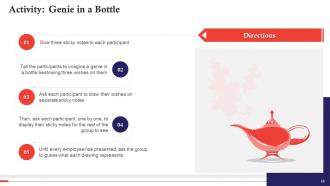
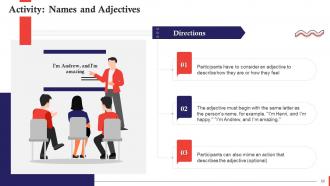
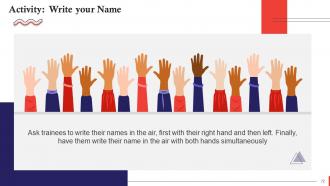
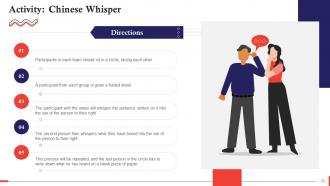
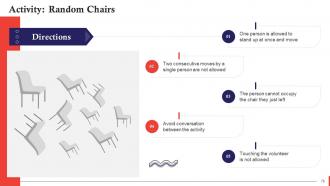
These slides contain energizer activities to engage the audience of the training session.
Slide 77 to 104
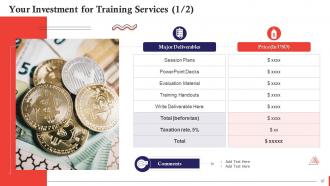
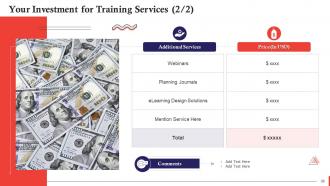
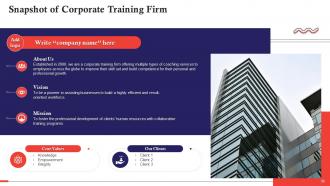
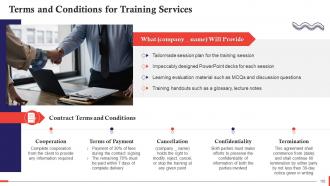
These slides contain a training proposal covering what the company providing corporate training can accomplish for the client.
Slide 105 to 107
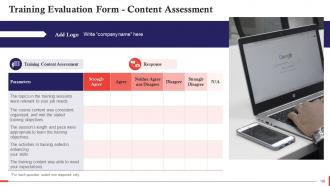
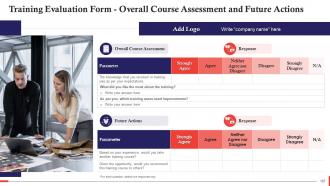
These slides include a training evaluation form for instructor, content and course assessment.
Follow Up Stage In Sales Process Training Ppt with all 112 slides:
Use our Follow Up Stage In Sales Process Training Ppt to effectively help you save your valuable time. They are readymade to fit into any presentation structure.















FAQs for Follow Up Stage In Sales
Focus on timing first - when to actually reach out matters more than people think. Then hit personalization and multi-channel approaches. Objection handling is huge, plus teaching reps how to add real value instead of just bugging people constantly. CRM tracking too because honestly, if it's not documented it never happened. Don't forget email templates and voicemail scripts. Social selling's becoming pretty important now. The whole thing is about being persistent but not annoying - which is trickier than it sounds. Role-playing scenarios work great so they can mess up in practice instead of with real prospects.
Dude, you gotta stop with those lame "just checking in" emails - they're basically spam now. Instead, bring up actual stuff from your calls. Maybe they mentioned that trade show next month or whatever challenge they're dealing with. I usually write 3-4 different versions depending on where people are in the process. Track what you've sent too so you don't look like an idiot repeating yourself. The whole point is making it feel like you're continuing a real conversation, not just blasting templates. Generic follow-ups are dead.
Hit them up within 48 hours with a thank you email - attach whatever you promised during the meeting. Wait a few days, then send something actually useful like an article that relates to what you discussed. After that, weekly check-ins work well. Mix it up though - email one week, LinkedIn the next, maybe a quick call. Just don't be annoying about it (we've all had that salesperson who won't quit). Oh, and write this stuff down or you'll totally forget what you already sent them. Trust me on that one.
Dude, just share quick customer stories that match their situation. Like "Sarah at Company X had the same inventory nightmare you're dealing with" - way better than boring feature lists. Keep stories super short though, nobody reads novels in email. Mini-stories about industry stuff work too, honestly. The trick is making it feel personal to whatever problem they mentioned. Always circle back to how your thing solves their specific mess. People connect with real examples way more than generic pitches.
Start with response rates - that's your foundation for seeing who's actually engaging. Conversion rates matter too, like how many follow-ups turn into meetings and then deals. Oh, and definitely track time-to-conversion since good follow-up should speed things up, not make your sales cycle drag on forever. Email opens and reply sentiment are key - nobody wants prospects getting annoyed at you. I'd say track which touchpoints work best and how often you're hitting each deal. Honestly, most CRMs can handle the basics, then you can get fancy later once you nail down what actually moves the needle.
Look, your CRM is gonna save your sanity here. It tracks every single conversation and reminds you to follow up automatically. I used to think logging everything was such a pain, but now I can't imagine working without it. When you've got like 50 leads going, you need to see who you talked to last week and what they actually said. The good ones even tell you what to do next based on where people are in your pipeline. Set up those automated sequences too - they're clutch for the repetitive stuff. Trust me, just start doing it now.
Honestly, spacing is everything - give people room to breathe. I'd go 3-5 days between the first few touches, then maybe weekly after that. Don't be like me making rookie mistakes and hitting them up daily (ugh, so cringey). Each time you reach out, bring something actually useful - maybe an article they'd care about or insights about their industry. Oh, and always sound friendly instead of desperate. That makes a huge difference. Give them an easy escape route too, like "totally fine if the timing's off right now."
Dude, switch up your approach first - if you've been hitting email, try LinkedIn or just call them. Find something recent about their company to mention so it doesn't feel generic. Breakup emails actually work surprisingly well? Like "this is my last attempt unless you respond." Sounds harsh but people notice. Also throw them something useful - maybe a case study that's actually relevant to their situation, not another pitch about your product. The whole thing needs to feel like it's about solving their problem, not you desperately trying to hit numbers.
Dude, role-playing actually works really well - you get to mess up without losing real deals. I used to think it was super awkward but honestly it boosted my confidence so much. Set up scenarios your team actually deals with, like cold outreach or handling objections when someone goes radio silent. Have people switch roles so they see both sides. Don't use those generic scripts though, that's useless. Record sessions if you can - watching yourself back is painful but helpful lol. Oh and definitely talk through what went wrong after each round.
Honestly, most people either come on way too strong or send those useless "just checking in" emails that nobody cares about. The timing's usually off too - either they're blowing up your phone or they disappear for weeks. Here's what kills me though: people have one decent conversation, then their follow-ups sound like they talked to a completely different person. You gotta actually listen to what they said they wanted. Don't give up after two tries either. Takes like 5-8 touches usually. Track how often you're reaching out and always reference something specific from your last chat - works way better than generic stuff.
You gotta match how your industry actually works, not just wing it. B2B tech? Think months of nurturing with technical stuff. Retail customers want quick promos within days - totally different game. Healthcare needs educational content that won't get you in compliance trouble (learned that one the hard way). Real estate is all timing and market updates, while financial services people want hard data and proof. Hospitality's more about feelings and experiences. Before you start blasting emails, figure out how your specific market makes decisions and what tone they're used to hearing.
Honestly, just pick a CRM and stick with it - HubSpot's pretty solid, or Salesforce if you're feeling fancy. Pipedrive's good too. Set up some automated email sequences so you're not manually sending everything (trust me, you'll forget otherwise). If you want to get really into it, Outreach and SalesLoft are amazing for sequencing, though there's definitely a learning curve. But honestly? Even something basic like Boomerang works if you're just getting started. The biggest mistake people make is tool-hopping instead of mastering one system. Start with whatever you've already got and explore those automation features first.
Honestly, LinkedIn's your best bet for this - share stuff they'd actually care about or drop thoughtful comments on their posts. Twitter works too for those quick interactions. Sometimes just liking someone's tweet keeps you in their head better than sending another email, which is kind of weird but true. Google alerts are clutch here - set them up for your prospects' companies so you can jump on congratulating wins or sharing relevant news. Don't just push your own content though, that's annoying. I'd start with like 15 minutes a day scrolling through your key prospects' feeds.
Scarcity and social proof are my go-to moves. Limited time offers create that urgency - works every time. I love dropping names of other clients who crushed it with similar results, or mentioning what's trending in their industry right now. Reciprocity's another big one since you've already given them value upfront. Here's something I probably do too much - I frame things around what they'll lose instead of what they'll gain. People hate missing out more than they love winning. Just don't be weird about it. Layer this stuff in naturally or they'll smell the sales tactics from a mile away.
Dude, start tracking your follow-up data - it's a game changer. Check response rates by timing and message style. I was way too pushy until the numbers showed me otherwise lol. Short sentences work better than I expected. Notice which objections keep popping up so you can handle them earlier in the process. Also track who never responds at all - that's telling you something about how you're qualifying people upfront. Just throw it all in a basic spreadsheet and review monthly. You'll spot patterns that totally change your approach.
-
I was never satisfied with my own presentation design but SlideTeam has solved that problem for me. Thank you SlideTeam!
-
Unique design & color.