

Fraud Investigation And Response Playbook Powerpoint Presentation Slides






Try Before you Buy Download Free Sample Product
 Impress Your
Audience
 100%
Editable
 Save Hours
of Time


A single fraud event can completely devastate a companys reputation and public trust. Because of a fraudulent event, businesses lose 7 percent of their annual revenue. Businesses follow an anti-fraud playbook to effectively investigate and respond to a risk event. Check out our competently designed Fraud Investigation and Response Playbook template that includes risk governance structures, controls, and processes to safeguard resources and assets. Our anti-fraud playbook will assist businesses in addressing scalable fraud risk assessment methodologies and four-phased approaches to effectively track and tackle any risk event. At first, organizations can use slides on corporate fraud overview, why fraud risk governance is essential to educate their employees about various types of fraud, their impact, and their importance for a business. Post educating the employees companies can use sections addressing anti-fraud programs to address the key stakeholders about their four-phased approaches to identifying, assessing, preventing, and correcting fraud events. Lastly, businesses can use a use case slide to manage information about a specific fraud risk profile having details about fraud events, risk factors, likelihood and impact, and preventive measures. Get access now.
People who downloaded this PowerPoint presentation also viewed the following :
Content of this Powerpoint Presentation
Slide 1: This slide introduces Fraud Investigation and Response Playbook. State your company name and begin.
Slide 2: This slide shows Purpose of the Playbook.
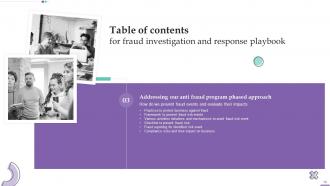
Slide 3: This slide presents Table of Content for the presentation.
Slide 4: This slide highlights title for topics that are to be covered next in the template.
Slide 5: This slide provides an overview about corporate frauds along with the factual information of global fraud events.
Slide 6: Purpose of this slide is to inform the audience about the benefits of having an effective fraud risk governance.
Slide 7: This slide highlights title for topics that are to be covered next in the template.
Slide 8: This slide presents Addressing Our 360 Degree Approach to Fraud Risk Management.
Slide 9: This slide displays Our Team Structure for Handling Fraud Risk Events.
Slide 10: This slide depicts the responsibility matrix that the company employs to ensure that anti-fraud controls.
Slide 11: This slide represents Effective Communication Plan to Address Fraud Event Appropriately.
Slide 12: This slide highlights title for topics that are to be covered next in the template.
Slide 13: This slide showcases How do we Identify Fraud Risks and their Likelihood of Occurrence.
Slide 14: This slide shows Identifying the Ways in Which Fraudster Targets our Business.
Slide 15: This slide presents Fraud Risk Governance Scorecard to Determine Current Business Position.
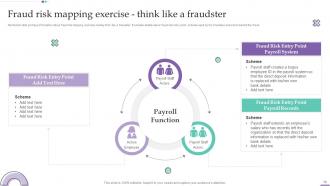
Slide 16: This slide displays Fraud Risk Mapping Exercise - Think Like a Fraudster.
Slide 17: This slide depicts information about the likelihood and impact assessment post performing the fraud risk.
Slide 18: This slide represents Current Versus Target Level Assessment for Anti Fraud Program.
Slide 19: This slide highlights title for topics that are to be covered next in the template.
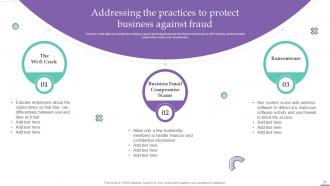
Slide 20: This slide showcases Addressing the Practices to Protect Business Against Fraud.
Slide 21: This slide shows Framework to Prevent Fraud Risk Events.
Slide 22: This slide presents Various Activities Initiatives and Mechanisms to Avoid Fraud Risk Event.
Slide 23: This slide displays Addressing the Checklist to Prevent Fraud Risks.
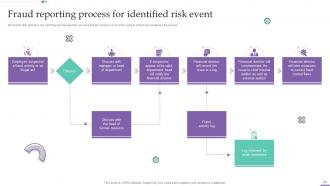
Slide 24: This slide represents Fraud Reporting Process for Identified Risk Event.
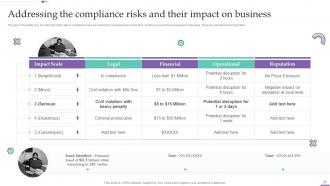
Slide 25: This slide showcases Addressing the Compliance Risks and their Impact on Business.
Slide 26: This slide highlights title for topics that are to be covered next in the template.
Slide 27: This slide shows Corrective Action Plan to Prevent Fraud in Future.
Slide 28: This slide presents Gather information about the actual and potential fraud risks.
Slide 29: This slide highlights title for topics that are to be covered next in the template.
Slide 30: Following slide depicts a use case for a fraud risk profile.
Slide 31: This slide contains all the icons used in this presentation.
Slide 32: This slide is titled as Additional Slides for moving forward.
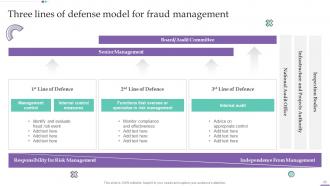
Slide 33: This slide represents Three Lines of Defense Model for Fraud Management.
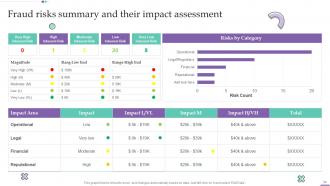
Slide 34: This slide showcases Fraud Risks Summary and their Impact Assessment.
Slide 35: This slide displays Column chart with two products comparison.
Slide 36: This is About Us slide to show company specifications etc.
Slide 37: This slide shows Post It Notes. Post your important notes here.
Slide 38: This slide shows SWOT describing- Strength, Weakness, Opportunity, and Threat.
Slide 39: This slide displays Mind Map with related imagery.
Slide 40: This slide contains Puzzle with related icons and text.
Slide 41: This is Our Mission slide with related imagery and text.
Slide 42: This slide depicts Venn diagram with text boxes.
Slide 43: This is a Timeline slide. Show data related to time intervals here.
Slide 44: This is a Thank You slide with address, contact numbers and email address.
Fraud Investigation And Response Playbook Powerpoint Presentation Slides with all 49 slides:
Use our Fraud Investigation And Response Playbook Powerpoint Presentation Slides to effectively help you save your valuable time. They are readymade to fit into any presentation structure.





















FAQs for Fraud Investigation And Response Playbook
Key indicators include unusual financial transactions, documentation inconsistencies, behavioral changes in personnel, unexplained asset increases, and irregular vendor relationships. These red flags enable investigators to prioritize resources effectively, streamline assessment processes, and accelerate case resolution, with many financial institutions and corporate security teams finding that early indicator recognition significantly reduces investigation time and enhances fraud prevention outcomes.
Organizations develop robust fraud prevention strategies through comprehensive risk assessments, internal control systems, employee training programs, real-time monitoring technologies, and clear reporting mechanisms. These proactive measures streamline detection by establishing baseline behaviors, automating suspicious activity alerts, and creating transparent investigation protocols, with many financial institutions and healthcare organizations finding that prevention-focused approaches ultimately reduce investigation costs while enhancing operational security.
Digital fraud investigation tools include artificial intelligence algorithms, blockchain analytics platforms, data visualization software, automated case management systems, and machine learning-powered pattern recognition technologies. These technologies streamline investigations by accelerating transaction analysis, identifying suspicious behavioral patterns, and automating evidence collection processes, with financial institutions and insurance companies finding significantly reduced investigation timelines and enhanced detection accuracy.
Differentiating between fraud, errors, and legitimate misunderstandings requires examining intent, pattern analysis, supporting documentation, and behavioral indicators during investigations. Fraudulent activities typically show deliberate concealment and systematic patterns, while errors appear random with cooperative responses, and misunderstandings involve incomplete information with willingness to clarify, ultimately enabling organizations to pursue appropriate remediation strategies.
Employee training serves as a critical first line of defense against workplace fraud by educating staff to recognize red flags, understand reporting procedures, and foster a culture of ethical accountability. Through comprehensive fraud awareness programs, organizations enhance detection capabilities, reduce response times, and minimize financial losses, with many companies finding that well-trained employees identify suspicious activities significantly earlier than automated systems alone.
Organizations should handle whistleblower tips through secure, anonymous reporting channels, dedicated investigation teams, strict confidentiality protocols, and robust protection measures against retaliation. These systems streamline fraud detection by encouraging internal reporting, maintaining legal compliance, and protecting whistleblower identities, with many financial institutions and healthcare organizations finding that confidential tip programs ultimately deliver faster fraud resolution and enhanced organizational integrity.
Ethical considerations include maintaining confidentiality, ensuring due process, avoiding bias, protecting whistleblower identities, and respecting privacy rights throughout investigations. These principles enable investigators to conduct thorough inquiries while preserving organizational integrity and legal compliance, with many financial institutions and corporations finding that ethical frameworks ultimately strengthen case outcomes and stakeholder trust.
Establishing chain of custody requires documenting each evidence transfer through detailed logs, witness signatures, secure storage protocols, and time-stamped records from collection to analysis. This systematic approach ensures legal admissibility by maintaining evidence integrity, with many organizations using digital tracking systems and specialized storage facilities to streamline documentation processes while minimizing contamination risks.
Investigators must navigate privacy laws, evidence preservation requirements, regulatory compliance standards, employment law constraints, and potential criminal prosecution protocols. These legal frameworks vary significantly across jurisdictions and industries, with financial institutions, healthcare organizations, and public entities facing particularly stringent requirements, ultimately requiring careful coordination with legal counsel to ensure investigations maintain integrity while protecting organizational interests.
Collaboration with law enforcement agencies enhances fraud investigations by providing access to broader investigative resources, legal authority for evidence collection, and inter-agency intelligence sharing. Through strategic partnerships, financial institutions and corporations can leverage specialized expertise, accelerate case resolution, and ensure proper prosecution pathways, while law enforcement gains valuable industry insights, ultimately delivering more comprehensive fraud prevention and stronger deterrent effects.
Post-fraud investigation steps include updating security protocols, implementing enhanced monitoring systems, revising internal controls, conducting staff retraining, and establishing regular audit schedules. These preventive measures strengthen organizational defenses by closing identified vulnerabilities, improving detection capabilities, and creating accountability frameworks, with many companies finding that comprehensive post-incident reviews ultimately reduce future fraud risks significantly.
Best practices for documenting fraud investigation findings include maintaining detailed chronological records, preserving all evidence with proper chain of custody, creating comprehensive case summaries, and ensuring legal compliance throughout documentation processes. These practices enable organizations to support potential litigation, demonstrate due diligence to regulators, and strengthen internal controls, with many financial institutions finding that thorough documentation ultimately reduces liability and enhances investigative credibility.
Data analytics leverages pattern recognition, anomaly detection, machine learning algorithms, predictive modeling, and behavioral analysis to identify suspicious trends and deviations from normal business operations. Through advanced statistical techniques, organizations can detect unusual transaction patterns, identify high-risk customer behaviors, and flag potential fraud indicators across financial services, insurance claims, and procurement processes, ultimately enabling proactive fraud prevention and significantly reducing financial losses.
Common business fraud types include payment fraud, identity theft, accounting manipulation, vendor fraud, and cybersecurity breaches. These threats can be tackled through automated monitoring systems, employee training programs, and robust verification processes, with banks and retail companies finding that combining real-time analytics with comprehensive audit trails significantly reduces losses while enhancing operational security.
Internal auditing supports fraud investigations by conducting independent assessments, analyzing financial records, and identifying control weaknesses that enable fraudulent activities. These auditors enhance risk management by establishing robust monitoring systems, implementing preventive controls, and providing objective insights to management, with many organizations finding that regular internal audits significantly reduce fraud exposure while strengthening overall governance frameworks.
-
SlideTeam is my go-to resource for professional PPT templates. They have an exhaustive library, giving you the option to download the best slide!
-
The templates are easy to get, and the chat customer support is excellent.