


Fraud Risk Management Guide Powerpoint Presentation Slides




Try Before you Buy Download Free Sample Product
 Impress Your
 Audience
 100%
100% Editable
 Save Hours
 of Time


A single fraud event can completely devastate a companys reputation and public trust. Because of a fraudulent event, businesses lose 7 percent of their annual revenue. Businesses follow an anti-fraud playbook to effectively investigate and respond to a risk event. Check out our competently designed Fraud Risk Management Guide template that includes risk governance structures, controls, and processes to safeguard resources and assets. Our anti-fraud playbook will assist businesses in addressing scalable fraud risk assessment methodologies and four-phased approaches to effectively track and tackle any risk event. At first, organizations can use slides on corporate fraud overview, why fraud risk governance is essential to educate their employees about various types of fraud, their impact, and their importance for a business. Post educating the employees; companies can use sections addressing anti-fraud programs to address the key stakeholders about their four-phased approaches to identifying, assessing, preventing, and correcting fraud events. Lastly, businesses can use a use case slide to manage information about a specific fraud risk profile having details about fraud events, risk factors, likelihood and impact, and preventive measures. Get access now.
People who downloaded this PowerPoint presentation also viewed the following :
Content of this Powerpoint Presentation
Slide 1: This slide introduces Fraud Risk Management Guide. State your company name and begin.
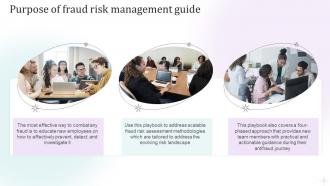
Slide 2: This slide shows Purpose of fraud risk management guide.
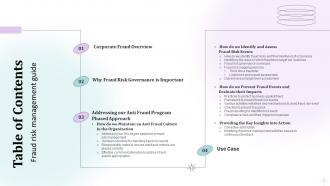
Slide 3: This slide presents Table of Content for the presentation.
Slide 4: This slide highlights title for topics that are to be covered next in the template.
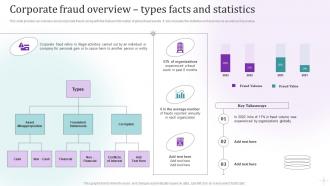
Slide 5: This slide provides an overview about corporate frauds along with the factual information of global fraud events.
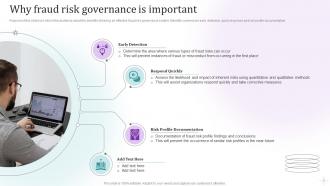
Slide 6: Purpose of this slide is to inform the audience about the benefits of having an effective fraud risk governance.
Slide 7: This slide highlights title for topics that are to be covered next in the template.
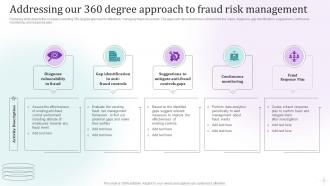
Slide 8: This slide presents Addressing Our 360 Degree Approach to Fraud Risk Management.
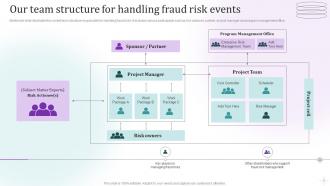
Slide 9: This slide displays Our Team Structure for Handling Fraud Risk Events.
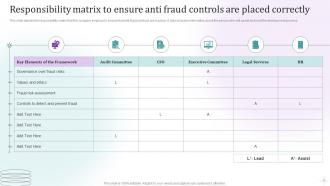
Slide 10: This slide depicts the responsibility matrix that the company employs to ensure that anti-fraud controls.
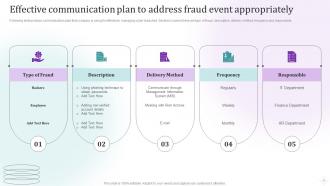
Slide 11: This slide represents Effective Communication Plan to Address Fraud Event Appropriately.
Slide 12: This slide highlights title for topics that are to be covered next in the template.
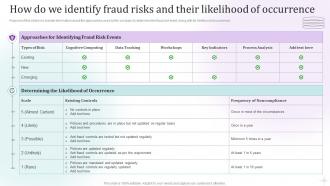
Slide 13: This slide showcases How do we Identify Fraud Risks and their Likelihood of Occurrence.
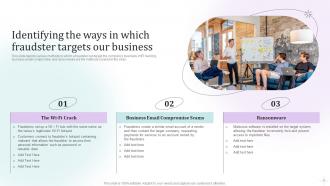
Slide 14: This slide shows Identifying the Ways in Which Fraudster Targets our Business.
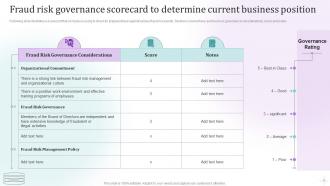
Slide 15: This slide presents Fraud Risk Governance Scorecard to Determine Current Business Position.
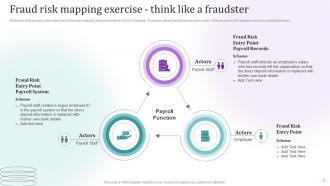
Slide 16: This slide displays Fraud Risk Mapping Exercise - Think Like a Fraudster.
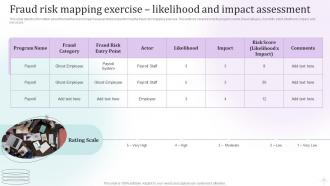
Slide 17: This slide depicts information about the likelihood and impact assessment post performing the fraud risk.
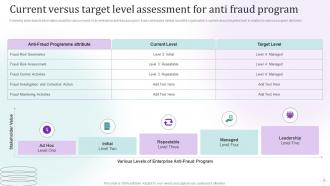
Slide 18: This slide represents Current Versus Target Level Assessment for Anti Fraud Program.
Slide 19: This slide highlights title for topics that are to be covered next in the template.
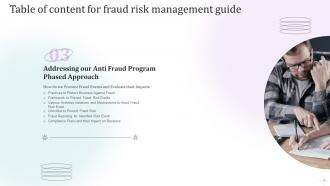
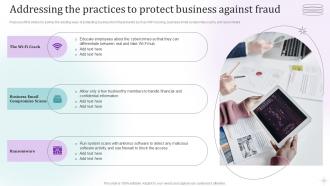
Slide 20: This slide showcases Addressing the Practices to Protect Business Against Fraud.
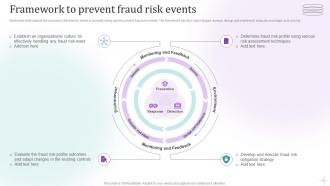
Slide 21: This slide shows Framework to Prevent Fraud Risk Events.
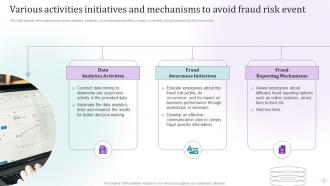
Slide 22: This slide presents Various Activities Initiatives and Mechanisms to Avoid Fraud Risk Event.
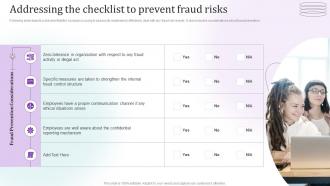
Slide 23: This slide displays Addressing the Checklist to Prevent Fraud Risks.
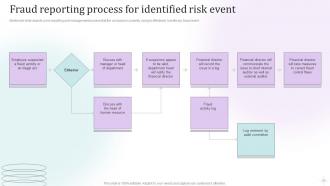
Slide 24: This slide represents Fraud Reporting Process for Identified Risk Event.
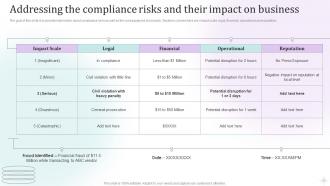
Slide 25: This slide showcases Addressing the Compliance Risks and their Impact on Business.
Slide 26: This slide highlights title for topics that are to be covered next in the template.
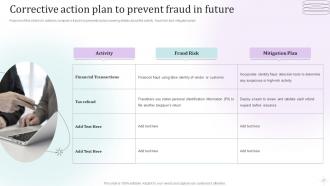
Slide 27: This slide shows Corrective Action Plan to Prevent Fraud in Future.
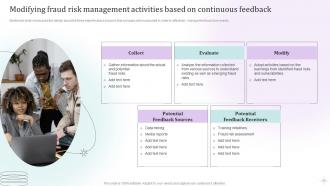
Slide 28: This slide presents Gather information about the actual and potential fraud risks.
Slide 29: This slide highlights title for topics that are to be covered next in the template.
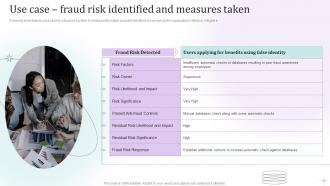
Slide 30: Following slide depicts a use case for a fraud risk profile.
Slide 31: This slide contains all the icons used in this presentation.
Slide 32: This slide is titled as Additional Slides for moving forward.
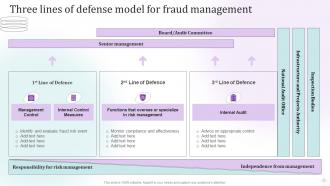
Slide 33: This slide represents Three Lines of Defense Model for Fraud Management.
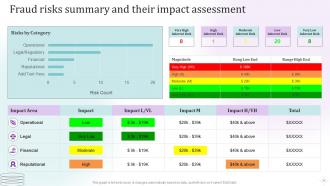
Slide 34: This slide showcases Fraud Risks Summary and their Impact Assessment.
Slide 35: This is Our Mission slide with related imagery and text.
Slide 36: This is Our Team slide with names and designation.
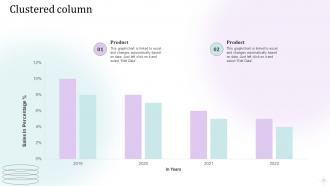
Slide 37: This slide provides Clustered Column chart with two products comparison.
Slide 38: This slide provides 30 60 90 Days Plan with text boxes.
Slide 39: This slide contains Puzzle with related icons and text.
Slide 40: This slide presents Roadmap with additional textboxes.
Slide 41: This is a Timeline slide. Show data related to time intervals here.
Slide 42: This is a Thank You slide with address, contact numbers and email address.
Fraud Risk Management Guide Powerpoint Presentation Slides with all 47 slides:
Use our Fraud Risk Management Guide Powerpoint Presentation Slides to effectively help you save your valuable time. They are readymade to fit into any presentation structure.









FAQs for Fraud Risk Management Guide
You basically need three things: prevention, detection, and response. Think of it as a three-legged stool - knock one out and everything falls apart. Prevention means solid internal controls, training your people, and making sure duties are split up properly. Then you've got detection through monitoring systems, data analytics, and regular audits to spot problems early. Here's the thing though - most companies totally blow the response part. You need clear procedures for when stuff hits the fan, investigation protocols, recovery plans, all that. Oh and honestly? The magic happens when all three actually work together instead of being separate silos. I'd start by figuring out where your biggest gaps are right now.
Honestly, start with mapping out where you're most vulnerable - financial stuff, who has access to what data, vendor relationships, all that. Most companies totally ignore basic things like segregation of duties, which is literally fraud 101. Do anonymous surveys with your team about workplace pressure too - you'd be surprised what people admit to. Look at past incidents if you've had any. The whole point is being real about your weak spots instead of pretending everything's perfect. Oh, and don't just do this once a year - quarterly makes way more sense.
Honestly, training your employees is probably your strongest weapon against fraud. Most scams work because people don't question weird requests or sketchy processes. Teach your team to spot social engineering tricks and follow proper authorization steps. Make it hands-on and relevant to what they actually do - nobody wants to sit through another PowerPoint marathon, right? Cover how to report suspicious stuff without getting in trouble. I'd do refresher sessions every quarter since new scams pop up constantly. Oh, and definitely update everything when you hear about fresh schemes hitting your industry.
Dude, ML algorithms are insane at catching weird patterns humans totally miss - way better than us at sifting through tons of data. Set up automated alerts for sketchy transactions. Behavioral analytics will flag when someone's acting off compared to their usual habits. Multi-factor auth is a must everywhere. Device fingerprinting and geolocation help catch account takeovers too. The fraud detection stuff now vs like 2019? Night and day difference, honestly. Oh and definitely start with whatever areas are getting hit hardest, then build out from there. Don't try to do everything at once.
Watch for weird financial stuff first - unexplained variances, duplicate payments, sketchy vendor relationships. Transaction amounts just under approval limits are super suspicious. Behaviorally? That "perfect" employee who never takes vacation might be hiding something, honestly. Look for people working crazy hours, living beyond their means, or getting defensive about oversight. High turnover in finance roles is a red flag too. Oh, and vendors complaining about payments. Set up automated alerts and make sure people can report things anonymously - you'd be surprised what comes out.
First thing - get familiar with SOX, PCI DSS, and AML rules because they change all the time. Document everything (yeah, it's boring but regulators eat that stuff up). Your fraud systems need to spit out whatever reports the law demands, so check that early. Train your people on both spotting fraud AND staying compliant - can't have one without the other. Honestly, build this stuff into your processes from day one instead of scrambling to add it later. Do quarterly check-ins to catch problems before some regulator comes knocking.
Start by mapping out your main business processes and spotting where fraud could creep in - payments, vendors, expense reports, all that fun stuff. Then figure out which scenarios are most likely and would hurt the worst. I know it sounds pessimistic, but you've gotta think like a fraudster for a minute. Pull in people from different departments since they'll catch things you won't. Document everything and rank the risks. Oh, and don't forget to revisit this regularly - scammers get creative, so your assessment needs to stay fresh too.
Honestly, it starts with leadership actually doing what they preach instead of just making everyone sit through those awful training videos. Your policies need to be super clear about what flies and what doesn't - then actually enforce them no matter who screws up. Give people a way to report stuff without getting thrown under the bus. I mean, nobody wants to be the office snitch, but sometimes you gotta speak up. Keep doing ethics training but make it about real scenarios they'll actually face. Most important thing? Reward people when they choose integrity over taking shortcuts. That's how you build a culture where doing right doesn't feel stupid.
Yeah, remote work totally makes fraud easier to pull off. You lose all that casual oversight - like, nobody's gonna notice weird stuff when there's no water cooler chat, you know? Physical security goes out the window, and people get weirdly isolated which can mess with their judgment. Honestly, some folks rationalize sketchy behavior way easier when they're not seeing coworkers face-to-face daily. You gotta step up digital monitoring big time. Stronger login security is a must. Communication becomes way more critical too - can't just assume everything's fine anymore. It's basically switching from "I can see what's happening" controls to tech-based ones.
Okay so first thing - stop the bleeding immediately. Secure those systems, freeze any sketched accounts, and don't let anyone mess with the evidence. Call your legal team and leadership right away, plus whatever authorities need to know. I get wanting to dig into it yourself first, but honestly? Don't. You need backup on this stuff. Figure out how bad the damage is and be straight with people who got hit. Oh and definitely do a deep dive afterward to patch up whatever holes let this happen - that part's crucial but obviously comes later when you're not in crisis mode.
Honestly, you need to watch both sides - what you're catching and what you're stopping. Track your fraud detection rate and false positives (nobody wants legit customers getting blocked). Time to detection matters too. Financial stuff is obvious - fraud losses vs revenue, investigation costs. Prevention metrics are weird to measure since... well, you prevented them, but try tracking attempt volumes and how much friction customers feel. Run monthly reports, compare quarterly trends. Don't go crazy though - pick maybe 3-4 key ones to start.
Honestly, data analytics is a game-changer for fraud detection. It catches patterns you'd never see manually - like weird transaction behaviors or sketchy trends across huge datasets. Real-time analysis means you're spotting stuff instantly instead of days later during reviews. Machine learning models actually get better over time too, which is pretty neat. They adapt as fraudsters try new tricks. The best part? Predictive analytics lets you stop fraud before it even happens. I'd start with behavioral analytics on your riskiest transactions first, then build out from there once you see how it works.
Honestly, the hardest part is getting everyone on board - different departments always push back on costs until fraud actually hits them. Then suddenly they care. Your data systems probably don't talk to each other either, which is a nightmare. Finding that sweet spot between security and not annoying users is tricky too. Plus fraud tactics change constantly, so you're always playing catch-up. Oh, and good luck getting staff to take training seriously - everyone thinks they're immune. Start with a small pilot program though, and use real examples from companies like yours to scare people into caring.
Yeah, third-party vendors definitely bump up your fraud risk. Their security might be trash compared to yours, or they could mishandle your data. Breaches happen all the time - you've probably seen those news stories. Before working with anyone, dig into their background and make them match your security standards. Set up contracts that spell out who's liable if fraud happens (this part's crucial). Keep checking on them regularly too. I learned this the hard way at my last job - vendor oversight isn't glamorous but it's basically part of your fraud prevention now.
Look, you're basically trying to catch the bad guys without trampling on everyone else. Privacy vs protection - that's your main tension right there. Don't get carried away with all the surveillance tech just because it's available (I've seen people go way overboard). Make sure your methods aren't accidentally targeting certain groups unfairly. Keep investigations confidential, obviously. Oh and document everything - like, seriously document your reasoning because you'll need to explain yourself later if things get messy. It's honestly a balancing act where you can't win sometimes.
-
Thank you for offering such fantastic custom design services. The team is really helpful and innovative. In a very short time, I received my personalized template.
-
Nice and innovative design.