


Freight Forwarding Service Business Model




Try Before you Buy Download Free Sample Product
 Impress Your
 Audience
 100%
100% Editable
 Save Hours
 of Time


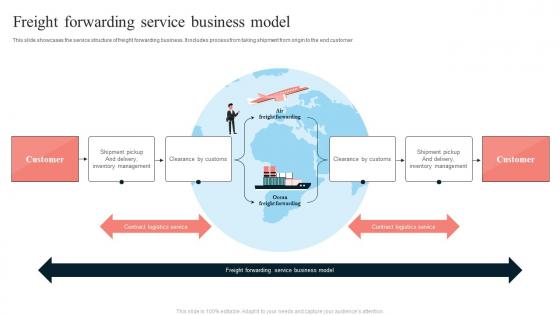
This slide showcases the service structure of freight forwarding business. It includes process from taking shipment from origin to the end customer.
People who downloaded this PowerPoint presentation also viewed the following :
Freight Forwarding Service Business Model with all 6 slides:
Use our Freight Forwarding Service Business Model to effectively help you save your valuable time. They are readymade to fit into any presentation structure.





FAQs for Freight Forwarding
Key components include comprehensive logistics services, strategic carrier partnerships, advanced technology platforms, regulatory compliance expertise, and global network coverage. These elements work together by streamlining supply chain operations, reducing transportation costs, and ensuring seamless international trade, with many freight forwarders finding that integrated digital solutions and strong relationships ultimately deliver competitive advantages and enhanced customer experiences.
Technology revolutionizes freight forwarding efficiency through automated documentation, real-time tracking systems, AI-powered route optimization, and digital customs clearance platforms. These innovations streamline operations by reducing manual errors, accelerating shipment processing, and enhancing supply chain visibility, with logistics companies finding that automated systems deliver faster transit times and significantly lower operational costs.
Customer service serves as a competitive differentiator in freight forwarding, encompassing real-time shipment tracking, proactive communication, rapid issue resolution, and personalized logistics solutions. Through dedicated account management and 24/7 support systems, freight forwarders build long-term partnerships with clients, ultimately reducing supply chain uncertainties and enhancing operational reliability in an increasingly complex global trade environment.
Freight forwarders differentiate through specialized expertise in specific industries, advanced technology integration, comprehensive service offerings, strategic partnerships with global carriers, and superior customer support capabilities. By focusing on niche markets like pharmaceuticals or automotive, implementing real-time tracking systems, and offering value-added services such as customs clearance and warehousing, forwarders create competitive advantages that enhance operational efficiency and deliver exceptional customer experiences.
Small freight forwarding companies face challenges including limited bargaining power with carriers, technology gaps, cash flow constraints, regulatory compliance complexities, and intense competition from larger players. These obstacles particularly impact operational efficiency and customer service capabilities, with many smaller firms finding that strategic partnerships, technology investments, and niche specialization help overcome scale disadvantages while delivering competitive advantages.
Freight forwarders can optimize supply chain management through digital tracking systems, automated documentation processes, strategic carrier partnerships, advanced analytics for route planning, and integrated inventory management platforms. These technologies streamline operations by reducing manual errors, accelerating shipment processing, and enhancing visibility across logistics networks, with many forwarders finding that real-time data integration ultimately delivers faster transit times and improved customer satisfaction.
Trade regulations and tariffs significantly impact freight forwarding businesses by influencing routing decisions, documentation requirements, compliance costs, and delivery timelines. These regulatory changes create both challenges and opportunities, with many freight forwarders finding that expertise in navigating complex trade policies becomes a competitive advantage, ultimately enabling them to deliver enhanced value through strategic route optimization and regulatory guidance.
Partnerships with carriers enhance freight forwarding models by securing preferential rates, expanding service networks, and improving capacity access during peak periods. Through strategic alliances, freight forwarders streamline operations, reduce transit times, and offer more competitive pricing to clients, while carriers benefit from consistent volume commitments, ultimately delivering enhanced customer experiences and stronger market positioning.
Best practices for freight forwarding pricing include transparent cost structures, dynamic rate adjustments based on market conditions, competitive benchmarking, value-added service bundling, and automated pricing tools. These strategies enhance profitability by optimizing margins, reducing quote turnaround times, and improving customer retention, with many forwarders finding that transparent pricing ultimately delivers stronger client relationships and competitive advantage.
Sustainability is increasingly central to freight forwarding through carbon footprint tracking, multimodal transport optimization, green warehouse operations, and sustainable packaging solutions. Many logistics companies are finding that eco-friendly practices, such as route optimization and electric vehicle integration, not only reduce environmental impact but also deliver cost savings and enhanced customer loyalty in an increasingly environmentally-conscious marketplace.
Freight forwarding software solutions deliver enhanced operational efficiency, automated documentation, real-time shipment tracking, streamlined communication, and improved cost management capabilities. These technologies enable logistics companies to reduce manual errors, accelerate processing times, and enhance customer visibility, with many freight forwarders finding that integrated platforms ultimately deliver competitive advantages through faster services and optimized resource allocation.
Data analytics enhances freight forwarding decision-making by providing real-time visibility into shipment tracking, predictive insights for route optimization, and comprehensive performance metrics across carriers and corridors. Through advanced analytics platforms, freight forwarders can anticipate delays, optimize capacity utilization, and reduce costs significantly, while delivering faster, more reliable services that strengthen customer relationships and competitive positioning.
Essential skills for freight forwarding professionals include logistics coordination, international trade regulations knowledge, supply chain management, negotiation abilities, and technological proficiency with freight management systems. These competencies enable professionals to streamline shipping processes, navigate complex customs requirements, and optimize delivery routes, with many freight forwarders finding that strong communication and problem-solving skills ultimately deliver faster shipments and enhanced customer satisfaction.
Geopolitical factors significantly impact freight forwarding through trade restrictions, tariff changes, border security protocols, and shipping route disruptions that alter operational costs and delivery timelines. These developments force forwarders to diversify supply chains, establish alternative partnerships, and leverage technology for route optimization, with many companies finding that geopolitical awareness ultimately delivers competitive advantage through enhanced risk management and strategic planning capabilities.
Future trends shaping freight forwarding include digital transformation through AI and blockchain, sustainable logistics practices, last-mile delivery optimization, autonomous transportation, and enhanced supply chain visibility platforms. These innovations streamline operations by reducing manual processes, improving tracking accuracy, and minimizing environmental impact, with many logistics companies finding that early adoption delivers significant competitive advantages and operational efficiency.
-
“Love it! I was able to grab an exciting proposal because of SlideTeam.”
-
The presentations are very helpful. I am always able to get appropriate templates for the different topics related to my profession.