


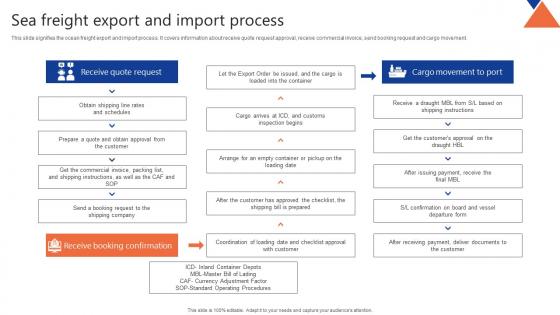
Sea Freight Export And Import Process




Try Before you Buy Download Free Sample Product
 Impress Your
 Audience
 100%
100% Editable
 Save Hours
 of Time


This slide signifies the ocean freight export and import process. It covers information about receive quote request approval, receive commercial invoice, send booking request and cargo movement.
People who downloaded this PowerPoint presentation also viewed the following :
Sea Freight Export And Import Process with all 6 slides:
Use our Sea Freight Export And Import Process to effectively help you save your valuable time. They are readymade to fit into any presentation structure.





FAQs for Sea Freight Export
So basically you book cargo space first, get your stuff to the port, deal with customs paperwork, then wait for the actual ocean trip. After that it's more customs stuff at the destination. The paperwork's honestly the worst part though - you need commercial invoice, packing list, bill of lading minimum. Transit time varies wildly depending where you're shipping but could be days to weeks. Oh and definitely start on documentation super early! I can't stress this enough. Customs delays will absolutely wreck your timeline if you wait until the last minute.
Dude, containerization totally changed shipping. Those standardized metal boxes made everything so much faster - loading and unloading is a breeze now. Your stuff stays protected the whole journey too. Ships can pack way more containers than they ever could with loose cargo. Plus ports use cranes instead of having workers haul everything by hand, which honestly seems like it should've been obvious from the start. The best part? Container goes straight from ship to truck to train without anyone touching your actual goods. Definitely go with containers if you're shipping anything.
You'll need your commercial invoice, packing list, bill of lading, and certificate of origin. The freight forwarder handles the bill of lading - it's basically your shipping receipt and contract combined. Also grab an export declaration if you're shipping from the US. Honestly, the paperwork never ends! Customs will pick apart your commercial invoice, so include detailed product descriptions and accurate values. Here's the annoying part: everything has to match perfectly. Product descriptions, quantities, all of it. One tiny discrepancy and you're stuck waiting at customs while they figure it out.
Honestly, customs rules run the whole show when it comes to sea freight. Different countries have their own import/export requirements, banned items lists, duty rates - the works. Documentation is a nightmare (seriously, the paperwork never ends). Mess something up and your shipment gets stuck in limbo for weeks, plus you'll get hit with fines. Delays cost money too. Find a good freight forwarder who actually knows the routes you're shipping on - worth every penny. They'll deal with all the compliance stuff so you don't have to stress about it.
So freight forwarders handle all the shipping headaches you don't want to deal with. They'll book cargo space, sort out paperwork, arrange pickups, and get your stuff through customs. Basically your shipping wingman. Going direct to shipping lines? Good luck with that mess - I learned that one the hard way. They also bundle smaller shipments together so you get better rates, which is pretty sweet. Plus they track everything for you. If you're just starting out with international shipping, definitely find a solid forwarder first. Way easier than figuring it out yourself.
Honestly, just focus on three things: speed, cost, and how reliable the route is. Direct shipping costs more but gets there fast. Routes with stops are cheaper but take longer and your stuff gets handled more (which can be sketchy). If you're shipping something that'll spoil, obviously go faster even if it hurts the budget. One thing people forget - check what the inland transport will cost from whatever port you pick. Sometimes you save on ocean freight but get hammered on trucking costs. Get quotes for like 2-3 different routes and compare the whole door-to-door picture, not just the boat part.
Most shipments use 20-foot or 40-foot dry containers - they're your basic workhorses. Need extra height? Go with a 40-foot high cube. Reefers keep stuff cold, which is clutch for food or pharmaceuticals. Got something weirdly shaped? Open-tops work for tall cargo, flat racks for machinery that just won't fit anywhere else. Oh, and tank containers exist for liquids and chemicals - forgot about those. The whole system seemed confusing when I first dealt with it, but really just match your cargo to what it needs. Size, weight, temperature requirements - that's basically it.
You'll want to get cargo insurance sorted before your stuff leaves port - it covers the whole sea journey. Your freight forwarder can handle this for you (honestly way less hassle than doing it yourself), or you can buy direct from an insurer. It protects against theft, damage, total loss, all that fun stuff. Usually runs about 0.1-0.3% of your cargo's value, based on CIF terms. Oh, and grab that insurance certificate before shipping! Trust me, trying to file claims without proper coverage is absolutely brutal.
So smart containers are huge right now - sensors track temp, location, all that stuff in real-time. Routes get optimized by AI before delays even happen. Honestly the accuracy is getting scary good. Digital platforms handle most documentation now, which is amazing because paperwork was such a nightmare. Oh and you get way better visibility into shipments obviously. Container tracking should probably be your first move if you're thinking about upgrading. That'll give you immediate results while you figure out the rest.
Ports are seriously the biggest pain point in sea freight - they'll totally mess up your timeline. Congestion, staffing issues, broken equipment... your stuff just sits there. Some ports run way better than others too. Delays happen everywhere - when ships dock, unloading containers, customs, getting trucks coordinated. Peak season is a nightmare, and don't even get me started on bad weather. Honestly, I always pad my schedules with extra time now. Also worth checking port performance stats before picking your route - saves headaches later.
So for sea freight, there's a bunch of environmental stuff you gotta deal with. IMO has these sulfur limits now - ships need low-sulfur fuel or scrubbers. Ballast water management is another big one to stop invasive species spreading. CO2 reporting requirements keep getting stricter too. Honestly, ports are adding their own green rules left and right which gets confusing. Your freight forwarder better know this stuff inside out because fines can be brutal if you mess up. I'd definitely ask them about environmental compliance certs upfront - saves headaches later. Trust me on that one.
Shipping schedules basically control your whole timeline - they decide when boats leave and get to ports, which affects how long your stuff waits around. Miss one departure? You're looking at waiting a week or more for the next one. Major routes like Asia to US have ships leaving almost daily, but smaller routes might only go weekly (or worse). Peak season is always a nightmare for delays. Honestly, I'd check schedules way early and build in extra time - learned that the hard way. It'll save you stress later.
Honestly, port delays are gonna be your worst enemy - stuff just sits there forever. Missing paperwork is another killer, like one form goes wrong and you're waiting days for customs to release your cargo. Container shortages have been absolutely insane lately, especially if you're shipping popular routes. Oh, and don't get me started on how rates can randomly spike while your stuff's already moving. Weather screws everything up too. Damage claims? Total paperwork nightmare. I'd say always pad your timeline with extra days and triple-check docs before sending anything - trust me on this one.
Dude, shipping costs are wild right now. It's pure supply and demand - rates change constantly based on how many ships are available and which routes everyone wants. You'll get hit with a base rate plus like a million surcharges (fuel, security, port fees, whatever else they can think of). Full containers are way cheaper per unit than sharing space with other people's stuff. Peak seasons are brutal - I've seen costs literally double before Chinese New Year. Oh, and always get quotes from multiple freight forwarders. Make them break down every single fee upfront because hidden charges will destroy your budget later.
Start with the heavy stuff on the bottom and spread weight around so nothing shifts during transport. Block and tie down everything properly - trust me, you don't want to open that container to find chaos inside! Plan your loading order before the container shows up or your crew will be standing around confused. Max out your space but watch those weight limits. Oh, and take photos of everything for insurance - learned that one the hard way. Honestly, a good loading plan saves you so much headache later.
-
Extremely professional slides with attractive designs. I especially appreciate how easily they can be modified and come in different colors, shapes, and sizes!
-
I am a big fan of their newsletters because that is how I found my perfect requirement at the time of urgency. Thank God, I kept opening those.